Her Story
Women teachers run Gaza's tent classrooms through a third year
Graphic: Times of Palestine
Original Reporting
The Newsdesk gathers reporting from wire services and primary sources and rewrites every story in-house before publication. How our journalism is made →
Most of the schooling reaching children in Gaza's displacement camps is being delivered by teachers working without a regular salary, and in initiative after initiative documented since 2024 by Palestinian and international outlets, the women who founded those classrooms are still the ones standing in front of them.
The scale of the official effort is set out in UNICEF's own figures.
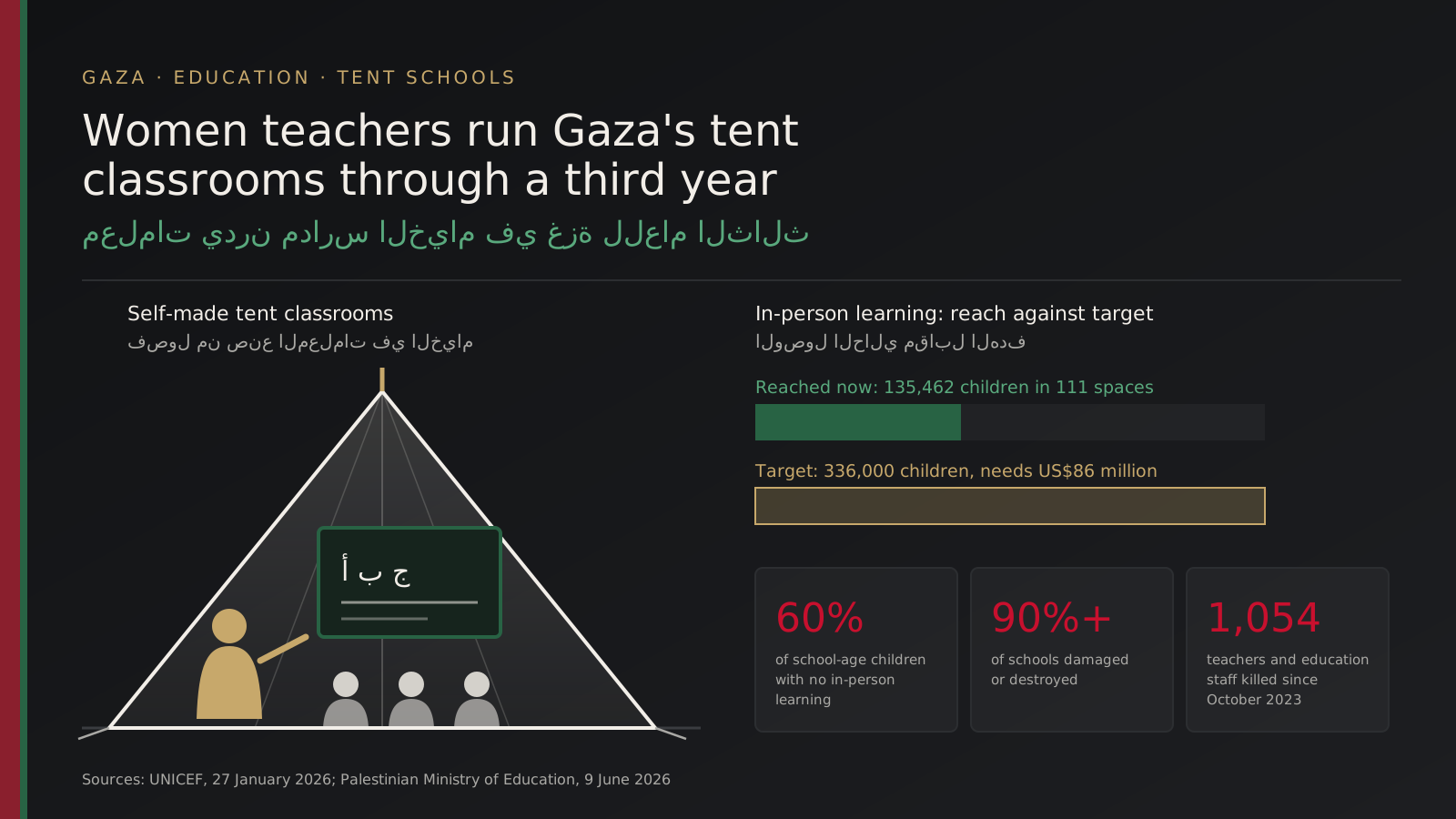
In a statement issued in Geneva on 27 January 2026, the agency said its Back to Learning programme would expand to 336,000 children, that 60 per cent of school-age children in Gaza then had no access to in-person learning, and that more than 90 per cent of schools had been damaged or destroyed.
UNICEF's country office put the current reach at 135,462 children in 111 temporary learning spaces.
UNICEF said it needed US$86 million for the rest of the year to reach the 336,000, and told UNICEF USA in February that the goal is to return every school-age child in Gaza to in-person learning in 2027, at a cost of about $280 per child per year including mental health support.
What the teachers themselves are paid appears rarely in the published record. UNICEF's own account of the Asdaa Learning Space in the south — where it says 130 teachers, administrators and social workers serve about 3,500 students — describes a small stipend for staff, the majority of whom are displaced and have no other income.
The European Training Foundation, in its February 2026 update on education in Gaza, wrote that most teachers carry a double burden of personal loss and traumatised students, often without salaries or formal psychosocial training.
Outside that system, the tents are self-made.
Felesteen reported in November 2025 that a retired teacher, Fatima al-Halabi, pitched a large tent on a narrow plot in the Nasr neighbourhood west of Gaza City and turned it within weeks into a school of about 100 pupils, its space divided into six classrooms by nylon curtains hung from wood salvaged from destroyed houses.
She and six volunteer women teachers work with a wooden board, a few sticks of chalk and notebooks whose pages have been re-stapled, drawing letters in the air with their fingers.
Ikram Talaat Ahmed, 29, wrote in an account published by Lit Hub in October 2025 that she and her husband converted the tent they live in at Deir al-Balah into a school after learning that the occupation had destroyed both her house and her educational centre. She teaches first through sixth grade; the roll passed 200 and four teachers volunteered to join her.
The pattern held from the first year.
Al-Araby Al-Jadeed reported in September 2024 on Al-Hashimiya School, set up under tarpaulin among the displacement tents at Mawasi Khan Younis by the teacher Fidaa al-Zinati and staffed by women volunteers; Anadolu, the same month, quoted the Arabic teacher Mariam al-Sheikh describing an initiative she launched with three other women teachers inside the Hashemiya shelter.
+972 Magazine reported in October 2024 that one teacher's single tent classroom in the south had grown to more than 550 students from first through twelfth grade.
Money has come with conditions. Organisers of several initiatives told Al-Araby Al-Jadeed in September 2024 that donor institutions had offered to adopt their tent schools and pay teachers' salaries provided the programmes were confined to psychosocial relief and did not teach the Palestinian curriculum — an offer the organisers called blatant blackmail.
Al Jazeera reported on 14 August 2026 that teachers in Gaza are still working through worn tents and scarce income, with one calling on whatever administration governs the Strip to come and see what teachers need.
The salaried side of the sector is contracting.
The National reported on 24 January 2026 that UNRWA would cut local staff working hours by 20 per cent from 1 February against a $220 million shortfall for 2026, with hundreds of dismissals in Gaza including about 500 in education; one staff member's monthly pay was to fall from $1,200 to $900.
Before the war, by UNRWA's own account, the agency ran 183 schools in Gaza with some 9,443 education personnel. In March 2025 it said it had opened 130 additional temporary educational centres, giving almost 47,000 children in-person learning while more than 270,000 were enrolled in its wider programme.
The Palestinian Ministry of Education, which announced in August 2025 that it was postponing the start of the school year because of the financial crisis facing the State of Palestine, said on 9 June 2026 that 21,701 students and education staff had been killed since October 2023, among them 1,054 teachers and educational staff, and that more than 179 government schools in Gaza had been completely destroyed.
Researchers at the University of Cambridge, cited in the February 2026 European Training Foundation report, estimate that students in Gaza have lost the equivalent of about five years of schooling since 2020, and that failure to restart structured schooling before 2027 could leave many young people ten years behind.
"War or no war, we study; we learn," Lamya Othman, displaced from Bureij to Deir al-Balah and offered work as a teacher there, told UN Women in April 2026.
Neither UNICEF nor UNRWA has published a breakdown by gender of who staffs the learning spaces, so how many of the women teaching in tents hold a stipend, and how many teach for nothing, is not on the public record.
Nor is it settled who will employ them next: The Times of Israel noted in November 2025 that the White House postwar plan does not state who will be responsible for education in Gaza, leaving it to a temporary administrative committee.
UNICEF said the same month that stationery, backpacks and teaching resources were waiting at the borders, not classed as lifesaving aid, and that teachers were writing on tent walls.



.jpg?width=640)