West Bank & Jerusalem
Israel approved none of 1,022 Palestinian housing applications last year
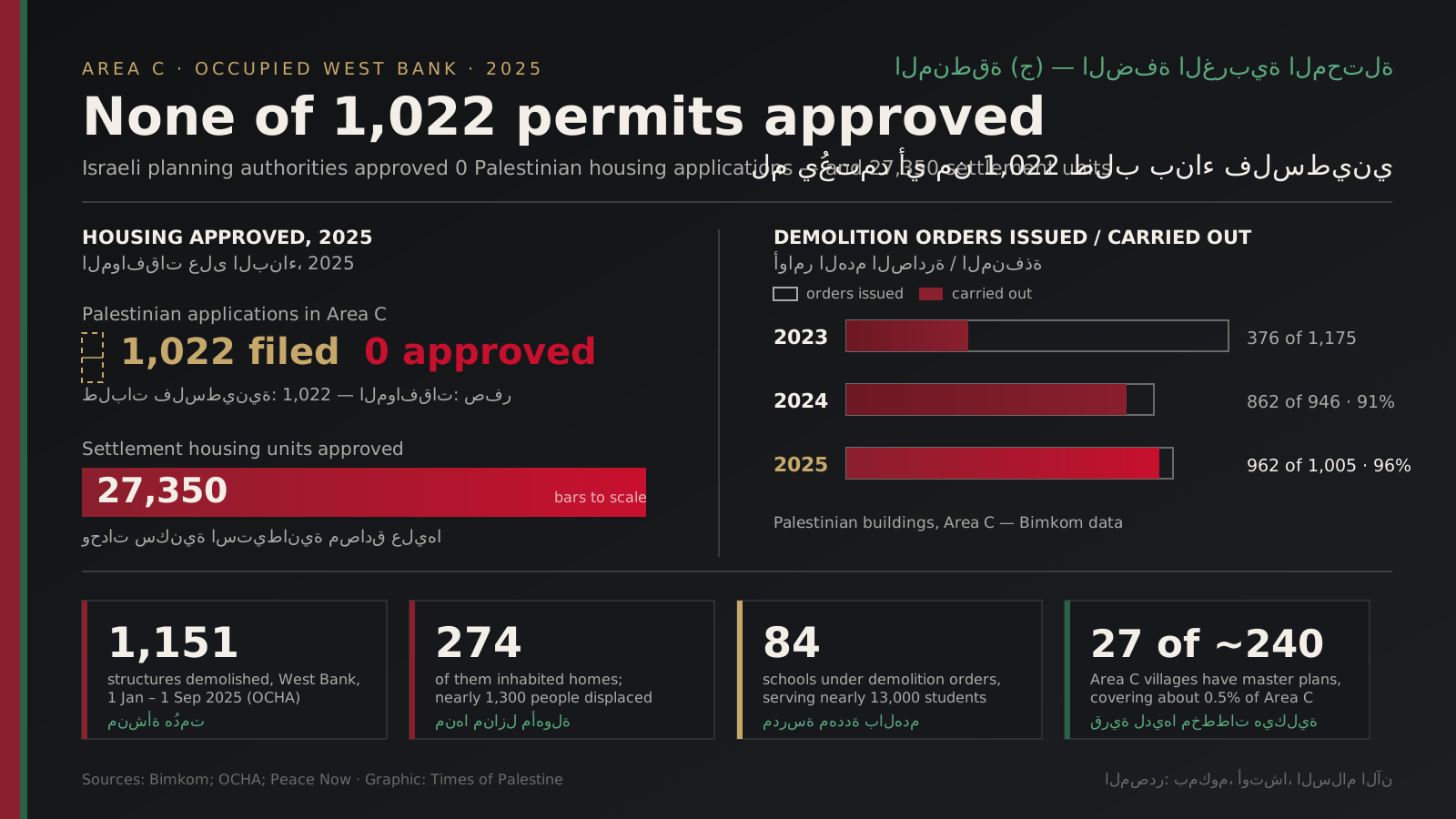
Graphic: Times of Palestine
Original Reporting
Israeli planning authorities approved none of the 1,022 applications Palestinians filed for housing construction in Area C of the occupied West Bank during 2025, according to data published by the Israeli planning rights organisation Bimkom and reported by The Times of Israel in July. Over the same year, according to the same figures, Israeli bodies approved 27,350 housing units in West Bank settlements.
Enforcement moved in the opposite direction. Bimkom's 2025 data show 1,005 demolition orders issued against Palestinian buildings in Area C, of which 962 were carried out — an execution rate of 96 per cent. In 2024, according to the same dataset, 862 of 946 orders were carried out, 91 per cent; in 2023 the figure was 376 demolitions out of 1,175 orders.
The gap between what Israeli authorities count as unlawful and what they demolish is documented on both sides of the ledger.
Peace Now, reporting on figures the Civil Administration presented to the Knesset Foreign Affairs and Defence Committee in July 2023, said that in 2022 the administration demolished about 550 Palestinian buildings out of roughly 1,600 it had identified as illegal in Area C — about 37 per cent — while demolishing 67 settler buildings out of some 340 identified, under 20 per cent.
The refusal rate is not new, but it has hardened. OCHA's Area C factsheet records an average approval rate of under 3 per cent for Palestinian permit applications between 2009 and 2016.
Bimkom data obtained through freedom-of-information requests and published by Peace Now show 98 permits issued against 4,422 applications between 2009 and 2018, and 24 approvals out of 2,550 applications between 2016 and 2020 — a rejection rate of 99 per cent.
Bimkom's earlier study, reported by The Jerusalem Post, found that in 1972 the military authorities approved 97 per cent of Palestinian residential applications in the West Bank, issuing more than 2,100 permits in that year alone.
Counts of applications differ by source and category. The Norwegian Refugee Council, citing the Israeli Planning Council, reported in October 2025 that 282 applications had been submitted since October 2023 and none approved — a far smaller denominator than Bimkom's 1,022 for 2025 alone. Neither body has published a reconciliation of the two figures.
The reason applications fail is largely structural. According to Bimkom, the Civil Administration holds complete control over planning and permits for roughly 150,000 Palestinians living in Area C, and villages without approved plans have their buildings classed as illegal by default.
A case study published by the Palestinian Centre for Policy and Survey Research found that of some 240 Palestinian villages in Area C, only 27 have master plans, covering about 0.5 per cent of Area C.
Data the Civil Administration supplied to Bimkom, summarised in Hebrew-language sources, indicate that valid planning for most other villages dates to the British Mandate.
The displacement toll is recorded by OCHA.
Between 1 January and 1 September 2025, OCHA documented 1,151 structures demolished across the West Bank for lack of permits — 274 of them inhabited homes — with 85 per cent in Area C, nearly 1,300 people displaced and more than 37,000 otherwise affected, a 44 per cent rise in structures over the same period of 2024.
By 30 September, according to NRC citing OCHA, the figure had reached 1,288 structures, an average of 4.7 a day, with 138 of them funded by international aid. OCHA reported in February 2026 that more than 1,700 Palestinians were displaced by lack-of-permit demolitions in Area C and East Jerusalem during 2025, a record.
In its report of 6 August 2026, OCHA said the monthly average of structures demolished in Area C and East Jerusalem since 2024 has been at least twice the average of the preceding 15 years.
Donor-funded structures are demolished in significant numbers.
OCHA reported on 23 July 2026 that Israeli authorities demolished 37 structures, 19 of them donor-funded, in the Arab al Jahalin/Wadi Mu'nes Bedouin community near Immatin in Qalqiliya, displacing 13 households — 64 people, including 34 children; many of the structures had been supplied as humanitarian assistance in 2021 and 2022.
In May 2026 OCHA reported that about 550 structures have been demolished since 2009 in 18 communities in the E1 area, including 175 donor-funded structures.
The investigative outlet Follow the Money reported in August 2024, citing an OCHA tally, that 986 EU-funded structures were demolished in the West Bank over 15 years to June 2023, at a value of about €3 million.
Compensation has not been paid. The Journal reported in April 2026 that Ireland and its West Bank Protection Consortium partners formally sought €1.7 million from Israeli authorities in February for assets destroyed or seized since 2015, and had received nothing.
Schools sit inside the same permit system. OCHA said on 6 August 2026 that 84 schools serving nearly 13,000 students are subject to demolition orders, and reported demolition proceedings against four schools in Area C, including the demolition of three school structures in Masafer Yatta.
IMEMC reported in July 2026 that an Israeli court upheld the demolition order against Al-Rifa'iyya school east of Hebron and rejected the appeal; the director of the Yatta education department, Basem Jabr, said the school serves nearly 400 students and is the only one available to those communities.
Israeli authorities present the demolitions as enforcement against unlicensed construction. The Civil Administration's supervision and enforcement unit, quoted by JNS in December 2024 alongside a Regavim survey, described acting against hundreds of illegal buildings and what it called agricultural infiltrations under a strategic work plan. Israel's foreign ministry did not respond to Follow the Money's questions about EU-funded demolitions.
The International Court of Justice, in its advisory opinion of 19 July 2024, found that demolitions for lack of a building permit in the West Bank and East Jerusalem amount to prohibited discrimination, and that extensive house demolitions and movement restrictions leave Palestinians in Area C little choice but to leave.
What follows the opinion is unresolved. Amnesty International reported in February 2026 that the Israeli cabinet allocated more than 244 million shekels to a government mechanism for land registration in Area C, moving those powers to the justice ministry, in territory where Peace Now estimates 58 per cent of land is unregistered.
The Al Walaja village council told OCHA it has received about 70 demolition notices in the Area C part of the village since the start of 2026, most of them stop-work orders on inhabited homes. No date has been published for when those orders will be executed.