Prisoners & Detainees
Israel renews ban keeping Palestinian prisoners from their families
Graphic: Times of Palestine
Original Reporting
The Newsdesk gathers reporting from wire services and primary sources and rewrites every story in-house before publication. How our journalism is made →
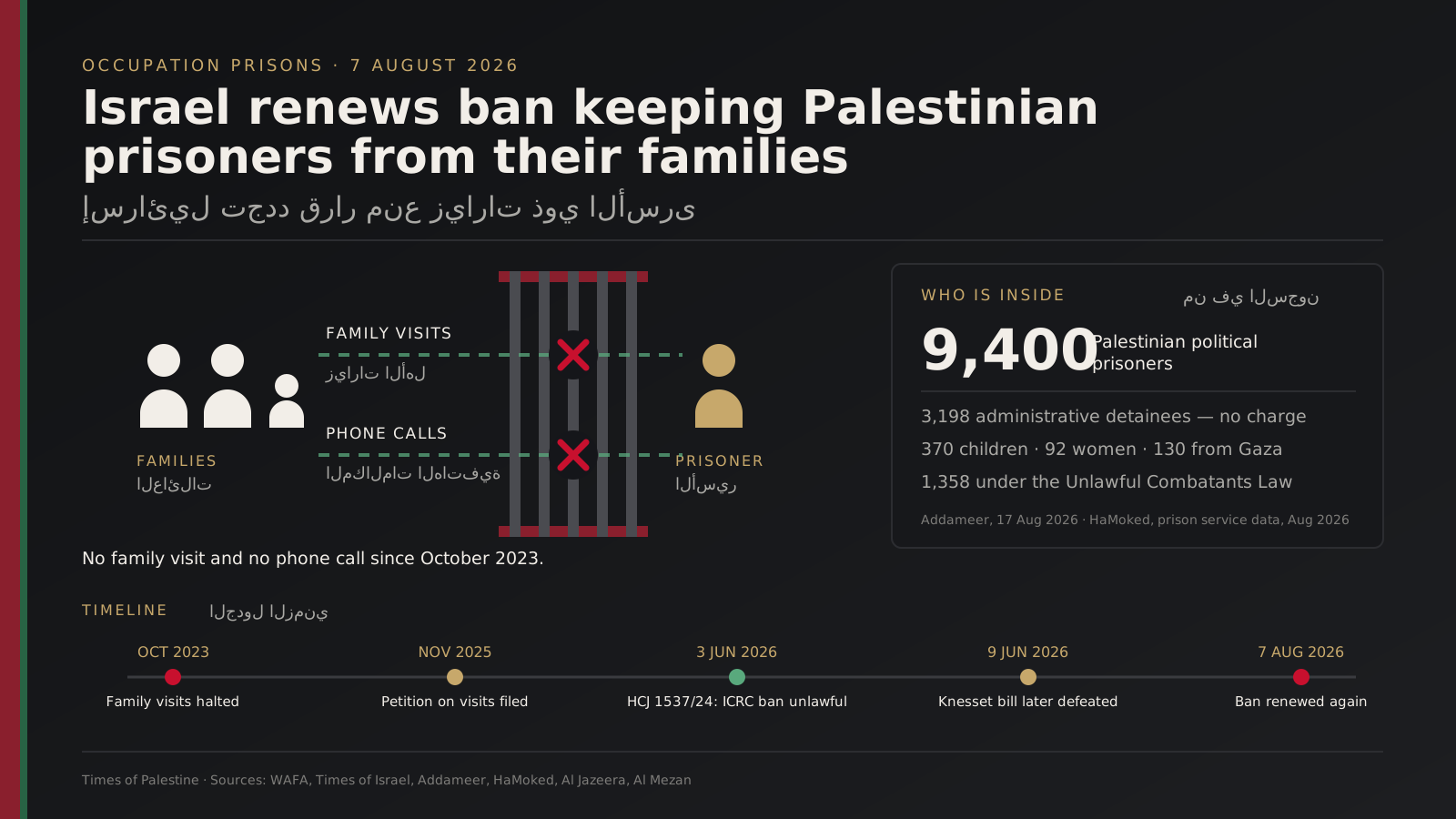
Israel's national security minister, Itamar Ben-Gvir, has renewed the order barring families from visiting Palestinian prisoners, the Palestinian Prisoners' Society said in a statement carried by WAFA on 7 August, extending into a third year a severance that has held since October 2023.
The freeze rests on a temporary order signed by prison service commissioner Kobi Yaakobi that instructs prisons to minimise or cancel routine activities entirely, the Times of Israel reported in November 2025. The same report said the order had been extended several times and was due to lapse on 31 July 2026. How long the August renewal runs has not been made public.
Addameer's statistics page, updated 17 August 2026, counts 9,400 Palestinian political prisoners, among them 3,198 administrative detainees held without charge, 370 children, 92 women, 400 Jerusalemites and 130 people from Gaza. HaMoked, working from prison service data for August 2026, records 7,965 "security" inmates inside Israel — 1,474 sentenced, 3,293 held pending trial, 3,198 in administrative detention — plus 1,358 people held under the Unlawful Combatants Law.
None of them has received a family visit since the war began. Nor may they telephone home: the Times of Israel reported that prisoners have been cut off from relatives through both phone calls and in-person visits since the order was issued.
The two bans are linked. In earlier litigation over Gaza prisoners, HaMoked noted that Israel had for years defended its sweeping ban on prisoners' phone contact by arguing that family visits took place regularly — a justification that collapses when the visits stop.
Rights groups petitioned Israel's High Court in November 2025 to restore family visits. "Parents have had no contact with their children," Daniel Shenhar, the HaMoked lawyer who filed the petition, said at the time, according to the Times of Israel. That petition has not produced a published ruling.
A parallel case over the International Committee of the Red Cross did. On 3 June 2026, the Supreme Court sitting as the High Court of Justice ruled unanimously in HCJ 1537/24 that the policy barring ICRC access to Palestinian detainees, and withholding information about them, had no legal basis and must be revoked, WAFA reported.
Al Jazeera reported that the petition had been filed in February 2024 by the Association for Civil Rights in Israel, Physicians for Human Rights-Israel, HaMoked and Gisha, and that the state sought 27 extensions before a hearing was finally held at the end of October 2025.
The Israeli site Ha-Makom, reporting on the judgment, wrote that Justice Daphne Barak-Erez described the proceedings as unusual in character, with the state filing dozens of postponement requests over more than two years and offering no alternative justification even after the court pointed this out in a decision of 2 February 2026.
Ha-Makom also reported that on 8 May 2026, while the judgment was being written, the state notified the court that the prime minister had ordered the ICRC to be allowed into five prison service security facilities and military facilities, including ones holding minors — but only to form an impression of conditions and speak with staff, without individual meetings with prisoners.
Middle East Monitor, citing Haaretz, reported the same restriction that week: entry to prisons, no meetings with detainees.
The ICRC's own position is unchanged. Its published FAQ states that it has not been able to visit any Palestinian detainee in Israeli custody since 7 October 2023 and stands ready to resume regular detention visits. Its West Bank spokesperson, Muhammad Abdullah, told WAFA on 30 June: "We do not have a specific date for beginning the visits."
Within a week of the ruling, the Knesset moved to override it.
Al Mezan recorded that on 9 June 2026 the Knesset passed in first reading a bill prohibiting ICRC visits to Palestinian detainees, less than a week after the court annulled the ban order first issued in October 2023 and renewed on 29 October 2025. The bill was then defeated.
The Jerusalem Post reported on 30 June that it drew 36 votes in favour and was removed from the agenda after 42 members voted against; The Canary gave the count as 41 to 36. The two tallies have not been reconciled in published accounts.
With families and the Red Cross both shut out, lawyers are the only channel left, and it is a narrow one. Defense for Children International-Palestine states that Israeli authorities have severely restricted lawyer visits since October 2023 and suspended family visits entirely, leaving the organisation unable to document conditions as before.
What reaches the public now comes largely through those lawyer visits.
The Commission of Detainees and Ex-Detainees Affairs publishes accounts after its lawyers enter prisons: following a visit to Megiddo, it reported that a 48-year-old detainee from Balata refugee camp, held since 27 November 2025, had lost about 30 kilograms because of insufficient and poor-quality food, and that the prison supplies his heart and blood-pressure medication daily but has refused treatment for reflux more than once.
Lawyer visits are not independent monitoring, and the Commission has said so, calling on the ICRC to issue a clear public report on detainees' conditions.
No date has been set for the first ICRC visit under the June ruling. The family-visit petition remains before the High Court, the renewed prison order has not been published, and nothing prevents the Knesset from reviving the bill it rejected in June.






%20(cropped).jpg?width=640)