Money & Access
Palestinians test Bluetooth mesh messaging as blackouts cut Gaza
Graphic: Times of Palestine
Original Reporting
The Newsdesk gathers reporting from wire services and primary sources and rewrites every story in-house before publication. How our journalism is made →
The newest version of bitchat, the Bluetooth mesh messaging app promoted to Palestinians as a fallback for communications blackouts, now ties a user's identity keys to the physical handset. The change matters most to people whose phones are searched or seized.
According to the release notes published on the app's App Store listing, bitchat mesh, version 1.7.1 encrypts private photos and voice notes before they travel over Bluetooth, adds identity verification during encrypted handshakes to block impersonation, and binds identity keys to the device so that they never sync or transfer — the notes state that a seized backup or cloned storage no longer yields a user's keys.
The same listing describes the earlier 1.6.0 release adding invite-only encrypted group chats that run entirely over the mesh, background presence so the app keeps relaying while the phone is locked, and couriers, which let one user carry messages for another until they reach the recipient. The developers claim automatic reconnection happens with, in their words, "zero extra battery drain."
That figure is the developers' own. No independent measurement of bitchat's power consumption on the handsets common in Gaza appears in the public record retrieved for this report.
The release history on the permissionlesstech GitHub repositories suggests power and data use have needed repeated attention. Android fixes listed there include pausing geohash heartbeat sampling when the app is backgrounded and closing Nostr subscription leaks, while the Android build description on APKMirror lists adaptive scanning and power management among its features.
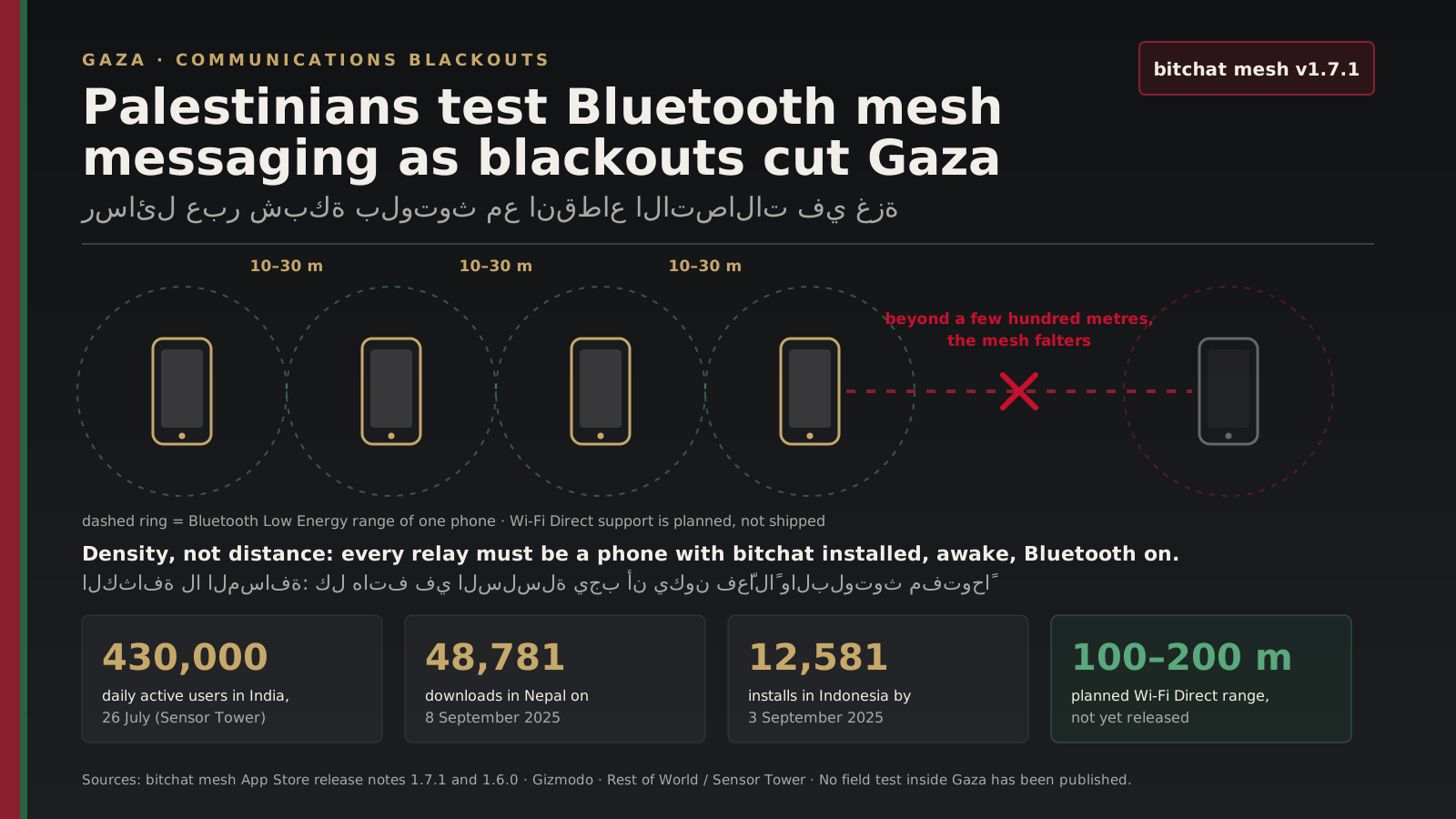
Range is the constraint no software release changes. Gizmodo's download page for the app puts Bluetooth Low Energy range at 10 to 30 metres, with Wi-Fi Direct support planned that would extend it to between 100 and 200 metres.
In its January report on the app's surge in Uganda, Gizmodo described each node extending reach up to 30 metres in crowded areas, and said Bluetooth meshes falter beyond a few hundred metres without a denser base of users.
Early coverage cited wider figures. The Arabic outlet Al-Araby reported in July 2025, when the app was still in TestFlight beta, a range of up to 300 metres — a span that in mesh terms is reached only by chaining hops through other phones running the app.
Density, then, not distance, decides whether the mesh functions in a camp block or a stairwell of displaced families. Every relay in the chain must be a phone with bitchat installed, awake, and with Bluetooth switched on.
Namrata Maheshwari, encryption policy lead at Access Now, told Rest of World that the app's decentralised architecture means there is no central server or database and therefore no central kill switch, and that downloaded apps keep working as long as users stay within the physical proximity the mesh requires.
The documented blackout deployments are all outside Palestine. Rest of World reported this month that bitchat hit an all-time high of 430,000 daily active users in India on 26 July, citing the market intelligence firm Sensor Tower, and that India accounted for 74 percent of global downloads between 20 and 26 July.
During Nepal's protests in September 2025, the app's co-developer, who uses the name Calle, said downloads rose from under 3,500 to nearly 49,000 on 8 September, more than 38 percent of all installs worldwide to that date, after authorities blocked 26 social platforms. BeInCrypto reported the figure as 48,781 downloads.
Gizmodo reported a comparable pattern in Indonesia the same month, with installs reaching 12,581 by 3 September, more than the United States and Russia combined.
In Uganda before this year's elections, the executive director of the Uganda Communications Commission, Nyombi Thembo, said regulators have the technical capability to disable bitchat, a claim the app's developers rejected, according to reporting syndicated by Yahoo News.
A January assessment by the Bloomsbury Intelligence and Security Institute recorded protest-driven uptake in Uganda and Iran during government-imposed blackouts, and warned the app remains exposed to surveillance, technical flaws and state countermeasures.
Nothing equivalent has been documented in Gaza or the West Bank. The advocacy group Tech for Palestine urged Palestinians in November 2025 to install the app, arguing that Palestinians depend on Israel for electricity, telecoms and internet routing. No study, deployment log or field test of mesh performance inside Gaza's camps has been published.
The blackouts themselves are extensively recorded. The Emergency Telecommunications Cluster reported on ReliefWeb that fibre cuts severed Gaza City and the north from 10 June 2025 and the entire Strip from 12 June, with partial restoration on 14 June followed by a fresh cut in the south and centre, amid nearly exhausted fuel and a lack of engine oil for generators.
Paltel said in September 2025 that fixed internet and landline services in Gaza and North Gaza governorates went down after several main feeder routes were struck, and that its crews were working around the clock under dangerous field conditions, Anadolu Agency reported. Middle East Eye reported that same blackout left close to a million people cut off as Israeli vehicles advanced into north-western neighbourhoods.
When the Palestinian Authority's telecommunications ministry blamed Israel for cutting the Strip's last fibre route in June 2025, Israel did not comment, Asharq Al-Awsat reported.
On installation, the practical guidance is narrow. The iOS app is the App Store listing bitchat mesh, id 6748219622. The Android build the developers publish is on the permissionlesstech GitHub releases page, where the June 2026 notes describe builds reproduced twice in independent jobs and a signed SHA-256 manifest a user can check against the file they downloaded.
Copies also sit on third-party mirrors including APKMirror and Aptoide, which are not the project's own channel. Which of the store listings circulating under the app's name are developer-published, and which are not, could not be established from the public record.
The project's own warning still stands in its documentation: the software has not received external security review, may contain vulnerabilities, and should not be relied on for sensitive use.