Politics & Diplomacy
Washington's first Gaza money funds a force, not housing

Image credit: The Harry S. Truman Building, State Department headquarters, Washington — Wikimedia Commons / US Department of State, public domain · License
Original Reporting
The Newsdesk gathers reporting from wire services and primary sources and rewrites every story in-house before publication. How our journalism is made →
Two letters left the State Department on 30 July. Reuters obtained them and reported their contents on Wednesday, three weeks later.
They record the first substantial American money committed to President Trump's plan for Gaza. Every dollar of it goes to a force.
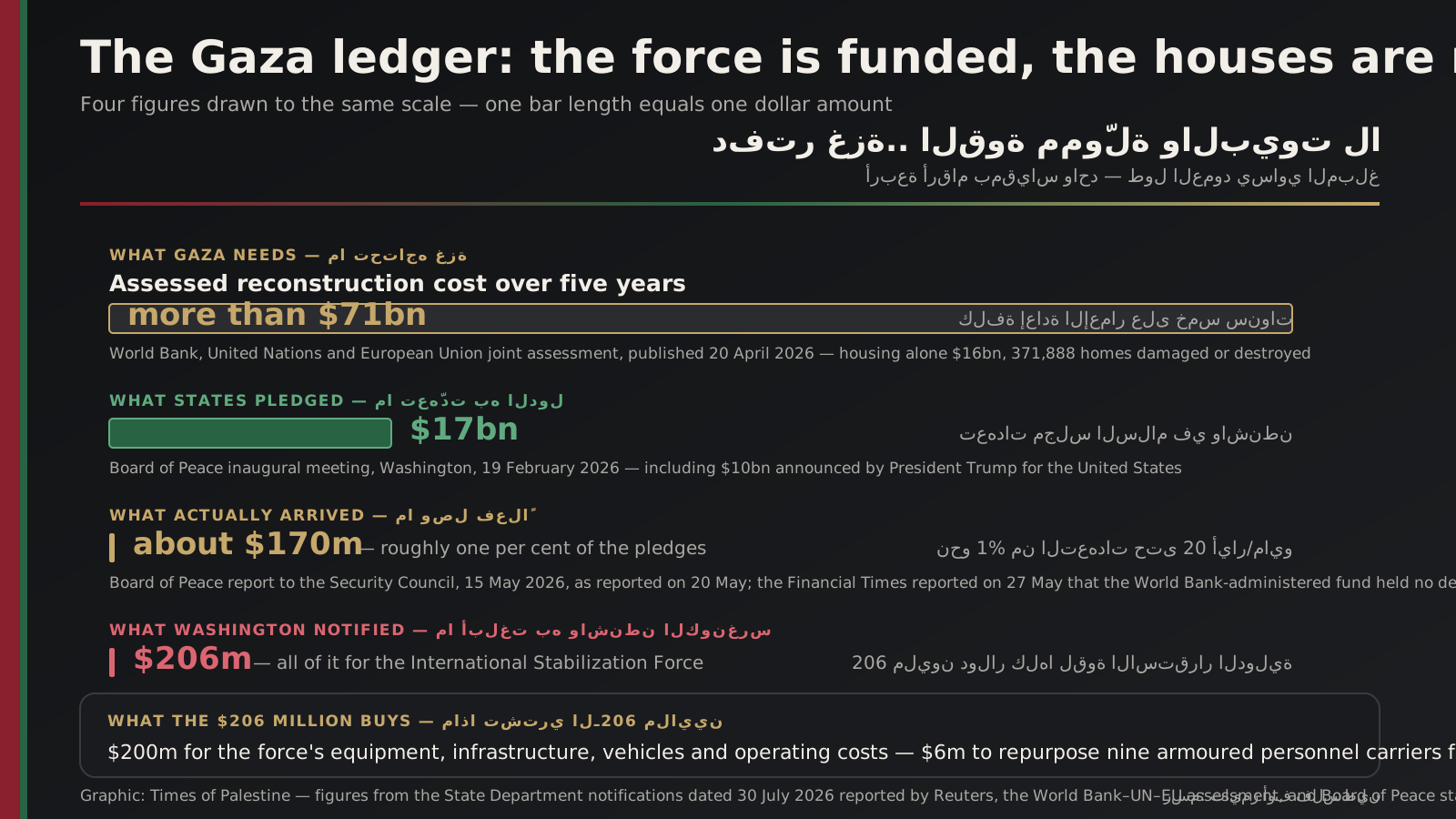
The department told Congress it will provide $200 million to the International Stabilization Force — the multinational force the Security Council authorised for Gaza — for its equipment, infrastructure, vehicles and operating costs. A second notification adds $6 million to repurpose American armoured vehicles for the same force.
The letters went to the appropriations and foreign affairs committees, the panels that hold the purse. A congressional notification is the step an administration takes before it spends money already appropriated on a new purpose; the committees have a window to object, and nothing on the public record says any of them did.
"The ISF will lead security operations, support comprehensive demilitarization, and enable the safe delivery of humanitarian aid and reconstruction material to Gaza," the notification says, in the text Reuters reported.
Tommy Piggott, the State Department spokesman, put the money in the plan's frame. "We are committed to the full implementation of the President's historic 21-point peace plan, of which the ISF is a key component," he said.
The ledger read from Gaza#
The figure is not large. What makes it worth a Palestinian reader's attention is what sits beside it in the ledger.
On 20 April the World Bank, the United Nations and the European Union published their joint assessment of what Gaza needs: more than $71 billion over five years. Housing alone accounts for over $16 billion of that. The assessment counted 371,888 homes damaged or destroyed, more than three-quarters of the housing stock, nearly 85 per cent of them destroyed outright.
Against that, the pledges. At the Board of Peace's inaugural meeting in Washington on 19 February, member states promised $17 billion — a quarter of the assessed need — with Trump announcing $10 billion of it on behalf of the United States.
Then the delivery. The Board of Peace's own report to the Security Council, submitted on 15 May and reported five days later, put the share of those pledges actually transferred at about one per cent. On that arithmetic the entire international pledge pool had moved roughly $170 million.
Which means the $206 million Washington has now notified for the force is larger than everything the world had transferred for Gaza's reconstruction as of late spring.
The record on the reconstruction fund itself is starker. The Financial Times reported on 27 May that the World Bank-administered account built to receive those pledges held no deposits at all, and a source described by AFP as familiar with the board said the same thing the same day.
One transfer did move. The United Arab Emirates sent $100 million, and it went to training Gaza's police force. The money that travels is security money.
What the $206 million builds#
An official of the Board of Peace, speaking to Reuters without being named, said the funding was needed for "the construction of a base for forces inside Gaza among other reconstruction projects". The same official described the past fortnight as a period of "significant advances".
The $6 million buys the smaller and more concrete item: nine armoured personnel carriers, originally destined for Nepal, redirected to the Gaza force, with Albania and Kosovo named as the first recipients.
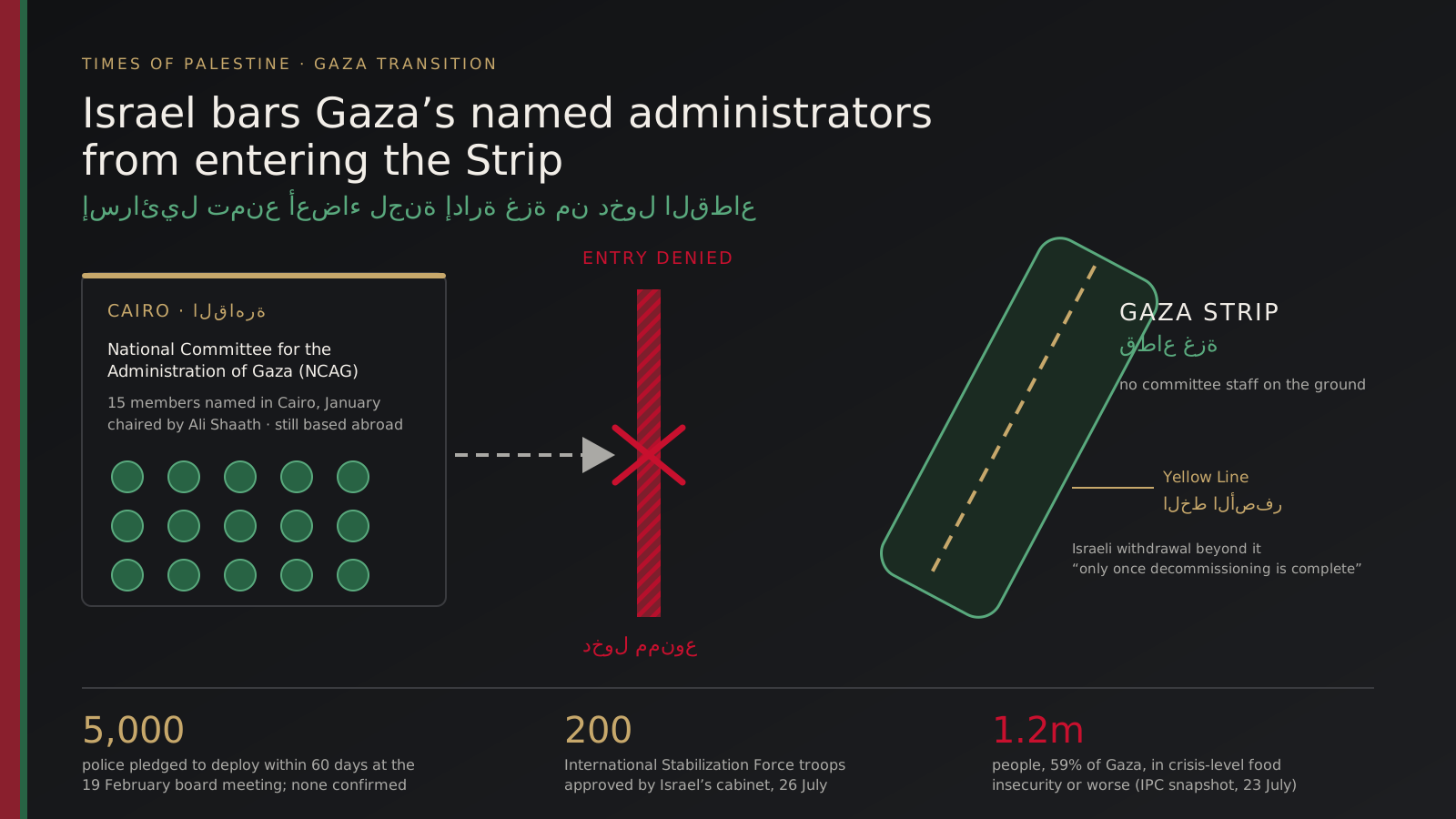
Five states have committed troops so far — Indonesia, Morocco, Kazakhstan, Kosovo and Albania — while Egypt and Jordan have agreed to train Palestinian police. Major General Jasper Jeffers, who commands the force, set its target at 20,000 soldiers in February. Israel's security cabinet cleared about 200 to enter on 26 July.
The base and the pilot project it serves are the part that touches Palestinian ground directly. Israel's cabinet approved a first reconstruction phase in Rafah on that same July date: temporary housing for tens of thousands of Palestinians, built in an area from which Israeli troops would pull back.
Running it falls to the National Committee for the Administration of Gaza, the technocratic body the board appointed, which would control access and screening with the force behind it.
Every resident would pass a security vetting before entering. That single condition is what has drawn the objection, in Gaza and in Cairo. Egypt, which borders Rafah, has treated the plan warily, reading a screened enclosure at the southern edge of the Strip as a step that could end with Palestinians pushed across its frontier.
The deadlock the money is meant to break#
The spending arrives while the plan it funds is not moving.
Prime Minister Benjamin Netanyahu holds that Hamas must disarm completely before Israeli forces withdraw any further. Hamas holds that it will disarm in phases as those forces leave. Neither has moved off that sentence.
Jared Kushner spent Monday in Jerusalem trying to close that gap and left without closing it. Officials told Israeli outlets the argument turned on Israel's continued strikes; Kushner told Netanyahu he would not object to strikes on genuinely imminent threats, and asked that the exception not be read broadly.
The strikes continued through the week regardless. Six Palestinians were killed at a café in Gaza City's fishing harbour and nine at a police station, according to hospitals and the Palestinian Red Crescent, in the counts carried by Israeli and American outlets.
The Board of Peace said nothing about either strike, keeping the silence it has generally kept over Israeli operations.
More than 1,200 Palestinians and four Israeli soldiers have been killed in Gaza since the ceasefire took hold in October, by the count of Gaza's health officials and the Israeli military.
Who holds the money#
The structure behind the spending has its critics in Washington, and the sharpest of them is Palestinian-American.
Zaha Hassan, a senior fellow at the Carnegie Endowment, wrote with her colleague Charles H. Johnson on 16 March that the board's charter "rests most authorities in one person, Board of Peace Chairman Donald Trump, in his personal capacity", and that the executive board he alone selects "controls budgets, financial accounts, and disbursements".
Their remedy was to route reconstruction money through existing World Bank mechanisms instead, which carry fiduciary oversight and a Palestinian Authority role. Nothing in the July notifications does that.
Washington's attention, meanwhile, sits east. Asked on Wednesday whether talks with Tehran might resume, Trump said the situation was "so good" that negotiations could wait, adding only that they might restart "maybe at some point" — a day after saying no talks were under way at all.
For Gaza the arithmetic of that distraction is plain enough. An administration six months into a war with Iran has funded the instrument that will police the Strip and has not yet moved the money that would rebuild a single street in it.