Politics & Diplomacy
Washington rebukes Israel over Syria and backs its Gaza strike

Image credit: Tom Barrack, US ambassador to Turkey and special envoy for Syria — US State Department via Wikimedia Commons (public domain) · License
Original Reporting
The Newsdesk gathers reporting from wire services and primary sources and rewrites every story in-house before publication. How our journalism is made →
Washington spent Tuesday objecting out loud to an Israeli air strike. The strike it objected to was in Syria.
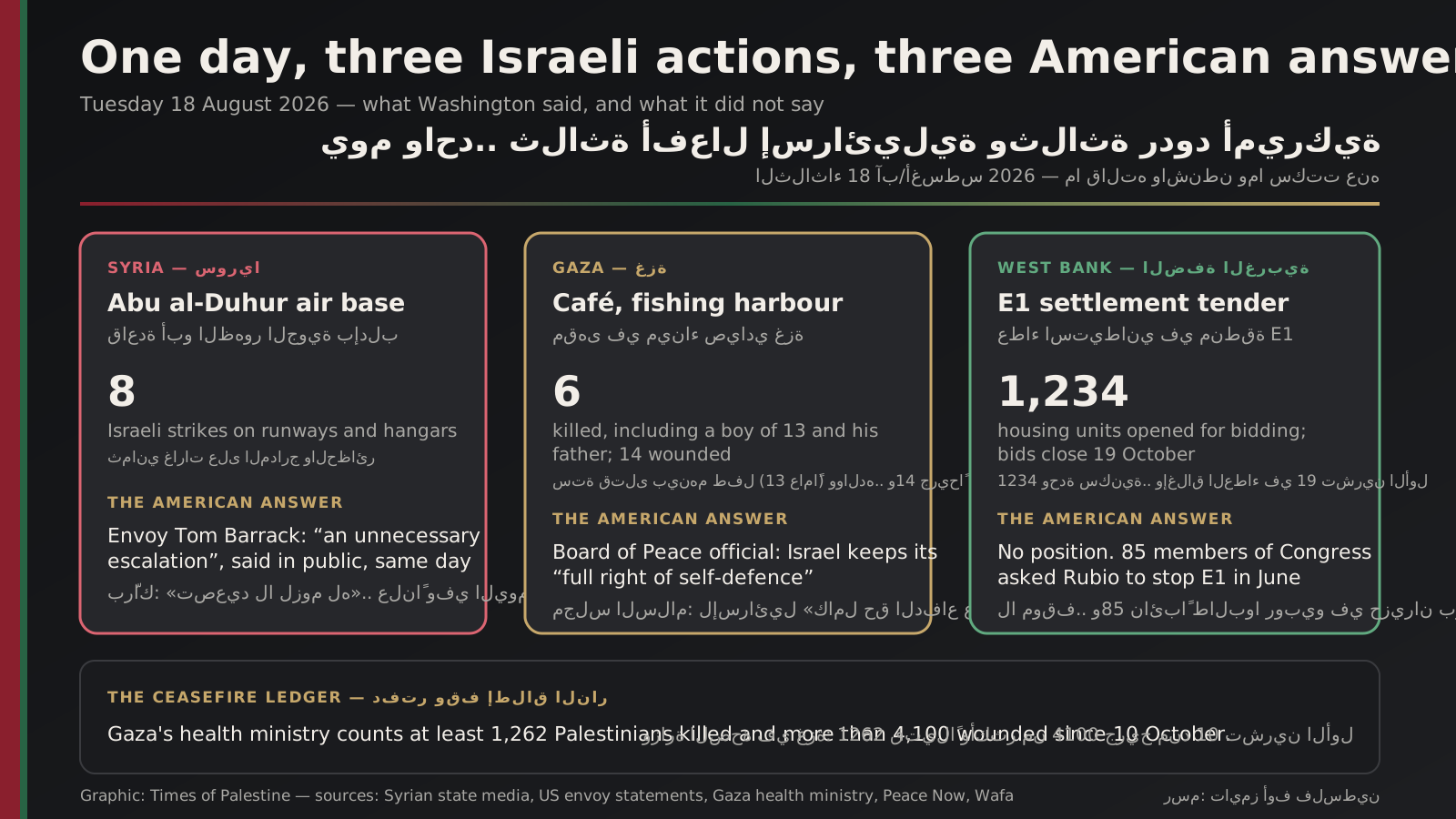
Eight Israeli bombs hit the runways and hangars of the Abu al-Duhur air base in Idlib province early that morning, Syrian state media reported, hours after a Turkish delegation had left the site. No one was killed.
Tom Barrack, the American ambassador to Turkey and the administration's special envoy for Syria, called the attack "an unnecessary escalation that does not advance regional stability", and urged the parties to "prioritise logical discourse over further military incidents".
Later the same day, an Israeli aircraft fired two missiles into a small café inside the fishing harbour of western Gaza City, an area that had filled with displaced families. Six Palestinians were killed, among them a 13-year-old boy and his father, and fourteen were wounded, Gaza medics told Reuters.
For that strike, the administration's public word was different. An official of the Board of Peace, the body President Trump chairs, said Israel retains its "full right of self-defence" and that there would be no Israeli redeployment until Hamas is disarmed.
The rebuke Israel did get#
Barrack's complaint was not only that Israel bombed a neighbouring state. It was that Israel had not told anyone.
Turkey received no warning, the envoy said, and "consequently observed the aircraft heading north toward its territory and therefore could have reasonably prepared its own response" — diplomatic language for two American partners nearly shooting at each other.
Netanyahu's office justified the raid by saying Israel and Syria had "agreed to a status quo in security matters" that Damascus was "on the verge of breaching" by letting Turkish troops deploy at an airbase near Aleppo.
Turkey's Presidential Communications Directorate called that account "frivolous", saying it was meant "to legitimise Israel's unlawful air strikes targeting the sovereignty and territorial integrity of Syria".
Syria's foreign minister, Asaad al-Shibani, said the attacks "don't have security justifications" and that Damascus would "continue in our diplomatic path to dissuade Israel from this policy". Jordan's foreign ministry called the raid an unjustified act of aggression.
Axios reported that White House and senior American officials were frustrated by the strike, in part because Trump treats his opening to President Ahmed al-Sharaa's government in Damascus as a foreign-policy achievement of his own — and reported, in the same account, that the administration is rarely willing to draw a clear red line with Netanyahu.
The strike that drew no rebuke#
The Israeli military said the Gaza City strike targeted Hamas commanders involved in the attacks of 7 October 2023, along with other fighters. It released no evidence, and named no one killed.
The strike landed one day after Jared Kushner left Jerusalem, and it landed on the first working day of a mechanism designed for exactly this kind of decision.
That mechanism was agreed on Monday between Kushner and Netanyahu: Israel reports a suspected emerging threat in Gaza, the mediators raise it with Hamas, and force becomes the last option rather than the first. No American official said on Tuesday whether the café was run through it.
Gaza's health ministry counts at least 1,262 Palestinians killed and more than 4,100 wounded since the ceasefire took effect on 10 October — nearly all of them in strikes Israel has justified as pre-emption.
Washington's instrument of choice#
Having criticised the Syria raid, Barrack proposed the same remedy the Gaza file received on Monday.
The United States is "actively working" to establish a deconfliction mechanism involving Israel, Syria and Turkey, he said, to prevent future miscommunication, adding that Washington already runs an information-sharing channel among the parties but that a more robust architecture with more resources is required.
Investing in such mechanisms is far less costly than relying on kinetic means of communication that can run into the hundreds of millions of dollars.
Tom Barrack, US ambassador to Turkey and special envoy for Syria, 18 August 2026
The sentence is worth reading twice from Gaza. It prices restraint against bombing, and finds bombing expensive.
What it does not do is remove anyone's ability to bomb. A deconfliction mechanism is a telephone line, not a prohibition. It arranges the conversation that happens before a strike, and leaves the decision where it already sits.
Palestinians now sit inside two of these arrangements without a seat in either. In Syria the parties are Israel, Turkey and Damascus. In Gaza they are Israel, the mediators and the Board of Peace, with Hamas informed through Egypt and Qatar.
The tender nobody in the administration answered#
While the envoys discussed mechanisms, Israel's housing ministry did something in the West Bank that no mechanism covers.
On Tuesday it opened bidding on 1,234 housing units in E1, the corridor of hills east of occupied Jerusalem, the Israeli monitoring group Peace Now reported. Haaretz put the same tender on its front page, and the official Palestinian news agency Wafa reported it covers seven settlement complexes.
Bids close on 19 October, one week before Israelis vote on 27 October. The units are part of 3,401 planned for E1, and the plan is still under an active legal challenge; Peace Now said the petitioners learned of the tender from the Israel Land Authority website rather than from the state.
For a Palestinian the significance of E1 is geographic, not symbolic. Built out, it joins Jerusalem to the Ma'ale Adumim settlement and severs the northern West Bank from the southern one, leaving Ramallah and Bethlehem connected only by detour roads that Israel controls.
Eighty-five members of Congress, led by Representatives Jan Schakowsky and Mark Pocan, wrote to Secretary of State Marco Rubio in June asking him to press Israel to halt construction in E1. The tender is the answer they received.
The administration's own position was stated earlier this month by Mike Huckabee, the ambassador to Israel, who said the United States "has never asked Israel to not apply sovereignty" and would not tell Israel what to do. On E1 specifically, the administration has taken no position at all.
A clock with no hands to receive the weapons#
Inside the Gaza plan itself, the friction Washington keeps private is about who will hold the guns.
Kushner told Fox News on Monday that Hamas should begin handing over weapons within thirty days. Under the plan, those weapons go to a new Palestinian police force under the National Committee for the Administration of Gaza, with the international force supervising.
Netanyahu is refusing to let police recruits leave Gaza for training in Egypt, Israeli officials told the Times of Israel, and Kushner objected to that refusal in Jerusalem along with the continuing strikes.
The arithmetic is simple and unforgiving. Without trained recruits there is no Palestinian body to receive a single rifle, and the thirty-day clock announced on American television runs against a queue that Israel has closed.
Meanwhile the force meant to police the Strip is being assembled from elsewhere. Ugandan and Burundian officers surveyed Rafah this week ahead of a possible deployment, after Uganda's parliament approved sending troops on 6 August.
The wider war stayed where it was. Trump said on Tuesday that no talks are under way with Iran and posted a map labelling the Strait of Hormuz as American territory, while Senator Tim Kaine prepares a war powers resolution to bar an attack on Oman, the country mediating for him.
Tuesday's ledger reads plainly enough from Gaza City and from Ramallah. When Israel struck a state Washington is courting, the envoy objected within hours and by name.
When Israel struck a café full of displaced Palestinians, and when its housing ministry put the middle of the West Bank up for sale, the administration offered a mechanism, a right of self-defence, and no position at all.