Politics & Diplomacy
Israel picks which foreign troops replace its army in Gaza

Image credit: Members of the US House Armed Services Committee at the Civil-Military Coordination Center, Kiryat Gat — Sgt. Kathryn Skonning, 207th Public Affairs Detachment / US Army via DVIDS · License
Original Reporting
The Newsdesk gathers reporting from wire services and primary sources and rewrites every story in-house before publication. How our journalism is made →
Jared Kushner spent Monday in Jerusalem arguing about when Israeli soldiers leave Gaza. The question the argument turns on is who arrives to take their place.
Kushner met Prime Minister Benjamin Netanyahu after two hours with Hamas's Khalil al-Hayya at El-Alamein on the Egyptian coast on Sunday, the Associated Press reported, alongside the envoy Steve Witkoff and Nickolay Mladenov of the Board of Peace.
A source with knowledge of the meeting told the agency that Kushner pressed for "concrete, verifiable steps" and told the delegation that Gaza "can never again be a source of terror for Israel".
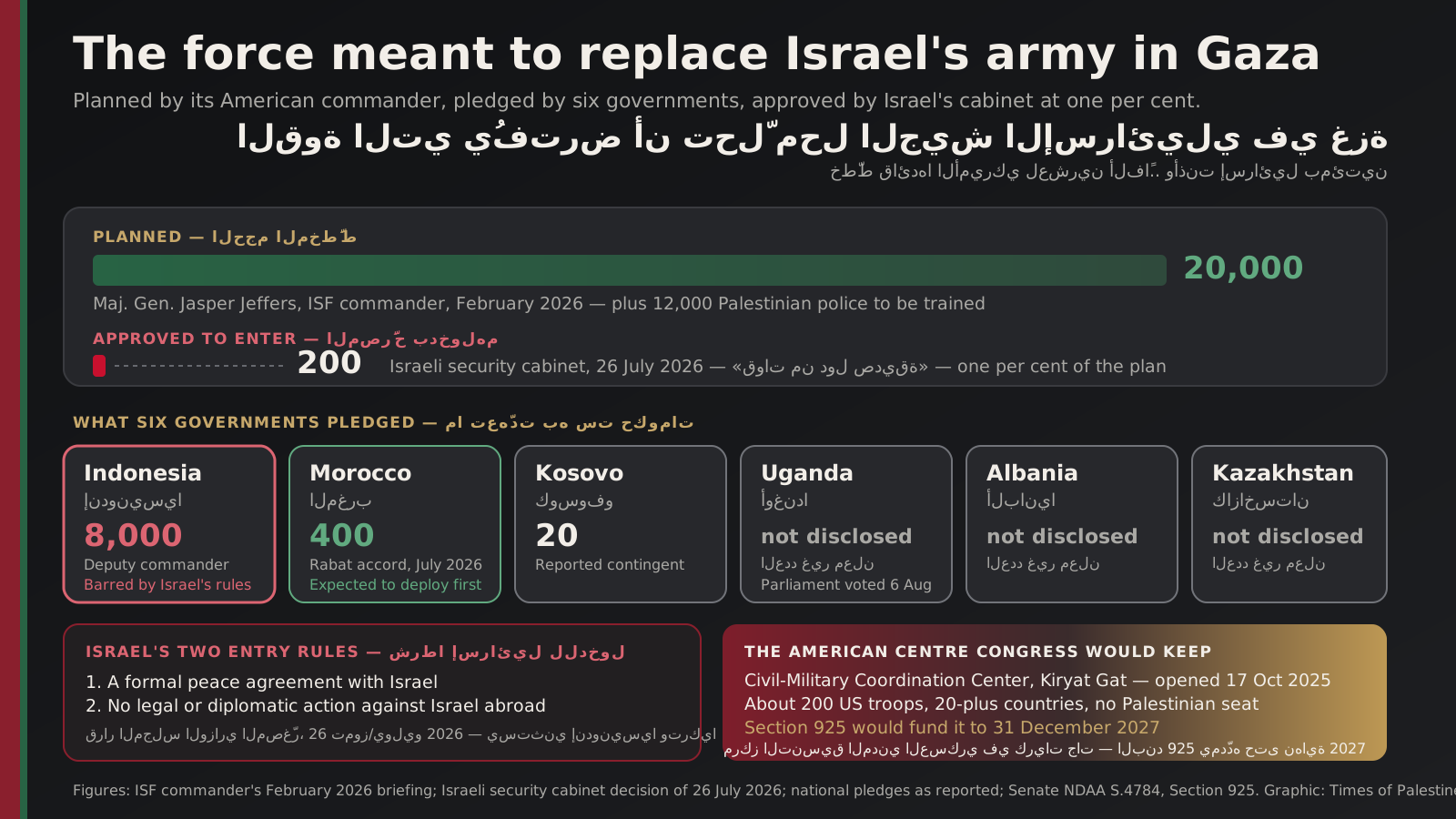
Every version of the roadmap ends the same way: Israeli troops withdraw and an International Stabilization Force takes over the ground. That force currently has 200 men cleared to enter.
The force on paper#
Security Council Resolution 2803, adopted on 17 November 2025, endorsed President Trump's Board of Peace and authorised the force for two years — to support demilitarisation, secure Gaza's boundaries, protect civilians and train Palestinian police.
Major General Jasper Jeffers, who commands US Special Operations Command Central, took charge in January. At the board's inaugural meeting in Washington on 19 February he set out the size: 20,000 soldiers, with 12,000 Palestinian police to be trained in Egypt and Jordan.
Eight months after the ceasefire, the Jerusalem Post reported in June that a handful of Moroccan planning officers had arrived and that no contributing country had a deployment date. Israeli officials told the paper they feared the force would become "a UNIFIL 2" — the UN mission in south Lebanon that watches a line without confronting anyone.
What Israel approved, and on what terms#
Israel's security cabinet voted on 26 July to let the force in. The Times of Israel reported the size of that opening: about 200 troops from what the decision called friendly countries.
Foreign Minister Gideon Sa'ar voted in favour. National Security Minister Itamar Ben Gvir voted against. Every subsequent entry requires the personal approval of Netanyahu, Defence Minister Israel Katz and Sa'ar.
An Israeli official set out what the decision does not do. "Israel maintains that the IDF will continue to hold the Yellow Line," the official said, "and there will be no [further] withdrawal whatsoever until Hamas has been completely disarmed."
Israeli forces hold roughly 60 per cent of the Gaza Strip, by the Associated Press's account.
The two rules that decide who comes#
The same decision sets the criteria for which armies may set foot in Gaza, and Israel alone applies them.
A contributing state must hold a formal peace agreement with Israel, and must not be pursuing legal or diplomatic action against Israel or Israeli officials in international forums.
The second rule reaches into the cases Palestinians depend on. A government that joins South Africa's genocide case at the International Court of Justice, or presses the International Criminal Court's warrants, disqualifies its own soldiers from the force that would replace Israel's.
The two rules exclude Indonesia and Turkey. The Times of Israel reported that Washington supported both countries' participation and Israel opposed it.
Indonesia was not a marginal offer: President Prabowo Subianto pledged 8,000 troops or more at the February meeting in Washington, and Jeffers named Jakarta deputy commander of the force. That pledge had already weakened, the same paper reported, as domestic opposition grew and Jakarta doubted the plan was moving at all.
Both excluded states signed this month's statement by eight Arab and Muslim governments holding Israel responsible for obstructing the roadmap. The rule bars from Gaza the governments most willing to say so out loud.
What is left is small. Morocco signed an accord in Rabat in July for 400 troops and is expected to deploy first. Uganda's parliament approved a contribution on 6 August. Albania, Kazakhstan and Kosovo have pledged contingents, Kosovo's reported at about 20.
The American centre Congress would keep#
While the force stalls, the American command above it is being written into United States law.
The Civil-Military Coordination Center opened at Kiryat Gat in southern Israel in October 2025, days after the ceasefire. Admiral Brad Cooper, who heads US Central Command, runs it.
Hanna Alshaikh of the Arab Center in Washington described how the building divides up: one floor for the American-led project, one for the other states and the aid organisations, another for the Israeli military. About 200 American troops work there beside personnel from more than twenty countries.
No Palestinian has a floor, or a desk. The European Union has pushed for Palestinian representation and the discussions proceed without it — the mechanism built for Gaza treats Gaza's people as its subject rather than a party to it.
Section 925 of the Senate's defence bill for the coming fiscal year, S.4784, filed by Senator Roger Wicker on 16 June, would authorise the defence secretary to keep that centre running until 31 December 2027 as the implementing body of the plan to end the war.
The secretary would also report to Congress by 1 March 2027, and every 180 days after, on the centre's staffing, casualties in the region and the stabilization force's effectiveness.
A New Policy, a Washington organisation campaigning for a different American approach to the region, called the section a codification of the United States as Israel's enforcement arm.
Congress would fund what the administration nearly shut#
The centre's own future was in doubt this spring.
Reuters reported at the start of May, citing seven diplomats familiar with its operations, that the centre would soon close, and that its aid coordination and ceasefire monitoring would pass to the American-commanded stabilization force.
The Board of Peace denied it. The report was wrong, the board said, and the centre "will continue to be mission critical to our efforts."
Whichever account holds, the transfer described has an obvious problem: the body that would inherit Gaza's aid coordination and ceasefire monitoring is the same force with 200 men cleared to enter.
The bill nobody has passed#
The Senate Armed Services Committee approved S.4784 by 18 votes to 9. On 14 July the Senate failed to open debate on it, 50 votes to 46, and the Congressional Research Service recorded no further step as of 24 July.
The House passed its own version, H.R. 8800, on 22 July by 216 to 212.
One amendment went to the heart of the Gaza force and never got a vote. Delia Ramirez of Illinois filed it on 17 June: no Pentagon money for participation in the stabilization force unless Congress passes a specific authorisation, consistent with the War Powers Resolution.
Congress left Washington for August with all of it unresolved.
Rafah is where the first soldiers land#
The 200 approved troops are meant for a pilot humanitarian zone in Rafah, from which Israeli forces would pull back.
Palestinians are not of one mind. The National reported in late July that Elias Al Najjar, 38, sheltering in eastern Khan Younis through winter floods and summer insects, would move his family the day it opens under international supervision.
Adham Abu Hweishil, 33, displaced from Jabalia, told the paper the objection is the address, not the housing: such places should be built where people's homes stood.
The peace council's writ would be confined to what Israel calls the humanitarian city in Rafah — the institutionalisation of Gaza's fragmentation.
Wissam Afifa, political analyst, to The National
The police half is further along than the military half. Egypt's foreign minister Badr Abdelatty said Cairo would train 5,000 officers for Gaza, with more than 500 through the first course.
Mohammed Samhouri, the Palestinian economist, wrote for the Arab Center in Washington on 13 August that it is hard to see how any of it works, given the mistrust and the huge imbalance of military power.
At least 1,262 Palestinians have been killed since the October ceasefire began, and five Israeli soldiers, by the Associated Press's count.
For a family in Rafah the sequence is not abstract. The first soldiers who come to replace Israel's will arrive from a list Israel approved, into a zone Israel designates, under an American command inside Israel where no Palestinian sits — and the law meant to keep that command running is stuck on a Senate floor nobody is standing on this month.




%20(cropped).jpg?width=640)