Research & Investigations
Israel decides who holds a Palestinian identity card
Graphic: Times of Palestine
Original Reporting
The Newsdesk gathers reporting from wire services and primary sources and rewrites every story in-house before publication. How our journalism is made →
Every legal document a Palestinian in the West Bank or Gaza holds — the identity card, the birth certificate, the passport — exists only if Israel has entered the holder in a registry it keeps a copy of and controls.
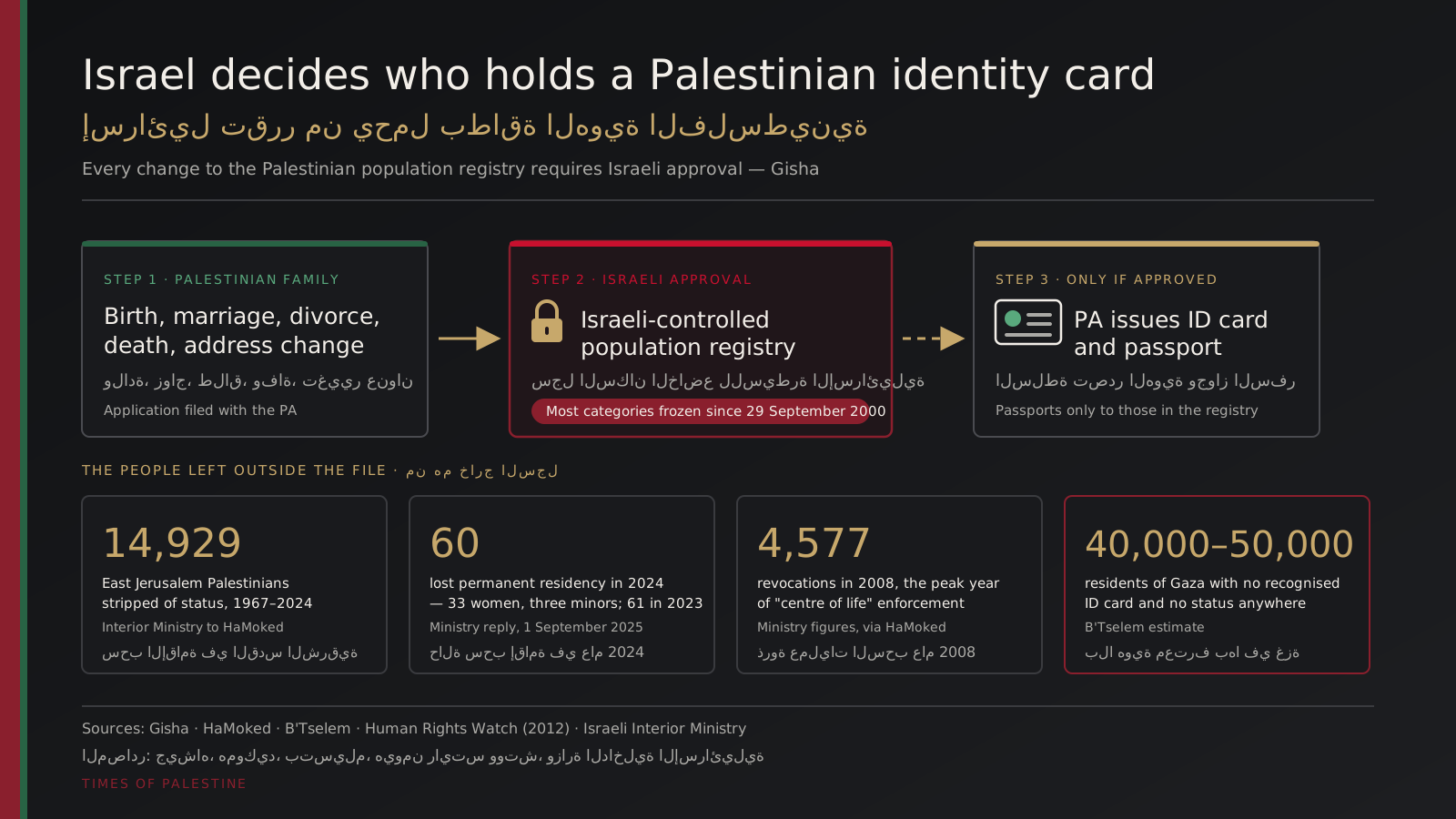
Gisha, the Israeli movement-rights group, states the rule plainly: any change to the Palestinian population registry requires Israeli approval, including registration of births, marriages, divorces, deaths and address changes, and the Palestinian Authority may amend or issue an ID card only once that approval is granted. Palestinian passports, Gisha adds, are issued by the PA only to residents listed in the Israeli-administered registry.
Most of those changes have not been approved for a quarter-century.
Human Rights Watch, in its 2012 report on Israeli control of Palestinian residency, found that after the second intifada began on 29 September 2000 the Civil Administration froze most categories of registry change, and that the one change it continued to process routinely was the registration of children under 16 born to a registered Palestinian parent, and only when the child was physically present in the occupied territory when the application was filed.
HaMoked, in a position paper published on 24 August 2021, said the freeze has remained in force, that the Israeli military retains decisive control although day-to-day administration passed to the PA, and that when the PA reports having transferred an application, the military systematically says it received no such request.
The people left outside the file are counted only in estimates. B'Tselem puts the number of residents of Gaza holding no Israeli-recognised ID card and no status in any other state at between 40,000 and 50,000, and attributes the situation to Israeli policy.
HaMoked says Palestinians registered with a Gaza address who live in the West Bank are treated as unlawfully present in their own homes unless they hold a one-year Israeli military permit.
Openings have come as one-off political gestures rather than policy. HaMoked records that in 2007 Israel offered to examine 50,000 family unification applications and roughly 23,000 were approved, before the incoming government halted approvals in 2009.
Gisha records a February 2011 agreement to let 5,000 Gaza-registered residents of the West Bank change their address, of which about 2,700 had been approved at the time of writing.
The Associated Press reported in January 2022 that fresh Israeli approvals granted West Bank residency to some 2,800 Palestinians who had moved there from Gaza before 2007.
In East Jerusalem the document is different and so is the way it is lost. Palestinians there hold Israeli permanent residency, a status that lapses.
Under the Entry into Israel rules as set out by the Israeli public-rights portal Kol Zchut, permanent residency expires after seven consecutive years abroad or on acquiring citizenship or permanent residency elsewhere; separately, the interior minister may revoke it for "breach of loyalty", and where the holder has been a permanent resident for more than 15 years or was born to a permanent-resident parent, the minister needs the justice minister's consent and must consult a statutory committee.
Kol Zchut also cites a Supreme Court ruling requiring the minister to weigh the particular position of native permanent residents of East Jerusalem and the Golan, given their ties to their birthplace.
The Times of Israel reported that from 1995 the Interior Ministry began requiring Jerusalemites to prove the city was their centre of life, and that revocations peaked in 2008 at 4,577, according to ministry statistics obtained by HaMoked.
HaMoked's most recent freedom-of-information request produced an Interior Ministry answer on 1 September 2025: 60 East Jerusalem Palestinians lost permanent residency in 2024, among them 33 women and three minors, and 52 were outside Israel on the date of revocation. The comparable figure for 2023 was 61.
Cumulatively, the ministry told HaMoked, 14,929 East Jerusalem Palestinians have had status revoked between 1967 and 2024 on the ground that it "expired of itself".
Writing in Haaretz in December 2020, Amira Hass cited earlier official replies to HaMoked showing 108,878 revocations affecting Palestinians from Gaza, and 25,645 Palestinians born in the West Bank stripped of status in 1994 alone.
Marriage across those lines runs into a statute.
Adalah reports that the Knesset passed the Citizenship and Entry into Israel Law (Temporary Order) on 10 March 2022 by 45 votes to 15, barring the interior minister from granting status to Palestinians from the West Bank and Gaza married to Israeli citizens, and to spouses from Syria, Lebanon, Iraq and Iran.
The Foundation for Middle East Peace notes the renewed text carries explicit language about the law's demographic purpose. Adalah calls it one of the most discriminatory laws in the world.
In Knesset debate reported by the Times of Israel, a Shas member defended the ban by citing attacks carried out by Palestinians who had gained access through unification, while a Ra'am member called the policy "racism for its own sake".
The Jerusalem Legal Aid and Human Rights Center says that after the 2003 law lapsed in July 2021 the Interior Ministry went on refusing applications anyway, that Israel's High Court found this contrary to administrative law in January 2022, and that the interim procedure which followed opened processing only to applicants over 50 who had held valid stay permits for at least five years.
For refugees outside historic Palestine, the paper depends on the host state. The Forced Migration Review notes the 1965 Casablanca Protocol committed Arab states to grant Palestinians rights while withholding naturalisation and issuing refugee travel documents to preserve refugee status.
Lebanon's General Security publishes its own requirements for biometric travel documents for Palestinian refugees, including separate categories for those "under study" and unregistered. Arab News reports that Jordan issues temporary passports, chiefly to those displaced after 1967, with an ID card determining the passport's class.
Recognition of Palestinian statehood has not touched the registry.
The 2013 presidential decree renaming official documents "State of Palestine" followed the UN General Assembly's 2012 upgrade; the Palestinian cabinet's service portal still lists a separate passport for Palestinians abroad who hold no Palestinian ID number, and HaMoked notes entry to the West Bank via the Allenby crossing is limited to people registered in the population registry.
After the September 2025 recognitions by the UK, Canada, Australia, Portugal and France, tallies of recognising states differ between outlets, from more than 150 to close to 160.
What is not known is how much of Gaza's civil archive survived the war — the Arabic outlet Noonpost reported extensive destruction of government institutions and civil records — and how many children born there since October 2023 have no entry in any registry at all.




%20(cropped).jpg?width=640)