Politics & Diplomacy
Huckabee threatens Qusra's settlers with sanctions Trump revoked in 2025
%20(cropped).jpg?width=640)
Image credit: Mike Huckabee, US ambassador to Israel, official portrait 2025 — Wikimedia Commons / US Embassy Jerusalem, public domain · License
Original Reporting
The Newsdesk gathers reporting from wire services and primary sources and rewrites every story in-house before publication. How our journalism is made →
The American ambassador to Israel reached for the Ten Commandments on Thursday.
Speaking to Reuters in Jerusalem, Mike Huckabee said of the settlers who have besieged three Palestinian homes in Qusra since 9 August that "you don't take something that doesn't belong to you". Taking a person's land or house, he said, is "a violation of God's law".
He called what happened in the village south of Nablus inexcusable and repugnant, and said the United States was appalled by it.
Then he named a consequence. Settlers found to have taken part could face American sanctions, Huckabee said, including a ban on entering the United States. In the same breath he added that he was not aware any such measure was under consideration.
Both halves of that sentence deserve a Palestinian reader's attention, because the machinery the ambassador invoked was dismantled by his own president nineteen months ago.
The order that no longer exists#
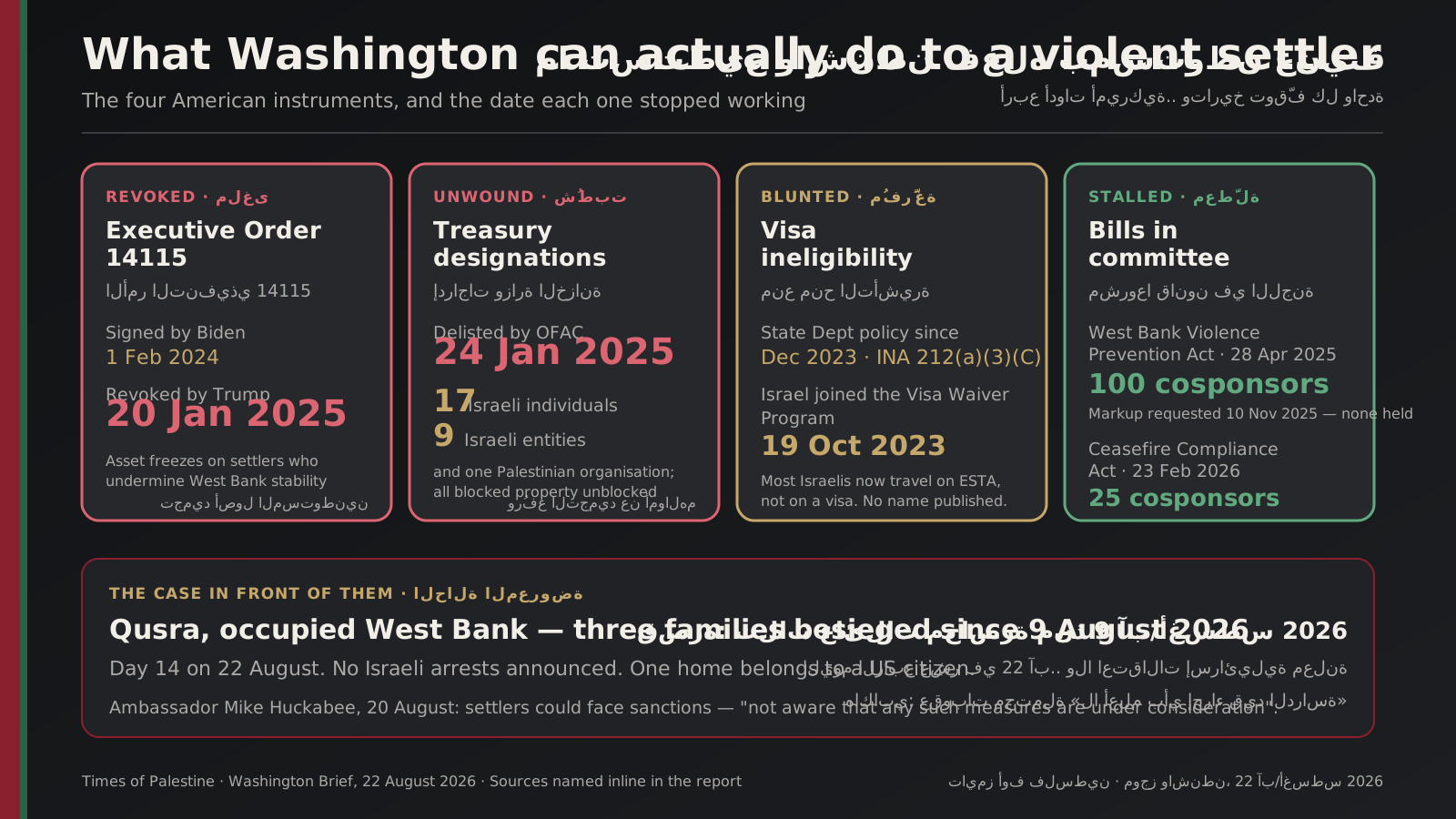
The tool Huckabee gestured at has a name and a paper trail. President Joe Biden signed Executive Order 14115 on 1 February 2024, declaring a national emergency over the West Bank and authorising the Treasury to freeze the assets of people who undermine peace and stability there.
For eleven months it was the only American instrument that put a financial price on settler violence. Under it the Treasury designated Israeli individuals, outposts and organisations, among them the Amana settlement movement, which builds and services outposts across the occupied West Bank.
President Donald Trump revoked the order on 20 January 2025, his first day in office, inside an omnibus rescission of Biden-era executive actions.
Four days later the Treasury's Office of Foreign Assets Control finished the job. On 24 January 2025 it struck everyone designated under the order from its sanctions list — by the count published in the legal journal Just Security, seventeen Israeli individuals and nine Israeli entities, along with one Palestinian organisation — and unblocked their property. The removals were entered in the Federal Register that week.
There is no successor order. When the ambassador told Reuters that settlers "could" face American sanctions, the authority that would have produced them had already been repealed, and the file of people once sanctioned under it had already been emptied.
What is left is a visa most settlers never need#
The second half of Huckabee's warning — a ban on entering the United States — rests on different ground, and that ground has quietly shifted too.
Since December 2023 the State Department has run a visa restriction policy under Section 212(a)(3)(C) of the Immigration and Nationality Act, the clause that lets a consular officer refuse a visa to someone whose entry would carry serious adverse foreign policy consequences.
Matthew Miller, then the department's spokesman, said the policy would cover dozens of settlers and their families. Because American law keeps visa records confidential, the department has never named a single one.
The practical difficulty is a piece of paperwork Washington handed Israel a few weeks earlier. Israel entered the American Visa Waiver Program on 19 October 2023, so an eligible Israeli citizen with a biometric passport travels to the United States on an ESTA authorisation, not on a visa.
A visa ineligibility can be applied to a waiver traveller by refusing the electronic authorisation, but that is a Homeland Security decision taken invisibly at the border-management level rather than a public act of policy. Nothing on the record suggests either has been used against anyone at Qusra.
The bills that would restore the tool sit in committee#
Congress has written the replacement twice, and neither text has moved.
Representative Jerry Nadler of New York introduced the West Bank Violence Prevention Act in the House on 28 April 2025, with Senator Cory Booker of New Jersey carrying the Senate companion alongside Senators Shaheen, Warner, Reed, Coons and Bennet. The bill is modelled directly on the revoked executive order, with one change that matters: it would require the president to impose the sanctions rather than permit him to.
The House version reached one hundred cosponsors, and on 10 November 2025 Nadler, Adam Smith and Jim Himes wrote to Brian Mast, the Republican chairman of the House Foreign Affairs Committee, asking him to schedule a markup — the committee session at which a bill is amended and voted on, and without which it cannot reach the floor. No markup has been held.
A second route runs through the weapons themselves. Representative Sean Casten of Illinois introduced the Ceasefire Compliance Act on 23 February 2026 with twenty-five Democratic cosponsors.
It would bar the use of American-supplied offensive weapons in Gaza and the West Bank if Israel breaks the October 2025 ceasefire, annexes the West Bank, or fails to act against settler violence, while exempting Iron Dome, David's Sling and Arrow 3. It, too, sits in committee.
The Senate has sent letters instead. On 5 March 2026 Chris Van Hollen of Maryland and thirty colleagues wrote to Secretary of State Marco Rubio, Attorney General Pam Bondi and Huckabee himself about Nasrallah Abu Siyam, a 19-year-old from Philadelphia killed in the West Bank — the ninth American citizen killed there since January 2022, by the senators' count.
It is unclear to us how many more Americans must die in the West Bank in order for this administration to take serious, credible steps to secure accountability.
Senator Chris Van Hollen and thirty colleagues, in their 5 March 2026 letter to the secretary of state, the attorney general and the ambassador
What Qusra received instead#
The reason Washington is speaking about this village at all is a passport. One of the three besieged houses belongs to Loui Ridi, a Palestinian American from the Toledo area of Ohio, who flew to the West Bank on Monday after watching his brother and his nephew being attacked on his own security camera.
Ridi told the American programme Democracy Now on Friday that he had contacted the embassy in Jerusalem and his congressman repeatedly, and asked the embassy to send a team to see the conditions for itself. "I'm not getting no protection here," he said. "I still fear for my life."
The two other families under siege at Ras al-Ein hold no American document, and no American official has spoken their names. Their water and electricity were cut in the first days; the Palestine Red Crescent Society said Israeli soldiers wounded a 15-year-old girl and a 70-year-old woman inside one of the houses on 19 August.
That is the shape of the protection on offer. It is citizenship-shaped, and even for the citizen it has so far produced a scriptural rebuke rather than a consular escort.
Washington's line on the wider file hardened slightly in the same week — a State Department spokesperson told the news site Axios on Friday that the United States does not support Israeli annexation of the West Bank, without naming the E1 settlement tender that prompted the question. Both statements share a structure. The principle is stated clearly; the instrument that would enforce it is left out of the sentence.
For Qusra's families the arithmetic is plainer than the diplomacy. The siege entered its fourteenth day on Saturday, Israeli police have announced no arrests, and the only American measure the ambassador could name is one his government took off the books before the first settler climbed the hill above their homes.