Her Story
Gaza's midwives deliver babies as registered births fall sharply
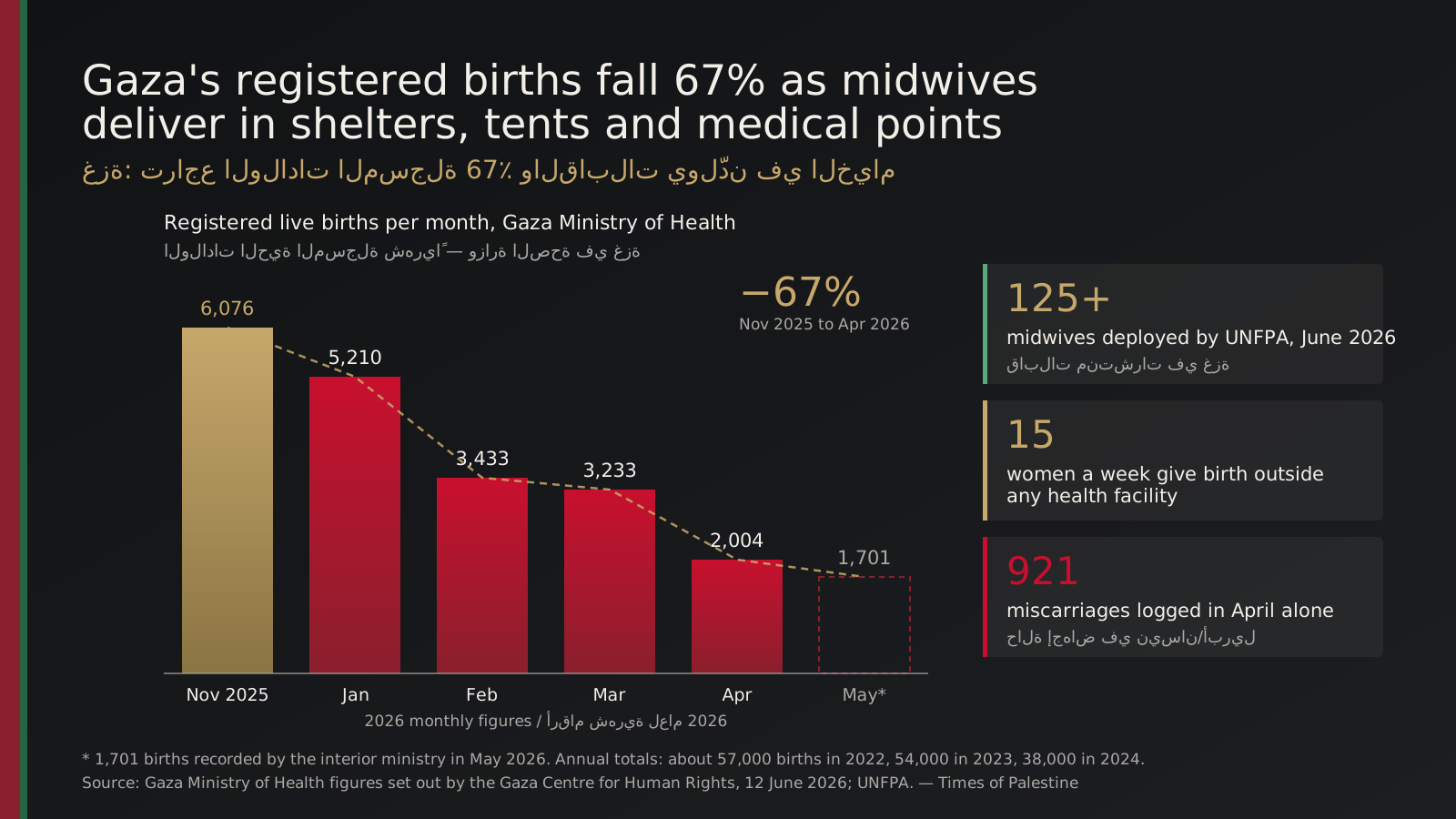
Graphic: Times of Palestine
Original Reporting
The Newsdesk gathers reporting from wire services and primary sources and rewrites every story in-house before publication. How our journalism is made →
Gaza's Ministry of Health registered 2,004 live births in April 2026, down from 6,076 in November 2025, a fall of 67 per cent, according to ministry figures set out by the Gaza Centre for Human Rights in a statement on 12 June and carried by the Palestinian Information Center, The New Arab and Common Dreams. The interior ministry recorded 1,701 births in May, the same reports said.
The monthly sequence published by the ministry runs downward through this year: 5,210 births in January, 3,433 in February, 3,233 in March, then April's 2,004. Annual totals cited in the same statement fell from about 57,000 births in 2022 to 54,000 in 2023 and 38,000 in 2024.
Those registration counts sit uneasily beside the estimates UN agencies are still using.
OCHA's situation report of 6 March 2026 put the number of pregnant women in Gaza at around 50,000 with roughly 160 to 180 births daily; its 19 March report gave a range of 130 to 160 daily births and said about 572,000 women and girls of reproductive age needed sexual and reproductive health services as of 16 March.
The Israeli-Palestinian outlet +972 Magazine reported last month that Gaza's birthrate fell 3.2 per cent in the first half of 2026 against the second half of 2025 — a far smaller drop than the ministry's monthly registrations show. Nothing in the published record explains the gap between the two sets of numbers.
What is not in dispute is who is catching the babies. UNFPA said in June 2026 it had more than 125 trained and equipped midwives deployed to health facilities and among communities in Gaza.
In December 2025 the agency's representative in Palestine, Nestor Owomuhangi, told UN News that 175 midwives were deployed and that UNFPA was supporting 22 health facilities, five of them hospitals, speaking outside Al-Shifa, which he described as largely in ruins yet still working.
UNFPA's situation report for October to December 2025 said that since the ceasefire it had renovated the maternity department at Alkhair hospital in Khan Younis, reopened primary health facilities, deployed midwives to health centres and communities and kept six containerised maternal health units running for emergency obstetric care, with an estimated 220,000 women and girls reached and more than 197,000 people accessing reproductive health services.
Outside those points, births happen where women are. UNFPA reported in December 2025 that at least 15 women a week were giving birth outside any health facility, some alone.
A midwife identified as Sahar told the agency in June 2026 about a friend who went into labour at seven months while trapped in Gaza City's Zeitoun neighbourhood: she used a knife heated over a fire to cut the umbilical cord and scented tissues as bandages.
The New Arab reported in November 2025 the case of Najla Salim, a 29-year-old midwife who delivered her own baby on a bathroom floor in an UNRWA school in north Gaza with a bottle of water and some cloths, holding the door for leverage.
A midwife the outlet named as Yasmine said that a month after the 10 October ceasefire, reaching a hospital remained difficult because transport was scarce and most roads were destroyed.
A qualitative study published in PLOS One on 20 May 2026 by Sahar Hassan, Suha Baloushah, Berit Mortensen and Muhammad Haroon Stanikzai interviewed nine midwives from northern, central and southern Gaza, aged 29 to 50, with between five and 26 years of experience.
All had been displaced repeatedly and were working in shelters, tents or temporary medical points. The authors describe them as torn between fear and professional compassion, and as unprotected while risking their lives.
The clinical picture behind those deliveries is documented. OCHA's 23 July report recorded nearly 4,000 miscarriage cases in Gaza in the first half of 2026, severe maternal morbidity at 82 cases per 1,000 deliveries, and 57.1 per cent of pregnant women anaemic, with 74 per cent of pregnancy losses in the first trimester.
It gave no figure for maternal deaths. Bassam Zaqout, director of Gaza Medical Relief, put pregnancy losses at 3,958 for the same period and called the rise unprecedented, Common Dreams reported in June.
The ministry logged 921 miscarriages in April alone, a rate of 460 per 1,000 live births; the Palestinian outlet Noon Post reported the pre-war rate at about 140 per 1,000. France 24's Observers desk reported on 11 August, citing ministry data relayed by OCHA, that losses tripled between the two halves of the year, one for every five live births.
Hunger runs through the figures. OCHA said partners screened 64,044 pregnant and breastfeeding women for acute malnutrition by mid-May and admitted 2,147 for treatment, and that 43,044 received nutrient supplements under a blanket feeding programme by early July.
A woman interviewed by Al Jazeera Arabic in June said folic acid, iron and vitamins were hard to obtain in the camps and painkillers required long queues, and that her daughter, born during the war, was malnourished.
The Gaza Centre for Human Rights argues the birth and miscarriage data amount to reproductive violence forming a distinct crime within the genocide; Physicians for Human Rights reached a comparable conclusion in a report published in January. No Israeli response appears in the reports that carried the centre's statement.
Whether fewer women are conceiving, whether births are going unregistered, or both, has not been established by any body that publishes on Gaza. Nor has UNFPA said publicly how many of its midwives are working now, after warning in August 2025 that the loss of US funding would cut planned deployments from 93 to 63.




%20(cropped).jpg?width=640)