Politics & Diplomacy
Washington threatens Iran's oil terminal and watches Britain's settlement ban

Image credit: Kharg Island, Iran, photographed from Space Shuttle mission STS-055, April 1993 — NASA, via Wikimedia Commons · License
Original Reporting
The Newsdesk gathers reporting from wire services and primary sources and rewrites every story in-house before publication. How our journalism is made →
Washington worked two files on Tuesday, and its own weight fell very differently on each.
On Iran, the president threatened in public to destroy the terminal that carries almost all of the country's oil exports. On Israeli settlement building, his administration was reported to be closely following a plan by an ally to act, without announcing anything of its own.
A threat aimed at an oil terminal#
President Donald Trump posted a short artificial-intelligence video to his Truth Social account over the weekend showing missiles striking Kharg Island, the small terminal in the northern Gulf through which Iran ships its crude. He wrote that the facility was "going to be blown to smithereens".
Vice-President JD Vance was asked about the post by reporters on Monday, before flying to Michigan, and did not walk it back.
"You guys are shooting at commercial shipping. You guys are behaving like a terrorist country. You've got to stop or there are going to be some consequences," Vance said, addressing Tehran, in remarks Al Jazeera reported.
The president "would be the first to say he doesn't make announcements about military actions on social media, but I think that he's sending a message to the Iranians," Vance added.
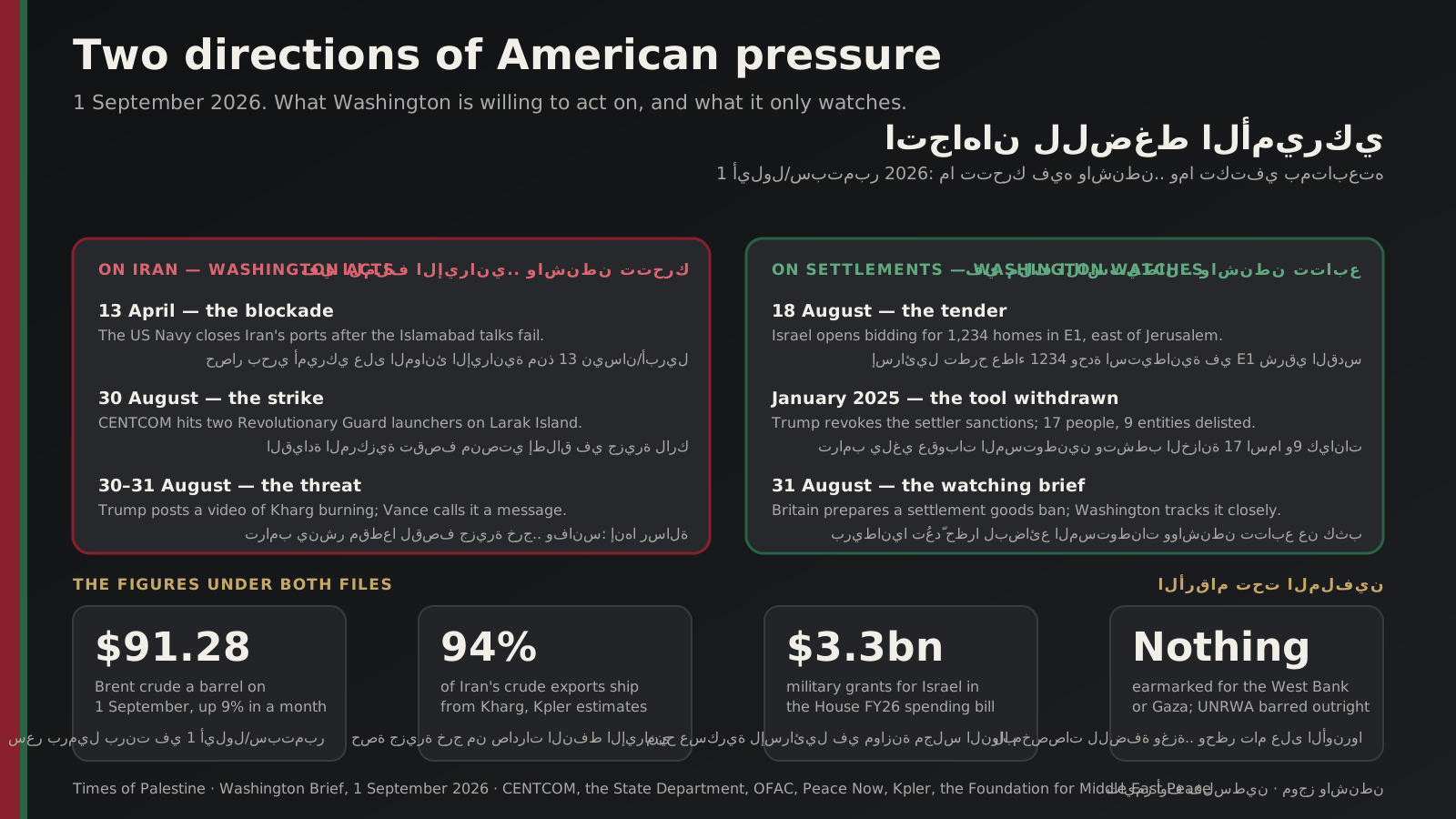
The shipping analytics firm Kpler estimates that about 94 percent of Iran's crude exports leave from Kharg, roughly 1.5 million barrels a day, most of it bound for China.
American forces have hit the island before. When Central Command struck Kharg in March, it said it destroyed 90 military targets there, including mine and missile storage, while preserving the oil infrastructure. The weekend post named the infrastructure itself.
An American official said on Monday that the military had not struck Kharg overnight, and there was no evidence that any attack on the island had taken place. An Iranian energy official dismissed the post as laughable.
The blockade is the older instrument#
The threat sits on top of a siege that has been running for four and a half months. The United States imposed a naval blockade on Iran's ports on 13 April, after talks in Islamabad failed to end the war, and Tehran has since named the blockade as the reason no negotiation moves.
Iran's parliament speaker, Mohammad Bagher Ghalibaf, answered the weekend's exchange in a video address. "If they intensify the blockade, we will definitely respond militarily," he said, adding that "if the enemy is determined to prevent us from exporting oil from the Persian Gulf, no one will be able to export oil."
"You've got to stop or there are going to be some consequences."
Vice-President JD Vance, asked on Monday about the president's video of Kharg Island burning
The waterway is already doing damage on its own. Iranian state television reported on Monday, citing the Revolutionary Guard, that a supertanker struck two naval mines in the southern lane of the Strait of Hormuz and caught fire. The Guard said the vessel had been passing illegally, and did not identify it or say what became of its crew.
Brent crude traded at $91.28 a barrel on Tuesday, about 9 percent higher than a month ago. Palestinian households and hospitals buy their diesel through the Israeli market, so that line moves before any policy does.
Britain prepares what Washington withdrew#
The second file has no threats in it at all.
Israel's housing ministry published a tender on 18 August and opened bidding immediately for more than 1,200 settlement homes in E1, the tract east of Jerusalem between the city and the Maale Adumim settlement. The Israeli monitoring group Peace Now counted 1,234 units; the wider plan covers about 3,400. Built out, E1 would separate the northern West Bank from the southern.
The State Department has not criticised the tender. It restated its position on the larger question on 21 August: "As the president has clearly stated, the US does not support Israel annexing the West Bank. A stable West Bank keeps Israel secure and is in line with this administration's goal to achieve peace in the region."
Thirty Democratic senators, led by Ruben Gallego, Alex Padilla and Adam Schiff, wrote to ask Israel to withdraw the E1 tenders and to ask the administration to consider targeted sanctions over settlement expansion and settler violence.
The instrument they are asking for existed until eighteen months ago. President Joe Biden created it by executive order on 1 February 2024, authorising asset freezes and travel bans on people driving settler violence and displacement in the West Bank.
Trump revoked the order on 20 January 2025. Four days later the Treasury's Office of Foreign Assets Control removed 17 Israeli individuals, nine Israeli entities, six farms and outposts and one Palestinian organisation from the sanctions list.
Britain is now moving into that space. The foreign secretary, Ed Miliband, said London would not "stand back and accept the destruction" of the two-state solution and would set out a comprehensive package of measures within weeks, including sanctions over E1.
The Telegraph reported on 26 August that the prime minister, Andy Burnham, is weighing a broad ban on trade in goods produced in Israeli settlements. Nearly 250 members of parliament have publicly backed such a ban, and a poll cited by Arab News found 50 percent of the British public in favour and 16 percent against, against annual British-Israeli trade of about £6 billion.
Chris Doyle, of the Council for Arab-British Understanding, called a ban "the bare minimum any self-respecting government should be doing", and said its weight would depend on whether it reaches financial services, insurance and online platforms rather than goods alone.
The Times reported on Monday that the Trump administration is following any British move toward a trade ban "closely". That is the whole of the reported American position: a watching brief on an ally's sanctions, at a moment when Washington has none of its own.
Israel's security chief spent the day at FBI headquarters#
The FBI director, Kash Patel, met David Zini, the director general of Israel's Shin Bet, at the bureau's Washington headquarters on Tuesday. Patel said the two discussed "counterterrorism efforts, breaking terrorist financing networks, intelligence sharing and building our technological capabilities like counter UAS training", the last a reference to defences against drones.
It was Zini's first publicised visit to the United States since he took over the agency in October 2025. The Israeli broadcaster Channel 13, which first reported the trip, described the agenda as sensitive matters, and neither government announced it in advance.
The Shin Bet's remit runs through the occupied West Bank, where it interrogates Palestinian detainees and recommends the administrative detention orders that hold them without charge. What the two services agree to share is not published, and Palestinians learn its shape only from the files it produces.
The money runs on a September calendar#
Federal funding expires on 30 September. The Senate appropriations chair, Susan Collins, and the committee's vice-chair, Patty Murray, announced a stopgap that would hold spending at current levels until 11 December, and the House was expected to vote on it as early as Tuesday.
Underneath the stopgap sits the bill the House passed on 14 January, the successor to what Congress used to call the state and foreign operations appropriation. Reading its text, the Foundation for Middle East Peace records $3.3 billion in military grants for Israel, to be disbursed within 30 days of enactment, with at least $250.3 million of it spent on procurement inside Israel.
The same bill earmarks nothing for the West Bank or Gaza. It bars all funding to UNRWA, the agency that runs schools and clinics for Palestine refugees. It prohibits direct assistance to the Palestinian Authority except under a waiver limited to six-month periods, and applies the Taylor Force Act's conditions to any West Bank or Gaza spending.
Two provisions carry no presidential waiver at all: aid stops if Palestinians obtain UN membership outside an agreement negotiated with Israel, or if they pursue an International Criminal Court investigation of Israeli nationals.
The calendar in New York#
The General Assembly's 81st session opens on 8 September, and the general debate runs from 22 to 28 September.
Washington has said it will deny visas to President Mahmoud Abbas and about 80 other Palestinian officials, for the second consecutive year. It is in American national security interests, the State Department said, "to hold the Palestine Liberation Organization and the Palestinian Authority accountable for not complying with their commitments, and for undermining the prospects for peace".
The UN spokesman, Stéphane Dujarric, said the organisation expects the United States to meet its obligations under the host-country treaty, which requires it to let foreign delegates reach UN business. Last year the Assembly voted 145 to 5 to let Abbas address it by video instead.
A reader in Ramallah or Deir al-Balah can measure a government by where it is prepared to spend its pressure. This week Washington spent it on an island in the Gulf, and on the tract of hillside that would cut the West Bank in two it spent none at all.