Politics & Diplomacy
CENTCOM struck Iran; Iran hit American bases in Jordan

Image credit: Sunrise over Muwaffaq Salti Air Base, Jordan — Eric Harris, U.S. Air Force / Air Forces Central, via Wikimedia Commons · License
Original Reporting
The Newsdesk gathers reporting from wire services and primary sources and rewrites every story in-house before publication. How our journalism is made →
A month of quiet in the American war on Iran ended on Sunday over a stretch of Gulf water. By dawn on Monday the reply had landed on Arab soil, in the desert east of Amman.
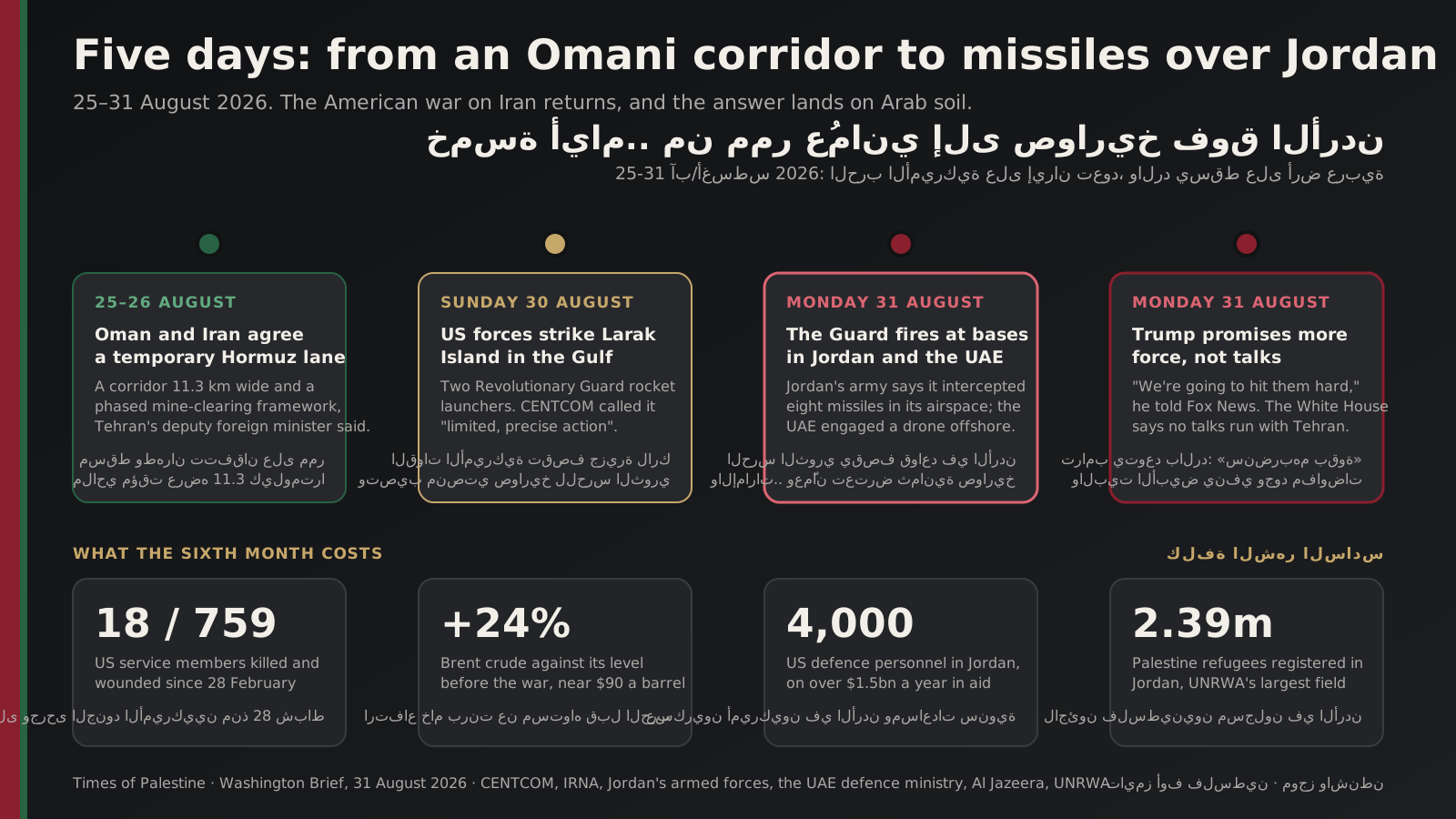
United States Central Command said its forces struck two Revolutionary Guard rocket launchers on Larak Island, a small Iranian island near the mouth of the Strait of Hormuz. It was the first American strike inside Iran in more than a month.
"U.S. forces took limited, precise action against IRGC minelaying forces posing an imminent threat in the Strait of Hormuz," the command said in a statement posted on Sunday.
Within hours the Islamic Revolutionary Guard Corps announced that it had fired ballistic missiles at King Hussein and Al Azraq air bases in Jordan, and at Al Minhad Air Base in the United Arab Emirates. Two Arab states hosting American forces became the address at which Washington's war is answered.
What each side says happened#
Jordan's armed forces said they intercepted eight missiles that entered the kingdom's airspace early on Monday and destroyed them before they threatened people or property. Residents near Aqaba reported hearing explosions.
The Emirati air force engaged a drone that came from Iran over the country's territorial waters, the defence ministry in Abu Dhabi said, calling the episode a dangerous escalation and a violation of sovereignty. The ministry denied that Al Minhad itself was struck.
Iran's official news agency IRNA reported that the strikes "inflicted heavy damage on the targets." Central Command called that claim absolutely false, and an American official said there were no impacts at United States bases.
The war entered its seventh month this weekend. Eighteen American service members have been killed and 759 wounded since it began on 28 February, and three American soldiers died in an Iranian strike on Muwaffaq Salti Air Base in Jordan on 17 July.
The claim that justified the strike is contested#
Central Command's case rests on a specific assertion: that the Guard was loading sea mines onto rockets to scatter them into the shipping lanes.
Harlan Ullman, a retired senior United States naval officer, told Al Jazeera the method is implausible, because a rocket-delivered mine hitting the water at speed would probably be wrecked on impact. He questioned why Iran would choose a novel technique when simpler ones exist.
Iranian state television showed the Guard using a Fajr-5 multiple rocket launcher in naval exercises in January 2025, which is the demonstration American officials point to. Iran has not confirmed that it deploys mines this way, and denounced Sunday's strike as an act of aggression.
Central Command had said last week that it finished clearing sea mines from the strait's international shipping routes and that its forces remain prepared to protect the free flow of commerce. Analysts have noted that clearing a waterway of that size is slow, systematic work.
Washington is not the address where the strait is being negotiated#
The diplomacy that could reopen Hormuz is running through Muscat, not through the State Department.
Oman's foreign minister, Badr Albusaidi, went to Tehran on 25 August for talks with his Iranian counterpart, Abbas Araghchi. Their joint statement described a phased framework for a temporary shipping corridor and for clearing mines, and said officials would keep working toward a permanent corridor and the future administration of the strait.
Iran's deputy foreign minister, Kazem Gharibabadi, said the following day that the two governments had agreed a temporary maritime route roughly eleven kilometres wide.
Five days later the American navy struck the island that sits beside it.
The White House said last week that no negotiations are running between Washington and Tehran. President Donald Trump told Fox News on Monday, after the missiles fell in Jordan, that "we're going to hit them hard" and that "there will be a response."
Iran's president, Masoud Pezeshkian, has said his government does not seek war but will not stand by in the face of aggression.
Why a missile over Jordan is a Palestinian story#
Jordan is not a bystander in Palestinian life. More than 2.39 million Palestine refugees are registered there, the largest of the five fields where the UN relief agency UNRWA works, and about 18 percent of them live in the kingdom's ten recognised camps.
It is also the land bridge. The Jordan Hashemite Charity Organisation, working with the Jordanian army, sent its 190th land relief convoy to Gaza on 15 August, forty-three trucks of food, and the UN logistics cluster has moved more than 1,850 trucks of aid through the kingdom since December 2023.
And it is one of the two governments Washington has assigned a role in the day after. Under the Board of Peace arrangements, Jordan and Egypt train the new Palestinian police force intended for Gaza — around 5,000 officers, trained in Egypt — while Indonesia, Morocco, Kazakhstan, Kosovo and Albania supply troops for the international stabilisation force.
The same kingdom now hosts roughly 4,000 American defence personnel, most visibly at Muwaffaq Salti Air Base near Azraq, about a hundred kilometres east of Amman, where American aircraft and THAAD anti-missile batteries are stationed. Washington provides Jordan more than $1.5 billion a year in aid.
More than 2.39 million Palestine refugees are registered in Jordan — UNRWA's largest field — in the country now being hit for hosting American forces.
Curtis Ryan, a professor of political science at Appalachian State University, set out the trap in an analysis for the Arab Center Washington DC in March: American forces and missile defences help protect Jordan, and their very presence makes Jordan a target.
Ryan also recorded what Palestinians in the kingdom fear underneath all of it — that proposals to move Gaza's population to Egypt and Jordan revive the watan badil, the "alternative homeland" idea, in which Palestinian return is settled by permanent resettlement somewhere else.
Domestic patience with the arrangement is thinning. Hundreds of Jordanians signed an open letter demanding the withdrawal of foreign forces from the kingdom, arguing that their presence brings security, political and economic risk and pulls Jordan into other people's wars.
The cost reaches the pump#
For households in Gaza and the West Bank, the strait is a price, not a map.
Brent crude stood near $89.53 a barrel in mid-August, about 24 percent above its level before the war began in late February, Al Jazeera reported from market data. The US Energy Information Administration expects Brent to average $87 a barrel across 2026 and does not expect Middle East production to approach pre-war levels until early 2027.
Gaza's hospitals, bakeries and water pumps run on generators and imported diesel. West Bank fuel is bought at prices set in the Israeli market, which imports its own crude.
What happens next to the Omani corridor is not known. Neither government has said whether Sunday's strike suspends the phased framework, and Washington has not stated a position on the corridor at all.
Congress has already registered its objection and been overruled. The House of Representatives voted on 3 June, 215 to 208, and the Senate on 24 June, 50 to 48, to direct the president to withdraw American forces from hostilities with Iran. A concurrent resolution never reaches the president's desk and carries no force of law.
Six months in, the war has produced a pattern Palestinians can read without a briefing. The talking that might end it happens in Muscat. The deciding happens in Washington. The missiles land in Amman, Abu Dhabi and Tehran, and the bill arrives at a generator in Gaza City.