Politics & Diplomacy
Four US commands formally dissented from Hegseth's Iran war

Image credit: Pete Hegseth — Chad J. McNeeley, U.S. Department of Defense, via Wikimedia Commons · License
Original Reporting
The Newsdesk gathers reporting from wire services and primary sources and rewrites every story in-house before publication. How our journalism is made →
Four American military commands have put their objection to the Iran war on the record in writing, in the single document the War Secretary cannot file away as opinion.
European Command, Pacific Command, Southern Command and the navy returned the Pentagon's own force assessment marked non-concur — the military's formal term for registering disagreement while undertaking to carry out the order anyway. The army and the air force concurred while attaching warnings about risk.
The Washington Post reported the assessment on Sunday. The heads of the army, navy and air force, together with the four-star commanders for Europe, the Pacific and Latin America, told War Secretary Pete Hegseth that large-scale operations against Iran cannot be sustained without weakening the country's ability to meet threats elsewhere.
The warnings sit in the 14 August edition of the Secretary of Defense Orders Book, a document produced twice a month that records where every American warship, aircraft, unit and weapon in the world is committed. The officers' collective judgement, as the paper reported it, was that the campaign has been "too much for too long."
What the ledger says#
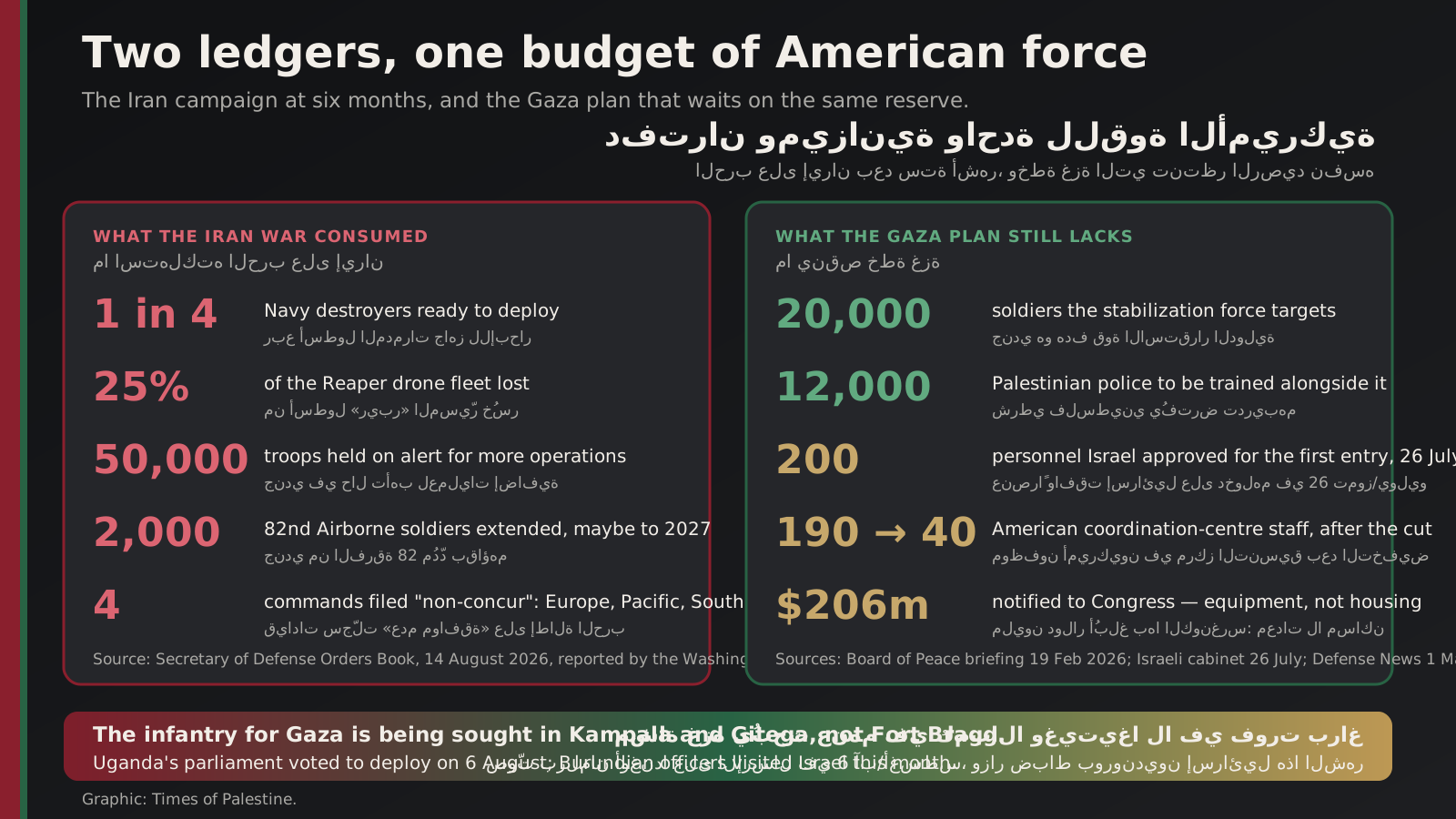
Admiral Daryl Caudle, the chief of naval operations, told Hegseth that barely a quarter of the navy's destroyer fleet is ready to deploy, a steep fall from the figure before the war.
About a quarter of the Pentagon's Reaper drone fleet has been lost. Stocks of Patriot and THAAD interceptors and of long-range Tomahawk missiles are drawn down, and American bases across the Middle East have taken billions of dollars in damage.
More than 50,000 troops are being held on alert for further operations. Two thousand soldiers of the 82nd Airborne Division, ordered to stay through September, may be kept in place into 2027.
Sean Parnell, Hegseth's spokesman, did not dispute the assessment. Decisions on the scope and duration of force commitments, he said, are made "based on the current threat assessment, strategic priorities established by the President, and the advice of the Chairman of the Joint Chiefs of Staff and Combatant Commanders." The department declined to discuss internal processes or classified documents.
"Too much for too long."
The judgement of the American service chiefs on the Iran campaign, recorded in the 14 August Orders Book
Congress made this argument and lost#
The elected branch got there first. The House of Representatives passed House Concurrent Resolution 86 on 3 June by 215 votes to 208, directing the president to withdraw American forces from hostilities with Iran. The Senate passed it on 24 June by 50 to 48, with the Republicans Bill Cassidy, Susan Collins, Lisa Murkowski and Rand Paul crossing over and the Democrat John Fetterman voting against.
A concurrent resolution is never sent to the president for signature and carries no force of law. The war went on.
What has changed since is the address the objection is filed at. General Dan Caine, the chairman of the Joint Chiefs of Staff, told Secretary of State Marco Rubio, Vice-President JD Vance and the CIA director John Ratcliffe that Washington needs an exit from the war, the Asharq al-Awsat newspaper reported on 8 August.
At a congressional hearing at the end of July, Caine had put the same point publicly and briefly: airpower has limits.
Gaza sits on the same ledger#
For a reader in Deir al-Balah these readiness tables are not somebody else's story. Everything Washington has promised Gaza — the force meant to stand between the Israeli army and Palestinian neighbourhoods, the police training, the sequence that is supposed to end in reconstruction — is drawn from the same reserve of American troops, money and attention that the Iran war is consuming.
Nickolay Mladenov, the Board of Peace's high representative for Gaza, told the UN Security Council on Wednesday 26 August that a return to full fighting would be "a point of no return for everyone." There would be, he said, "no roadmap to return to, there will be no administration to deploy and there will be nothing left on the ground to rebuild."
Gaza, he added, "does not have another catastrophe left in it."
That warning came nine days after Jared Kushner left the region without an agreement. He had met the Hamas leader Khalil al-Hayya in Egypt, then Netanyahu in Jerusalem, and the talks ended on 17 August on the question that has blocked everything since the spring: whether Hamas disarms before the Israeli army withdraws, or afterwards.
Twenty thousand soldiers, two hundred approved#
Major General Jasper Jeffers, the American officer commanding the International Stabilization Force, told the Board of Peace's first meeting in Washington on 19 February that the force is built for 20,000 soldiers alongside 12,000 Palestinian police, entering sector by sector and beginning with Rafah.
Indonesia took the deputy command. Morocco, Kazakhstan, Kosovo, Albania and Uganda pledged troops; Egypt and Jordan offered to train police rather than deploy their own.
Israel's security cabinet approved the force's entry on 26 July — an initial 200 personnel, into areas its army does not hold, in full coordination with that army, and with Israel keeping the right to approve which countries take part. The territory its forces control is roughly 70 percent of the Strip.
Uganda's parliament voted on 6 August to send soldiers, and the Associated Press reported Burundian officers visiting Israel this month to discuss the same.
American soldiers are not going in. Defense News reported on 1 May that the administration was folding its Civil-Military Coordination Center into the force and cutting the American staff there from about 190 to 40, with civilians from other countries taking their places.
The reason the infantry for Gaza is being recruited in Kampala and Gitega rather than Fort Bragg is written in the Orders Book.
The money runs on a calendar#
The argument now moves to appropriations. The federal fiscal year ends on 30 September, and Congress returns from its August recess with the House and Senate holding two different stopgap bills — one funding the government at current levels into the first week of December, the other a week longer — that must be reconciled before 1 October.
The House approved a $1.07 trillion defence appropriation on 24 June, close to the Pentagon's own request. The costs of a war that was not in the budget when it was written are what the service chiefs are now itemising.
The State Department notified Congress at the end of July that it would provide more than $206 million for the stabilization force, $200 million of it for equipment and infrastructure, the Haaretz newspaper reported on 20 August. That is the first American money committed under the Gaza plan, and it buys a force rather than housing.
On Sunday, as the assessment was being read in Washington, an Israeli airstrike near a bakery in Deir al-Balah killed a man, Hussam Nusair, and a three-year-old boy, Tayyem Hamdan, and wounded others, Gaza medics said. The Israeli military said it had struck a Hamas commander who was planning attacks.
The ceasefire agreed last October never stopped those strikes, and the plan that was supposed to replace them has no soldiers on the ground. Nothing in the 14 August Orders Book mentions Deir al-Balah. Everything in it decides how long Deir al-Balah waits.