The Diaspora
Honduras quit the Hague Group under a president of Palestinian descent
Graphic: Times of Palestine
Original Reporting
The Newsdesk gathers reporting from wire services and primary sources and rewrites every story in-house before publication. How our journalism is made →
On 4 March this year the foreign ministry in Tegucigalpa announced that Honduras was leaving the Hague Group, the bloc of states formed in early 2025 to coordinate legal and economic measures enforcing international court rulings on Palestine. Bolivia announced its withdrawal the same day.
The president who now governs Honduras is the son of Christian Palestinians from Bethlehem.
Two palaces, one ancestry#
Nasry Asfura — Tito, to Hondurans — was sworn in on 27 January 2026 after an election won with President Donald Trump's public backing. He is a construction magnate and a former mayor of Tegucigalpa. Days before taking office he travelled to Israel, where he visited the Western Wall and Yad Vashem. He does not present himself as Palestinian.
In neighbouring El Salvador, Nayib Bukele's paternal grandfather was born in Jerusalem and his grandmother in Bethlehem. His father, Armando Bukele Kattán, was born in El Salvador, converted to Islam as an adult and became a well-known imam. The son has governed as one of Israel's warmest partners in the hemisphere.
Both men descend from the same migration: Christian families who left the Bethlehem district and Jerusalem in the last Ottoman decades, arrived as itinerant merchants, and rose into the commercial and then political elites of their new countries.
The numbers, honestly stated#
Estimates of these communities vary widely and should be read as estimates. Honduras is usually described as holding the second-largest Palestinian-descended population outside the Middle East, with figures ranging from tens of thousands to more than two hundred thousand depending on how descent is counted.
El Salvador's community is put at sixty to a hundred thousand in a country of more than six million. Chile's, the largest outside the Arab world, is commonly estimated at around half a million.
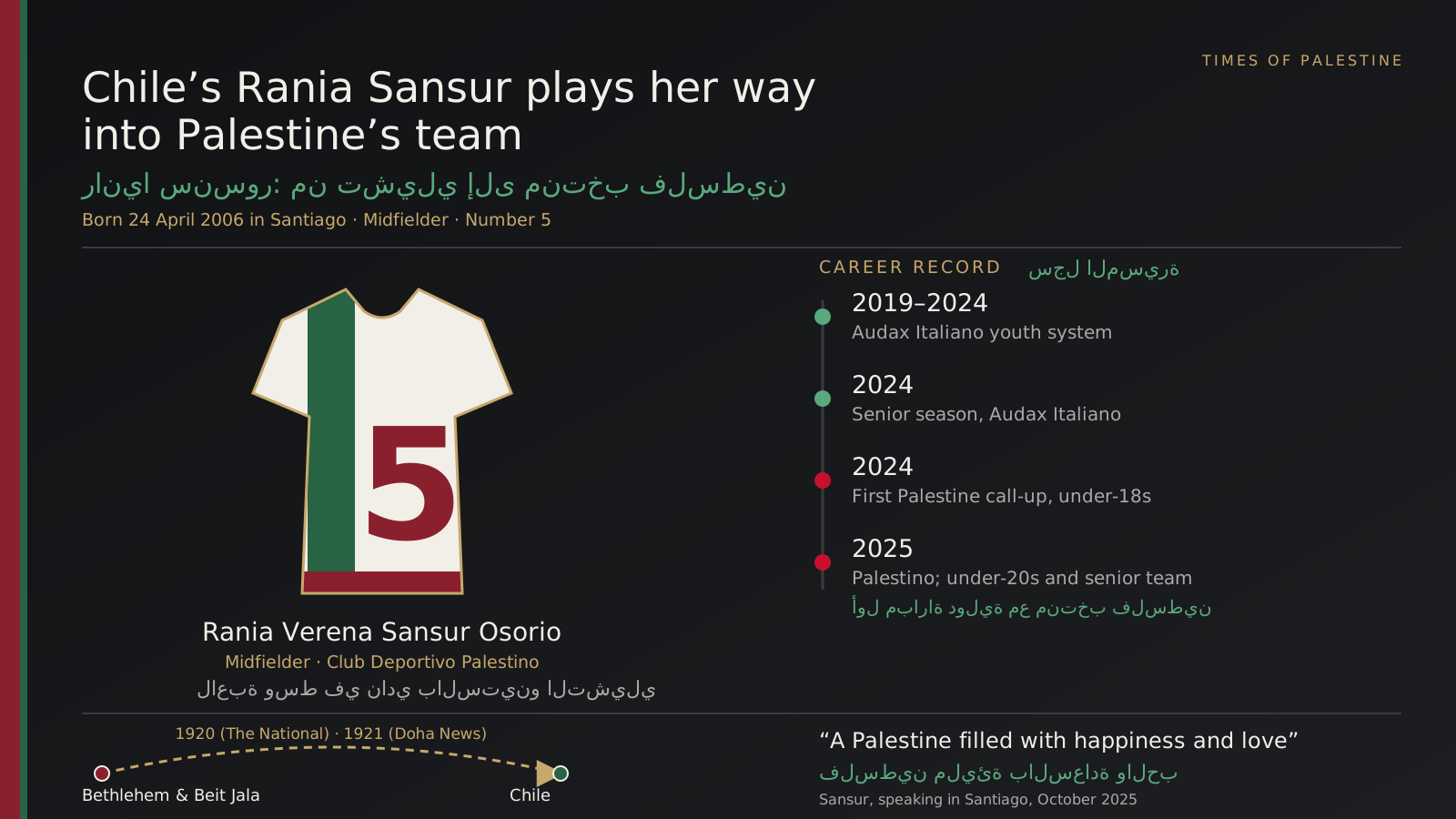
Chile is also where the political direction runs the other way, and where the community's most visible institution flies the flag every week.
What descent does and does not decide#
The honest conclusion is the uncomfortable one. Palestinian ancestry in Latin America has produced no single politics, and there is no reason it should have.
These families emigrated more than a century ago, before the Nakba and before the occupation, and their descendants' political alignments have followed the class and the country they joined rather than the villages they left.
A Honduran construction magnate and a Salvadoran president who built a security state are the products of Honduran and Salvadoran politics. Reading them as Palestinians who chose wrongly misunderstands what a hundred and twenty years of distance does.
What can fairly be recorded is the consequence, which is measurable. The Hague Group's purpose is to convert court rulings into state practice — arms transfers, port access, procurement. It works by the number of governments willing to act together. Two of its members left it on the same day in March, and the departures prompted questions in the Arab press through August about whether the bloc is holding.
That is a loss for Palestinians whether or not it was meant as one, and it happened under a president whose grandparents came from Bethlehem.