Research & Investigations
Britain leaves Palestinian Balfour petition unanswered as September deadline nears
Running file Britain Owes Palestine →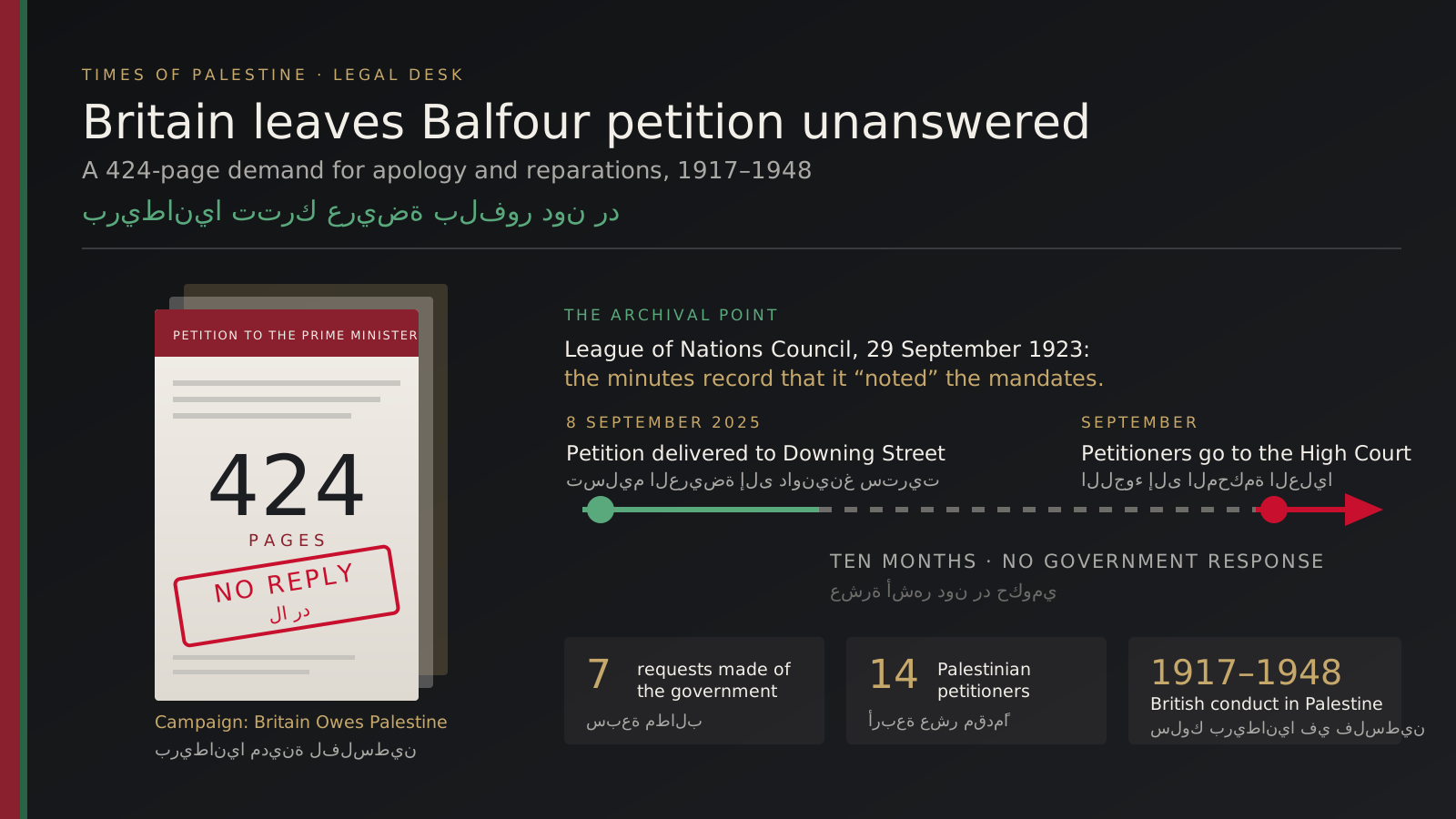
Graphic: Times of Palestine
Original Reporting
The Newsdesk gathers reporting from wire services and primary sources and rewrites every story in-house before publication. How our journalism is made →
The British government has not publicly answered a 400-page legal petition demanding acknowledgement, apology and reparations for its conduct in Palestine between 1917 and 1948, and the petitioners have set September — next month — as the point at which they go to the High Court.
The petition was delivered to Downing Street on 8 September 2025, launching the campaign Britain Owes Palestine.
Middle East Eye reported at the time that it was drafted by two King's Counsel; The National named them as Ben Emmerson KC and Danny Friedman KC, and reported that the document argues Britain "unlawfully failed" to recognise Arab self-determination and "lacked proper legal authority" for the Balfour Declaration and the Mandate for Palestine.
The Britain Palestine Project, which supports the campaign, says fourteen Palestinians are petitioners and that the document makes seven requests of the government. A December 2025 analysis published on the international law blog EJIL:Talk! put its length at 424 pages and described it as a pre-litigation demand for reparation.
“the position on the mandates rather than investing Britain with a mandate for Palestine. The American international lawyer John Quigley, who joined the petition's delivery, argued in a 2023 article in Cogent Arts & Humanities that the League”
In an opinion article published by Middle East Eye in late July, one of the petition's co-authors wrote that ten months after it was submitted, Downing Street had said nothing. No government response to the petition appears in the public record.
The legal theory turns on a narrow archival point. As the EJIL:Talk! analysis summarised the petition, the minutes of the League of Nations Council for 29 September 1923 record that the Council "noted" the position on the mandates rather than investing Britain with a mandate for Palestine.
The American international lawyer John Quigley, who joined the petition's delivery, argued in a 2023 article in Cogent Arts & Humanities that the League "had no power under the League Covenant to attribute legal significance to the Mandate for Palestine, or to give Britain a right to govern", and that Britain never gained sovereignty.
Quigley told Middle East Eye the petition was the first time Britain had been called to account for being in Palestine unlawfully.
The case that Britain breached obligations it did hold has been made outside the petition too. Shawan Jabarin, director of the Palestinian rights group Al-Haq, and the international lawyer Ralph Wilde argued in a 2023 piece for Mondoweiss that the Balfour Declaration violated Britain's legal obligations under the Covenant of the League of Nations, and that this establishes a basis for a Palestinian reparations claim.
The counter-arguments are not only political.
In his 2009 book From Coexistence to Conquest, the legal scholar Victor Kattan — also present at the petition's delivery — accepted, as the European Journal of International Law's reviewer set out, that Arabs in Palestine in 1917 could not independently invoke a right of self-determination, because self-determination was then "at best, a political principle"; his argument rests instead on Article 22 of the Covenant and the "sacred trust" owed to communities detached from the Ottoman Empire.
The EJIL:Talk! analysis counted three distinct scholarly positions on whether reparation is now owed, and weighed the work of James Crawford and Malcolm Shaw alongside the petition's case.
What a British court can do with any of this is a separate question from whether the history is established. The two closest precedents point in opposite directions, and neither was a judicial review.
The Mau Mau claims were ordinary tort claims, brought in the High Court in 2009 by five Kenyans detained during the emergency, according to the Hansard record of the settlement statement.
On 6 June 2013 the then foreign secretary William Hague told the Commons the government would pay a settlement and costs totalling £19.9 million covering 5,228 claimants, and would support a memorial in Nairobi.
Hague expressed "sincere regret"; the Kenya Human Rights Commission and the claimants' solicitors Leigh Day, whose account is recorded by the Society for Cultural Anthropology, describe the outcome as including a statement of apology delivered in Parliament, and put the payment at about £2,600 a claimant.
A retrospective on Lexology noted the decisive factor: colonial records kept so meticulously, and rediscovered at Hanslope Park, that a fair trial of decades-old events was possible.
The Chagos litigation shows the other outcome. The Court of Appeal's 2020 judgment in Hoareau and Bancoult records that the islanders' 2002 damages action was dismissed by Ouseley J in October 2003 as statute-barred under the Limitation Act 1980 and an abuse of process.
The 2003 judgment found the removals had been carried out with lawful authority and that no tort of unlawful exile exists. In 2012 the European Court of Human Rights declared a Chagossian application inadmissible on the ground that those who had accepted compensation had renounced the claim.
Judicial review is also filtered before it is heard. In the Palestine Action case, the Administrative Court's February 2026 judgment records that permission was granted on four of eight pleaded grounds; the Court of Appeal then held, in June, that the High Court had exceeded the proper limits of judicial review by substituting its own assessment in an area of national security.
The archive question sits underneath all of it. After a legal battle, the Foreign Office admitted in 2011 that it held 1,500 Kenya files at Hanslope Park, and eventually conceded some 20,000 files covering 37 former territories, as Vice reported.
Scholarship in the Journal of Imperial and Commonwealth History has argued that the disclosures raise unanswered questions about British counterinsurgency in Palestine, Cyprus, Aden and Malaya. A study published in the same journal last year found 88,000 Hong Kong colonial files still at Hanslope Park, some under a 50-year retention.
How many Palestine-era files the department still holds, and under what exemptions, is not stated in any public figure retrieved for this report.
Earlier attempts went nowhere in Britain. The Palestinian Authority's foreign minister Riad Malki announced at the 2016 Arab League summit that Palestine would sue over the Declaration; legal analysts told Gulf News the effort had little chance. In February 2021 the Court of First Instance in Nablus held the Declaration invalid for breaching peremptory norms and demanded a British apology, a ruling with no purchase in English law.
Forty-five MPs and peers signed a letter in March calling for an apology, among them Layla Moran, Nadia Whittome and Carla Denyer, according to Ma'an. That letter did not ask for reparations. Whether the government answers before the deadline, and whether any refusal is one a court will agree to examine, will be decided in the weeks ahead.