Money & Access
Israel's cash cap leaves Gazans paying brokers up to 55%
Graphic: Times of Palestine
Original Reporting
The Newsdesk gathers reporting from wire services and primary sources and rewrites every story in-house before publication. How our journalism is made →
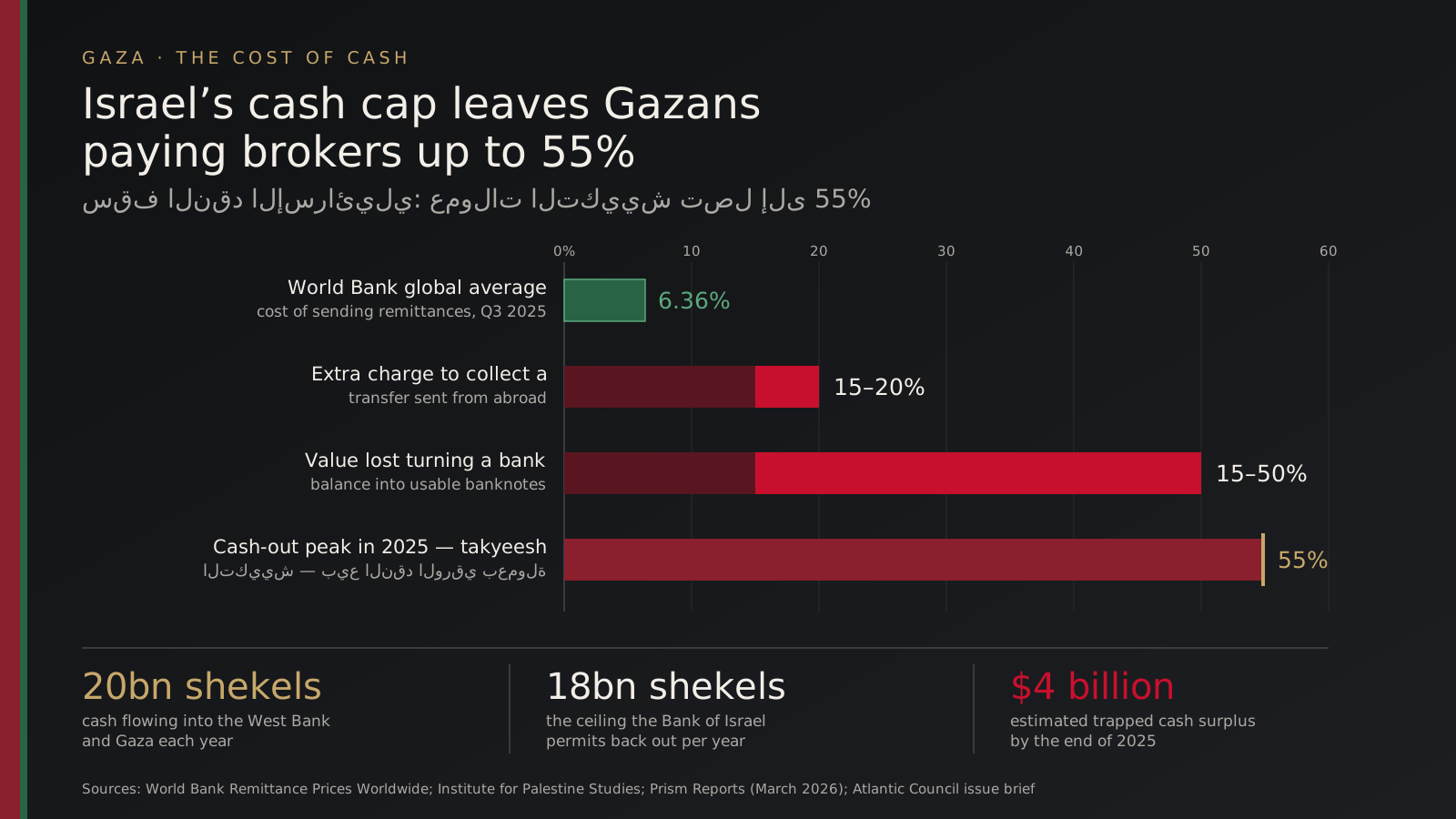
Money sent to a family in Gaza arrives in a bank account and then loses between 15 and 50 percent of its value before it becomes usable cash, according to the Institute for Palestine Studies, which reports that account holders must pay a broker to receive the transfer and hand over banknotes in return.
The institute says the condition of the notes sets the price: worn or damaged bills carry lower commissions than clean ones, and people receiving transfers from abroad pay an additional 15 to 20 percent simply to collect them.
Prism Reports, in a piece published in March 2026, put the peak higher, saying local and international reports had commissions for cash-out services — known in Gaza as takyeesh — reaching up to 55 percent during 2025, citing Sada News and Al-Araby Al-Jadeed.
The World Bank's Remittance Prices Worldwide database, by comparison, records a global average cost of 6.36 percent for sending remittances in the third quarter of 2025. The database tracks 367 corridors from 48 sending countries; the single corridor it publishes into the Palestinian territories runs from Jordan, priced on transfers of 200 and 500 dollars.
The gap between six percent and fifty is a cash shortage, and its mechanics are documented.
An Atlantic Council issue brief published this month estimates that roughly 20 billion shekels in cash flow into the West Bank and Gaza each year — wages of Palestinians working in Israel, trade with settlements, and rising demand for cash as financial risk grows — while the Bank of Israel permits Palestinian banks to move only up to 18 billion shekels a year back through correspondent channels in exchange for deposits.
Israeli authorities cite compliance and anti-money-laundering concerns, the brief says. By the end of 2025, it estimates, the trapped surplus was worth about $4 billion.
The Palestine Monetary Authority said in June 2025, through the official WAFA agency, that Israel's continued refusal to allow surplus shekels to move to Israeli banks had pushed it to study alternatives, including shifting away from the shekel as the main circulating currency.
Anadolu Agency reported later that month that before October 2023 the authority had coordinated quarterly transfers of excess cash to Israeli banks of about 4 billion shekels, some $1.16 billion, and that its governor, Yahya Shannar, was asking foreign diplomats to intervene.
Some of that logjam has since moved. Arab News reported in early August 2026 that Israeli authorities approved the early transfer to the Bank of Israel of 4.5 billion shekels, about $1.47 billion, after internationally mediated talks, and that Shannar said shipments planned for the fourth quarter of 2026 had been brought forward and would start that week.
The channel carrying those shekels is itself running out of time. The Times of Israel reported on 23 July that Finance Minister Bezalel Smotrich signed a waiver indemnifying Israeli banks for transactions with Palestinian banks until the end of 2026, after US officials raised correspondent banking with Israel.
JNS reported this month that Israel Discount Bank had already notified its Palestinian counterparts in July that it would stop correspondent services from 1 September, with Bank Hapoalim following on 1 October, and that Discount told Israeli media it had provided the services "on a temporary basis" while waiting for a permanent state arrangement that never came.
Inside Gaza, the retail price of cash sits far above its wholesale price. An investigation by Daraj in February 2025 found exchangers and brokers buying banknotes from merchants at about 2 percent — two shekels on every hundred — then selling liquidity on at multiples of that.
Truthout reported in April 2026 that commissions on transfers routed through PayPal account holders do not fall below 15 percent.
A Gaza resident told Palestine Nexus in August 2025 that 14 percent of every $100 he moved through a PayPal broker went to the account's owner, and that withdrawing the remaining $86 in cash cost a further 40 percent.
The Jordanian outlet 7iber reported in September 2025 that Gazans also pay separate commissions for small denominations and for undamaged notes.
Official statistics do not capture any of this.
The quarterly balance-of-payments releases issued jointly by the Palestinian Central Bureau of Statistics and the Monetary Authority record net current transfers from abroad — $262 million in the third quarter of 2025, down 38 percent on the quarter before — and compensation of Palestinian workers in Israel, which reached $196 million in the first quarter of 2026 as the current account deficit widened to $440 million.
The releases report the totals, not what households surrender to collect them.
The Monetary Authority's answer has been to move money without moving banknotes. It launched an instant transfer system between banks and digital wallets in 2024, crediting a beneficiary and notifying the payer within ten seconds, and 7iber reported that it applies no transfer fee to sender or receiver and works on basic handsets.
The authority announced a QR payment service from 14 June 2026. None of it solves the last step: the Institute for Palestine Studies notes that turning a wallet balance into banknotes still means finding a broker.
Cryptocurrency filled part of the space.
+972 Magazine reported in December 2025 that stablecoins were largely unknown in Gaza before the war and spread because they sit outside Israeli regulatory control, describing one man who received 500 USDT from his sister within minutes but struggled to find a connection stable enough to receive the withdrawal code.
Gizmodo, summarising Financial Times reporting in June 2026, said officials on the Board of Peace overseeing postwar Gaza had discussed adopting a dollar stablecoin as a payment tool rather than a new currency, with Tether and World Liberty Financial's USD1 among candidates, and no final decision taken.
Gizmodo noted that Cantor Fitzgerald, run by the sons of Commerce Secretary Howard Lutnick, holds a 5 percent stake in Tether, and that World Liberty Financial is tied to the Trump family.
Who would license, supervise or guarantee such transfers has not been settled publicly, and the reported timetable depends on a network upgrade Gaza does not yet have. The nearer deadline is 1 September, when Discount's notice takes effect.






%20(cropped).jpg?width=640)