Israeli Press
Israel budgets Area C land registration as parties debate sovereignty
Graphic: Times of Palestine
Original Reporting
The Newsdesk gathers reporting from wire services and primary sources and rewrites every story in-house before publication. How our journalism is made →
The argument now running through the Israeli press and party platforms before the 27 October election is largely about pace and packaging, not direction. The decisions that matter most for Palestinians in the occupied West Bank were taken in February, before the Knesset dissolved.
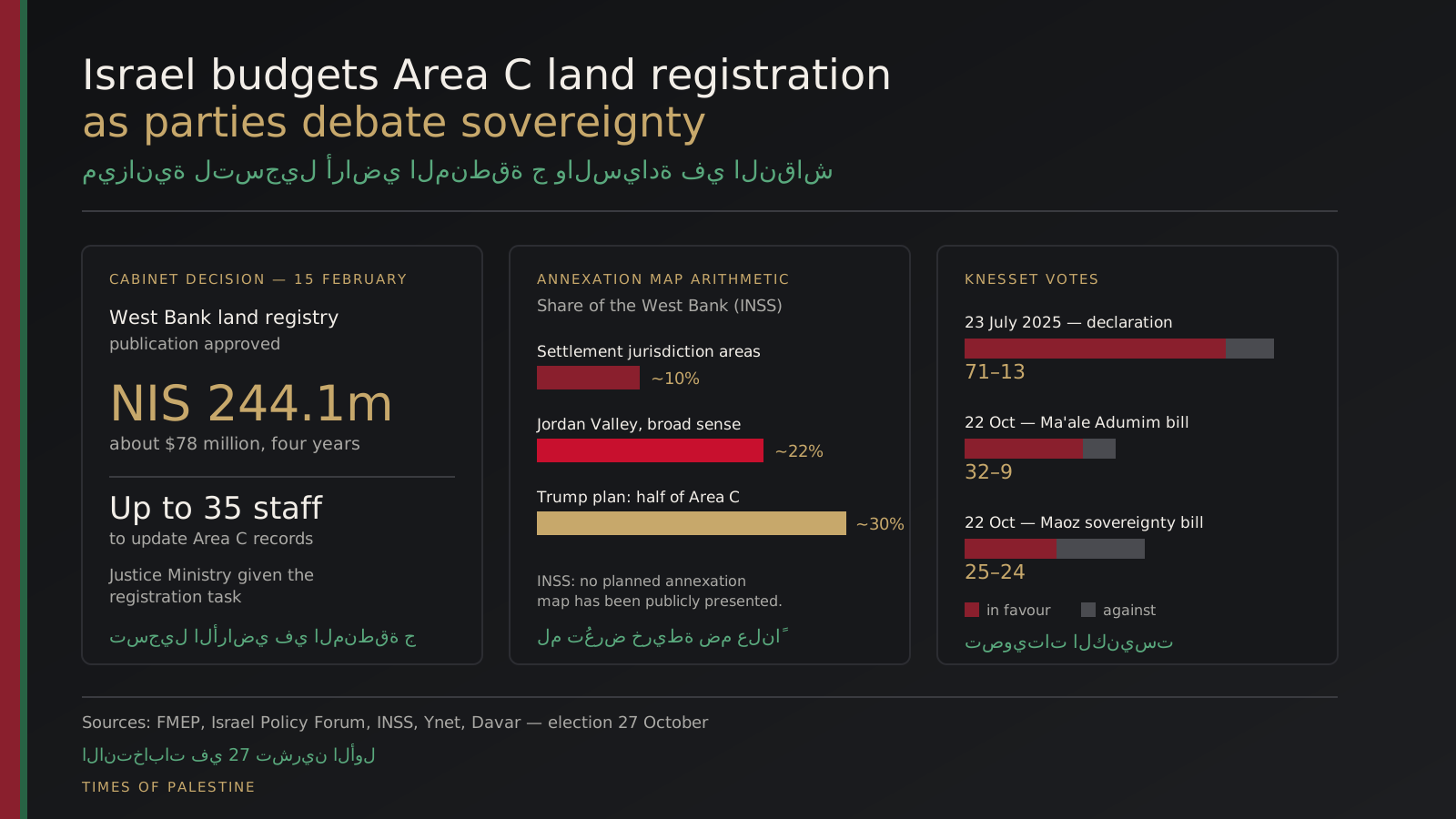
On 15 February the full cabinet approved publication of the West Bank land registry and allocated a four-year budget of NIS 244.1 million, about $78 million, for a mechanism of up to 35 staff to update records in Area C, according to the Foundation for Middle East Peace, which tracks settlement and annexation measures. The Justice Ministry was given the registration task.
The Israel Policy Forum reported that the security cabinet had approved the package a week earlier, on 8 February, describing measures that expand Israeli authority in the territory and ease Israeli acquisition of property there.
The World Socialist Web Site, reporting the same decisions, listed the repeal of restrictions on land sales to settlers, the revival of a state land-purchase mechanism, extended Israeli enforcement into Areas A and B, and a transfer of authority over Hebron settlements to the Civil Administration.
The Arab Center in Washington, in an analysis published in May, called the registration plan a political mechanism through which Israel asserts sovereignty over Area C rather than a technical reform, and said the February decisions facilitate de facto annexation.
What that means on the ground is already documented. The Middle East Institute, in a June backgrounder, said the powers held by Finance Minister Bezalel Smotrich over land surveying, registration, allocation and construction legality have produced strict enforcement of demolition orders against Palestinian building, for which Palestinians generally cannot obtain permits, while Israeli outposts are often spared or retroactively legalised.
The legal shift a formal annexation would bring was set out by the business daily Globes: the sovereign in Area C today is the military commander, not the government and Knesset, and applying Israeli law would replace military administration with civil authorities under a regime that makes expropriation easier — a change Globes said would fall lightly on settlers and heavily on Palestinians left with residency status.
Within the pro-sovereignty camp, the published argument has shifted from declaration to accretion. Israel Hayom reported in May that large parts of the Israeli right and the settlement movement no longer expect a single formal cabinet decision, having concluded that the political and international reality does not allow one soon, and have moved instead to building sovereignty step by step through facts on the ground.
A Ynet analysis last month made the same reading from the other side of the ledger: Smotrich did not deliver sovereignty despite declaring a "year of sovereignty" after Donald Trump's election, but succeeded on a series of files that until recently looked like wishful thinking in the settlements.
The Washington Institute reported Smotrich tying that programme directly to the ballot, saying that if his party enters the next government its goal would be to "complete this revolution" — cancelling the Oslo Accords and moving onto the path of sovereignty, while encouraging what he called voluntary emigration.
The countervailing case in Hebrew has come mainly from the security research world rather than the opinion pages.
In a paper published on 19 April by the Institute for National Security Studies, a Tel Aviv centre closely tied to Israel's defence establishment, Udi Dekel and Tami Kaner wrote that the government is applying de facto sovereignty in the West Bank through several lines of action that change the structure of control, justifying it on security grounds to secure domestic legitimacy while blocking any future political settlement, weakening the Palestinian Authority to the point of collapse and pushing Palestinians out of where they live.
An earlier INSS conference summary set out the arithmetic that any annexation map would involve: roughly 10 percent of the West Bank for settlement jurisdiction areas, about 22 percent for the Jordan Valley in its broad sense, and some 30 percent under the Trump plan's version of half of Area C. INSS noted that no planned annexation map has been publicly presented.
The party map is legible from the Knesset record.
On 23 July 2025 the plenum passed a non-binding declaration calling on the government to apply sovereignty in the West Bank and the Jordan Valley by 71 to 13, Ynet reported, with all coalition factions plus United Torah Judaism, Noam, Yisrael Beiteinu and one Yesh Atid member in favour; National Unity and Yesh Atid boycotted the vote, and members of the Democrats, Ra'am and Hadash-Ta'al voted against.
Speaker Amir Ohana called it historic.
On 22 October 2025, during Vice-President JD Vance's visit and against the government's stated position, the Knesset gave preliminary approval to two bills, the Davar news site reported: one applying sovereignty to Ma'ale Adumim, sponsored by MKs including Yisrael Beiteinu leader Avigdor Liberman, passed 32 to 9; a broader sovereignty bill from Noam MK Avi Maoz passed by 25 to 24.
Kan reported that Liberman said afterwards the bill passed despite Netanyahu's instructions not to vote for it.
Mako's election compass lists Otzma Yehudit under Itamar Ben Gvir as campaigning on sovereignty in the West Bank and Gaza.
Campaign rules are already biting. Haaretz reported on 19 August that the Heritage Ministry funded advertising on Channel 14 for archaeological sites in the West Bank that carried photographs and quotations of Minister Amichai Eliyahu; the ministry removed the items after Haaretz approached it. Election law bars the use of ministry assets for propaganda in the 90 days before the vote, a period that began on 29 July.
Separately, the archaeology organisation Emek Shaveh reported that a bill extending Israeli civilian jurisdiction over antiquities and heritage sites in the West Bank was moving toward a first plenum vote after committee discussions chaired by MK Zvi Sukkot.
Whether the registry is published, and on what terms Palestinian claimants can contest entries in Area C, has not been made public. Nor has any government produced the map.