Transparency & Accountability
Palestine's anti-corruption commission examined four of 2,542 asset declarations
Graphic: Times of Palestine
Original Reporting
The Newsdesk gathers reporting from wire services and primary sources and rewrites every story in-house before publication. How our journalism is made →
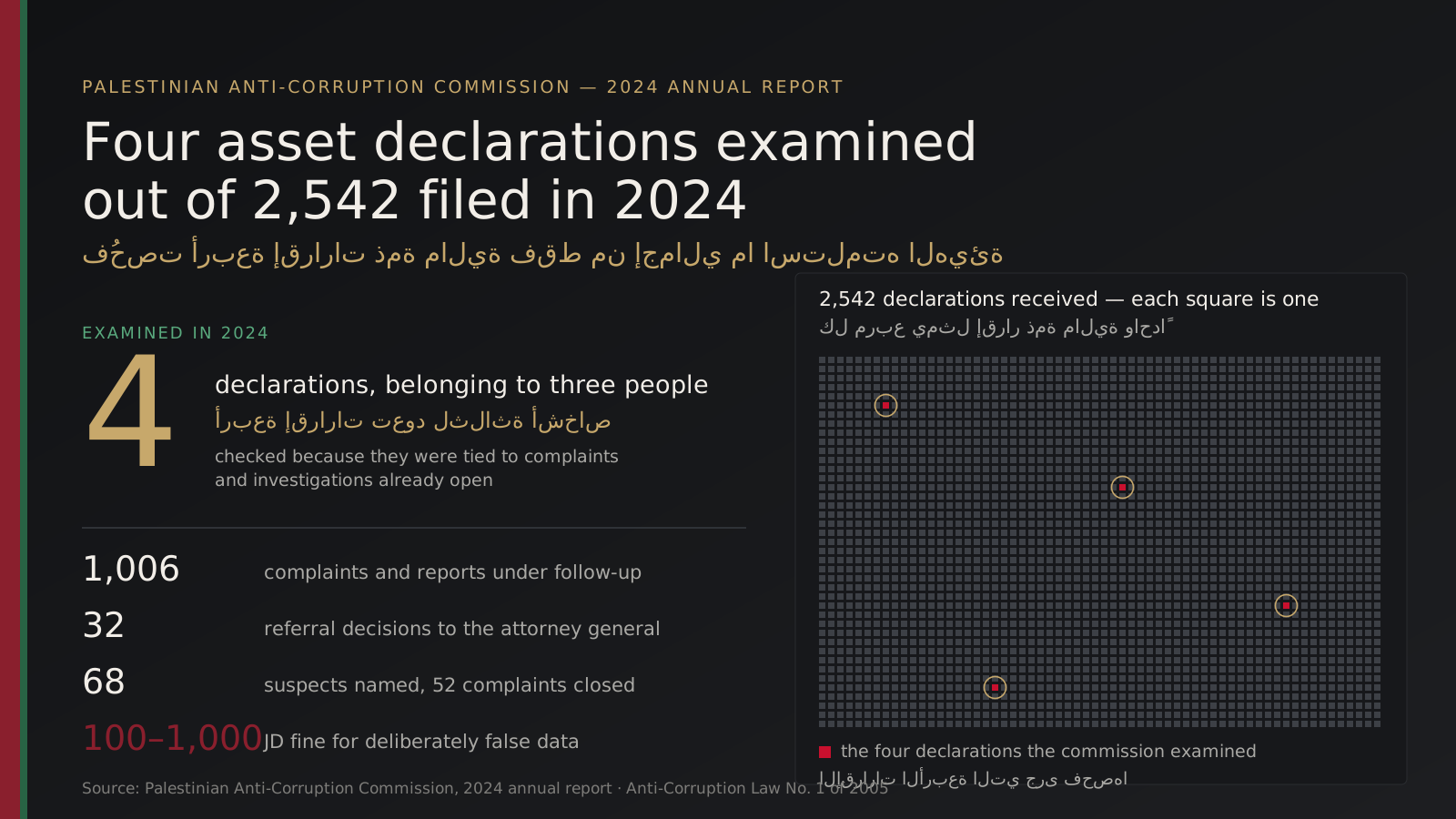
The Palestinian Anti-Corruption Commission received 2,542 asset declarations from officials obliged to file them during 2024 and examined four of them, according to the commission's own annual report for that year, published on its website. The four declarations belonged to three people, and the commission said it checked them because they were connected to complaints and investigations already open.
Filing is not optional. Under the Anti-Corruption Law No.
1 of 2005 and its amendments, as published in the Palestinian official gazette, officials covered by the law must declare what they, their spouses and their minor children own inside Palestine and abroad — property, movable goods, shares, bonds, cash, bank accounts, jewellery and precious metals — along with their debts and sources of income.
Every state body is required to send the commission, at the start of each fiscal year, a list of the names of its own staff who fall under the law.
The 2016 amendment, Decree-Law No. 18, widened that list considerably.
It brought in officials holding financial authority or signature rights, members of tender, procurement, sales, inventory, disposal, rental and quota committees, staff issuing licences and concessions, inspectors and storekeepers, and the heads and board members of charities, cooperatives, NGOs, political parties, unions, federations and clubs — explicitly including bodies that receive nothing from the public budget.
Anyone leaving a covered post must file a final declaration within 60 days.
Nothing in the amended law makes any of this public. The text directs that the head of state's declaration be kept sealed and confidential at the High Court of Justice, opened only with the court's permission and within the limits the law allows. Decree-Law No.
37 of 2018 provides that for the head of state, the prime minister and cabinet, the speaker and members of the Legislative Council, and members of the judiciary and public prosecution, the Basic Law and other applicable legislation govern their declarations, and that the commission may ask the High Court of Justice for permission to inspect them.
The penalty for lying on a form is a fine. The law, as reproduced in the commission's own published copy, sets a fine of between 100 and 1,000 Jordanian dinars for anyone who deliberately enters false data, and exempts from punishment anyone who corrects the entry before the error is discovered.
The commission's enforcement figures sit alongside its declaration figures. Its 2024 report records 1,006 complaints and reports under follow-up — 670 newly received, 331 carried over from previous years, five reopened — and 32 referral decisions sent to the attorney general, closing 52 complaints and naming 68 suspects.
Its 2022 report recorded 1,578 complaints under follow-up, of which 537 were shelved for lack of proof and 141 rejected for want of jurisdiction. The published reports give the number of declarations received but not the number of officials required to file, so no compliance rate can be read from them.
Al-Hadath reported the commission as putting its cumulative intake at roughly 56,138 declarations, a total the outlet dated from 2020 onward without giving a closing date.
Conflict of interest is governed separately, by cabinet regulation rather than by statute. Cabinet Decision No. 1 of 2020 requires a covered official to disclose any expected conflict on a set form as soon as it is discovered, and obliges the responsible official to notify the commission if the disclosure is not made.
Each body forms a three-member committee of senior staff to review the form and recommend within 14 days, with immediate recusal the prescribed remedy for a direct conflict. Failure to disclose is itself a corruption offence under the law. A separate gifts regulation, Cabinet Decision No.
10 of 2019, routes declared gifts to a committee of at least three senior officials that must report within two weeks, and the code of public office ethics adopted as Cabinet Decision No. 4 of 2020 bars using a post for private gain.
The gap AMAN identified is at the top.
In its fifteenth annual report, covering 2022, the anti-corruption coalition found the government had adopted the conflict-of-interest and gifts systems but exempted senior officials of state institutions from filing disclosure of movable and immovable assets, describing that group as the most exposed to corruption, and said exceptions granted to members of the political authority pointed to weak compliance with the codes.
Al-Hadath reported in March 2023, discussing an AMAN study, that the conflict-of-interest regulation left out categories the anti-corruption law does cover, among them the president and his advisers, the prime minister, members of the Legislative Council, judges and prosecutors, governors and diplomats.
The same report described a State Audit and Administrative Control Bureau finding that a number of employees had appeared under suspicion of conflict of interest through dual employment without the special cabinet permission required, and that their positions were subsequently regularised.
AMAN's eighteenth annual report, released on 30 June 2026 under the slogan that unaccountable authority moves a step closer to corruption, found that the practice of consulting the presidency on some cases involving influential figures leaves room for political pressure on the commission's independence.
It described the public prosecution's performance in 2025 as weak, citing the absence of a law regulating its work and the executive's continuing control over appointments. AMAN's regional director, Wael Baalousha, warned that the non-disclosure of companies' beneficial owners weakens the whole accountability system.
The commission's website reports that the government has referred a right-to-information bill to the president for approval. Whether it will reach the declarations themselves is not stated in the announcement.








%20(cropped).jpg?width=640)