Transparency & Accountability
Palestinian Authority forms inquiry committees that never publish findings
Graphic: Times of Palestine
Original Reporting
The Newsdesk gathers reporting from wire services and primary sources and rewrites every story in-house before publication. How our journalism is made →
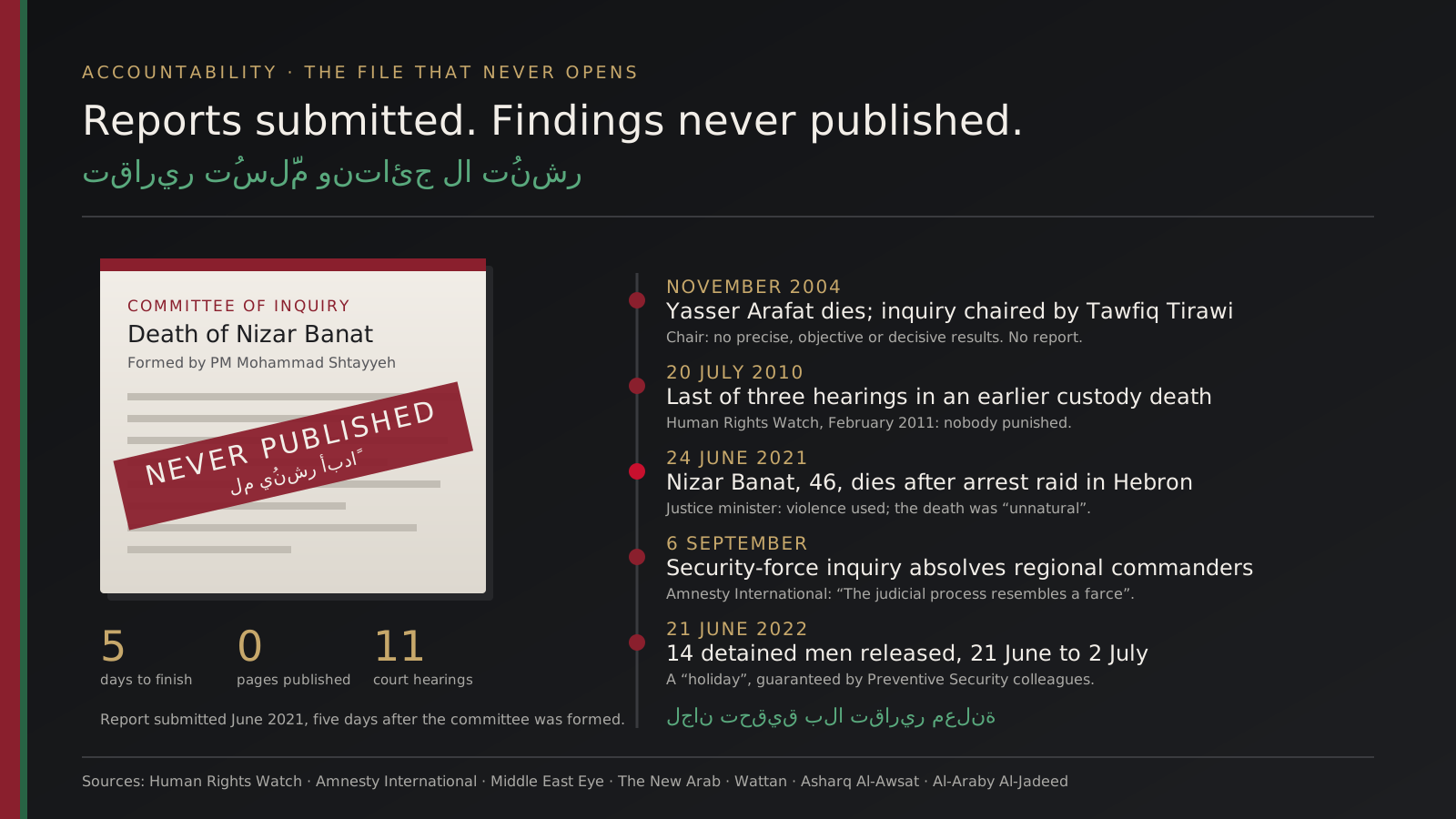
The official committee formed after the activist Nizar Banat died in Palestinian Authority custody finished its work in five days. Its report has never been published.
Human Rights Watch reported in June 2022 that Prime Minister Mohammad Shtayyeh formed a committee to investigate the death, and that its report, submitted five days later in June 2021, had not been made public.Human Rights Watch said Palestinian Prime Minister Mohammad Shtayyeh formed an official committee to investigate the death, but its report, submitted five days later in June 2021, has not been made public
Banat, a critic of the PA known for videos attacking its corruption and its security coordination with Israel, was 46. Middle East Eye reported that he died in custody after security forces stormed his home in Hebron to arrest him on 24 June 2021.
What the committee said in public was fragmentary and came through interviews rather than a document. The justice minister, who headed the committee, told Palestine TV that Banat had been subjected to physical violence and that his death was "unnatural". Middle East Eye reported that the committee confirmed "from footage and all reports" that Banat had left his home alive but lost consciousness on the way to hospital.
A second, separate inquiry ran inside the security forces. Amnesty International said that investigation, completed on 6 September, absolved regional commanders of all responsibility for the orders to arrest without a warrant and for the culture of excessive violence.
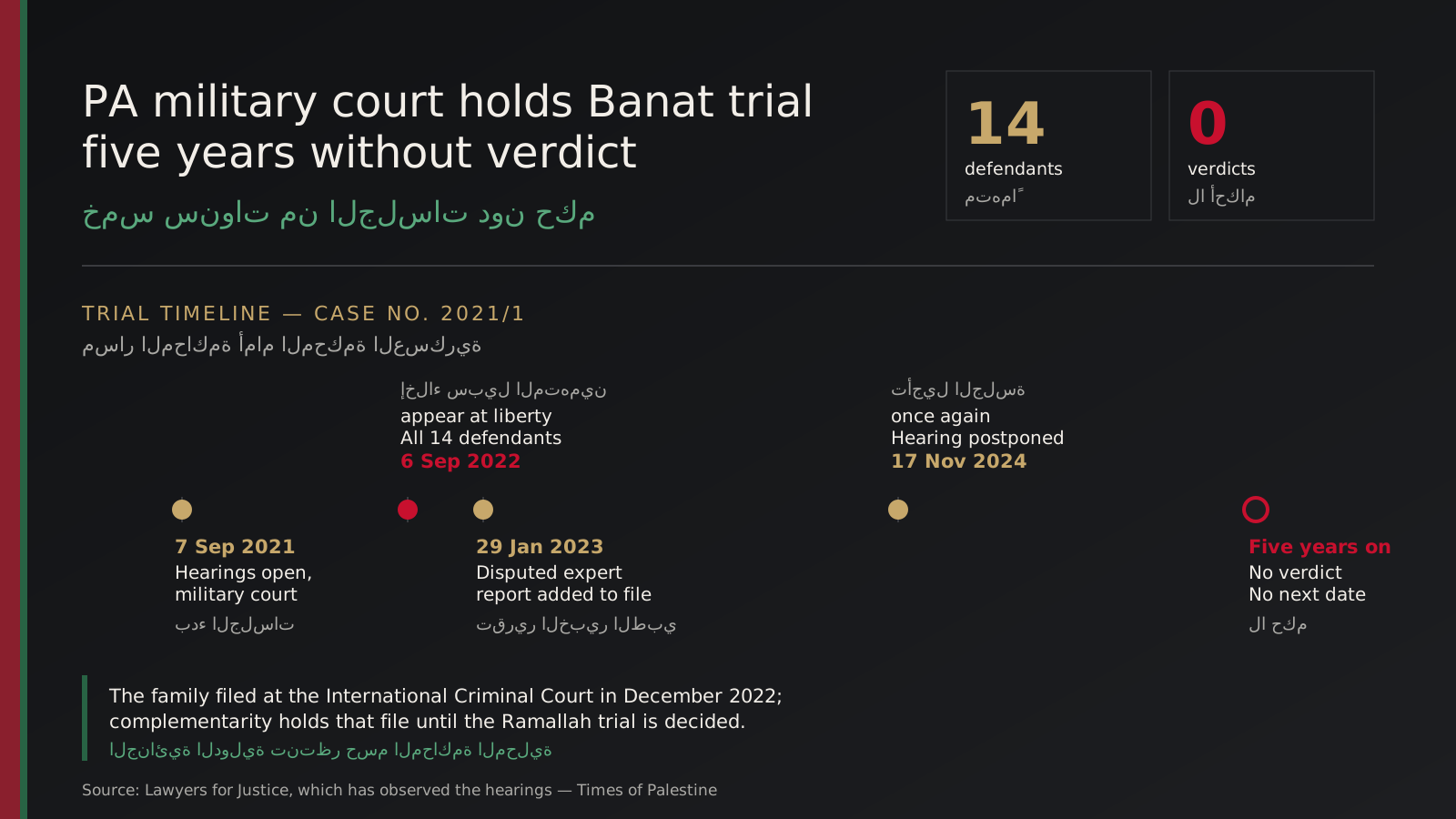
Amnesty said 14 men were detained in July 2021 at the military prison in Jericho, and that on 21 June 2022 the Military Attorney General authorised their release from 21 June to 2 July, a temporary release requested as a "holiday" and guaranteed by their colleagues in the Preventive Security Forces.
Amnesty described the process in a single phrase: "The judicial process resembles a farce".
The prosecution moved and stopped. The New Arab reported that 14 members of the security forces were arrested and charged in early July 2021 with provoking Banat's death, and that there had been 11 hearings at which the accused remained silent in court. Weeks after the death, The New Arab reported, the family had still not obtained a death certificate.
Two Palestinian oversight bodies asked, at the time, for the government report to be released.
The Independent Commission for Human Rights and the anti-corruption coalition AMAN told Wattan news agency that the report should be published for the public, AMAN's executive director Issam Haj Hussein saying the expectation from the moment the committee was formed was that its report would be published as soon as it was prepared, and that the withdrawal of some members had deepened citizens' doubts about the seriousness of such committees and their ability to produce recommendations preventing impunity.
The pattern predates 2021. Human Rights Watch reported in February 2011 on an earlier death in PA custody in which a criminal inquiry and a subsequent investigation failed to punish anyone, and the last of three trial hearings in that case was held on 20 July 2010. Human Rights Watch's 2022 finding was systemic: that Palestinian authorities are systematically mistreating and torturing Palestinians in detention, including critics and opponents.
The longest-running example is the committee into the death of President Yasser Arafat, who died in November 2004. Its chair has confirmed on the record that it has produced nothing conclusive.
Asharq Al-Awsat reported that Tawfiq Tirawi, the Fatah Central Committee member who heads the inquiry, said the committee had not yet finished its investigations and had not reached precise, objective or decisive results, that nobody holds correct, exclusive or secret information on the matter, and that the committee would submit its report to the Palestinian president.
Al-Araby Al-Jadeed reported that the committee has disclosed no results to date beyond accusing Israel of involvement in poisoning Arafat. That statement came 18 years after the death; more than two decades on, no report has appeared.
Where the machinery of oversight does produce documents, the trail also ends at delivery.
The State Audit and Administrative Control Bureau states on its own website that, alongside reports on each audited body, it issues quarterly reports and an annual report, and that the President, the Legislative Council and the Cabinet are supplied with the annual report in accordance with the law.
What is not set out is what any recipient did next.
On electricity arrears, structures were built rather than reports published.
The Institute for Palestine Studies records that the sector's main actors now include the Palestinian Energy and Natural Resources Authority, an Electricity Sector Regulatory Council established in 2011, the Palestinian Electricity Transmission Company created in 2014, and five distribution companies handling 75 per cent of distribution, and that the debts are deducted by Israel from the tax and customs revenues it collects on the PA's behalf.
The Prime Minister's Office said the Cabinet discussed a memorandum of understanding between the finance ministry and the Jerusalem District Electricity Company to regulate payment for electricity purchases, the debts and the financial relationship with the government. Neither the arrears total nor the repayment schedule appears in those published accounts.
AMAN, which has been Transparency International's Palestinian chapter since 2006, set out the wider environment in the eighteenth edition of its annual integrity report, covering 2025.
Raya reported that the coalition found that the absence of effective Palestinian oversight at the crossings opened space for brokers and legally unregulated security firms to divert and resell aid, and that it recorded a continuing decline in public freedoms, with Palestine classified as "closed" on the global civic freedoms index.
Whether the military court proceedings over Banat's death have resumed, and whether either the government committee's report or the security forces' investigation file will ever be released, is not stated anywhere in the published record.