Money & Access
Gaza teachers plan offline lessons for a broken network
Graphic: Times of Palestine
Original Reporting
The Newsdesk gathers reporting from wire services and primary sources and rewrites every story in-house before publication. How our journalism is made →
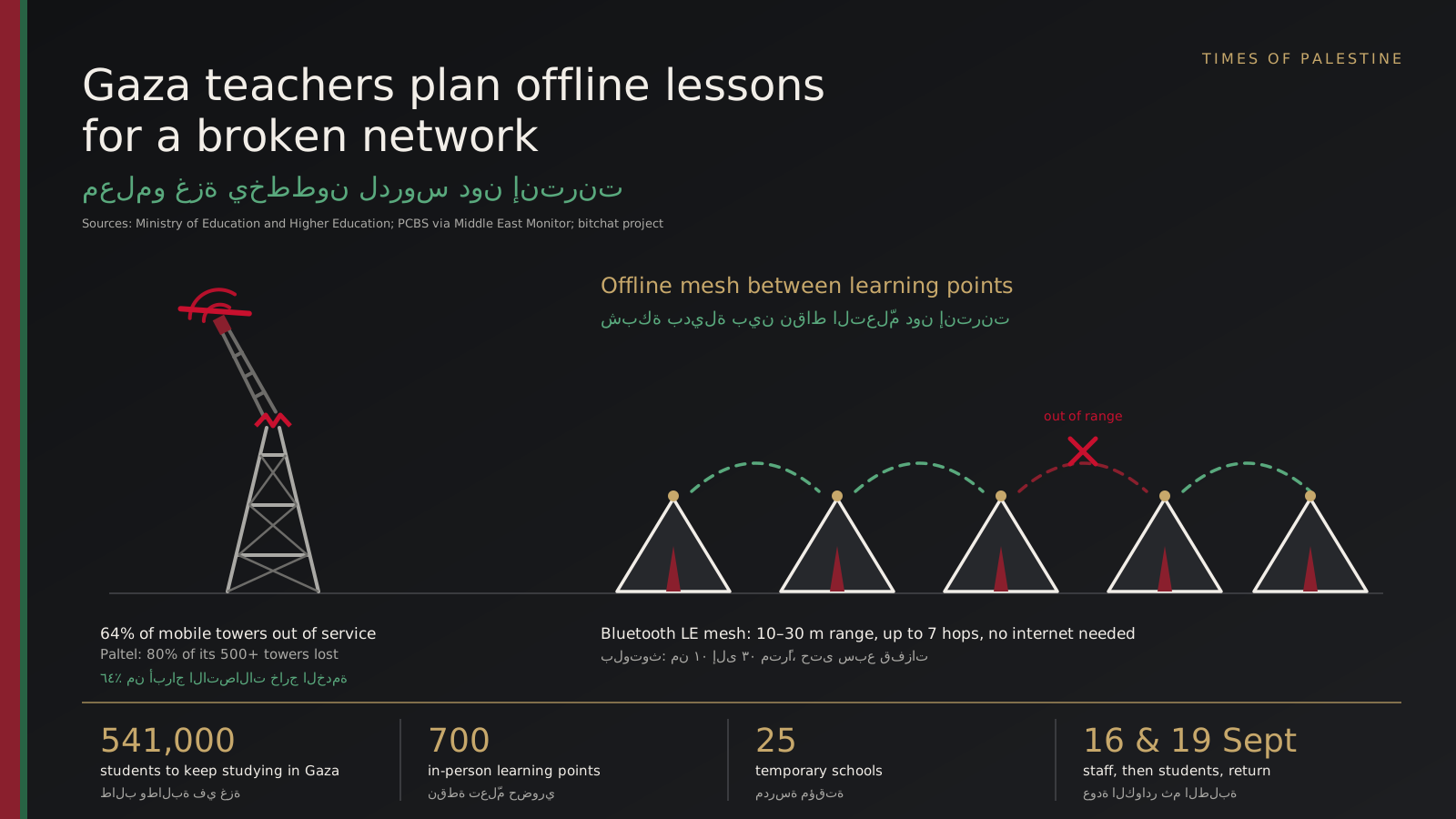
The Palestinian Ministry of Education and Higher Education has set the opening of the 2026/2027 school year in the Gaza Strip for 16 September for administrative and teaching staff and 19 September for students, according to the ministry decision reported by Palestine Post, which said the date followed the completion of arrangements and an assessment of conditions in the Strip.
The ministry attributed the later start to technical and logistical reasons and to the weather, citing high temperatures and the fact that students will be taught in tents and caravans.
The plan itself assumes the network. Palestinian official broadcaster PBC and the Ramallah-based agency reporting carried by Raya and Sama put the ministry's preparations at roughly 700 in-person learning points and 25 temporary schools in Gaza, alongside continued virtual learning for students unable to reach in-person sites — a combination intended to allow about 541,000 students to keep studying "according to available means".
In the West Bank, by contrast, about 846,000 students returned to 2,537 government, private and UNRWA schools under some 54,000 teachers when the year opened there, PBC reported.
“an ongoing examination and preparation for the shutting down of cellular communications and internet services to Gaza”
Gaza's connectivity is the weakest part of the arrangement.
Middle East Monitor, citing the Palestinian Central Bureau of Statistics, reported that 64 per cent of mobile towers were out of service as Gaza entered 2026, that Paltel had lost roughly 80 per cent of its more than 500 towers, and that mobile coverage in Rafah had fallen to 27 per cent, with sector reconstruction estimated at a minimum of $90 million.
The policy institute Al-Shabaka, citing the Palestinian digital rights group 7amleh, reported that more than half of Gaza's telecommunications infrastructure had been destroyed and a further quarter damaged, that Paltel's network remained 80 per cent offline, and that minimal power, strikes and restrictions on repair materials had blocked recovery.
Al-Shabaka further states that Israeli forces repeatedly targeted repair crews.
The Business and Human Rights Resource Centre, summarising reporting on the blackouts, quotes an Israeli communications ministry update saying there was "an ongoing examination and preparation for the shutting down of cellular communications and internet services to Gaza", and cites an Access Now finding of an 80 per cent fall in internet traffic.
Outages have been recurrent rather than exceptional.
The UN Emergency Telecommunications Cluster reported in June 2025 that a fibre cut had left southern and central Gaza with a complete loss of internet and severely degraded mobile service, days after repairs restored lines that had cut off the north from 10 June and the whole Strip from 12 June.
The Electronic Frontier Foundation, citing 7amleh, dated that outage to 11 June with partial restoration on 14 June. Internet Society Pulse recorded a further blackout in September 2025 and recommended a national emergency telecommunications plan as the practical route to resilience.
What teachers do when the line drops is, in the published record, mostly analogue. UNICEF reported in November 2025 that it had been impossible to bring educational supplies into Gaza and that teachers were writing on tent walls, with children attending three days a week for three hours because demand outstripped space.
The rights organisation DAWN reported in December 2025 that teachers rewrite lessons by hand and distribute them on scraps of paper, tear cardboard into writing surfaces, and run tent classrooms where children sit on sand. The Global Education Cluster has documented community-led learning spaces staffed by volunteer teachers from the same neighbourhoods.
UNRWA reported that the second semester of the 2025/2026 year began on 1 March with remote learning resumed alongside in-person classes in learning spaces.
The gap the ministry is trying to close is large. UNICEF said in January that it was reaching 135,462 children in 111 temporary learning spaces, that 60 per cent of school-aged children had no access to in-person learning, and that at least 92 per cent of schools would need full reconstruction or major rehabilitation.
Agency reporting carried by Felesteen put April 2026 figures at about 420,000 children — three in five — with no in-person education at all, amid shortages of supplies, safe space and teaching staff and risks from rubble and unexploded ordnance.
The European Training Foundation, citing University of Cambridge work, warned in February that if structured schooling cannot resume before 2027, many young people could fall up to ten years behind expected learning levels.
Mesh messaging is the fallback most often proposed for coordinators who need to move instructions between learning points during an outage, and its limits are documented.
The bitchat project's own repository describes a dual architecture: Bluetooth Low Energy mesh for offline messaging, with relaying through up to seven hops, and Nostr relays for internet-based reach — meaning the wide-area half stops working precisely when the network does.
Gizmodo's guide to the app puts current Bluetooth LE range at 10 to 30 metres, with Wi-Fi Direct support planned that would extend it to between 100 and 200 metres. The Android build requires Bluetooth, location and notification permissions and Android 8.0 or later.
The project documents its architecture, not measured performance in dense tent blocks or on a phone that may be charged once a day.
Distribution carries its own risk. The bitchat repository instructs users to install from the App Store or build from source they have verified, and states that a build from anywhere else cannot be verified, pointing to per-release hash manifests. For Android, the project publishes APK releases through the permissionlesstech GitHub account.
Google Play listings have prompted users to ask the developers directly whether they are genuine, and at least one Play listing describes itself as a mirror of the GitHub app rather than the app itself.
Whether the 700 planned learning points will hold offline copies of the curriculum, and whether repair materials will reach Gaza's operators before 19 September, has not been set out in any published ministry document. Nor has the ministry published what happens to the virtual half of the plan on the days the network is down.