Palestinians in Israel
Israel demolished 5,742 Naqab structures in 2025, resettling 40 families
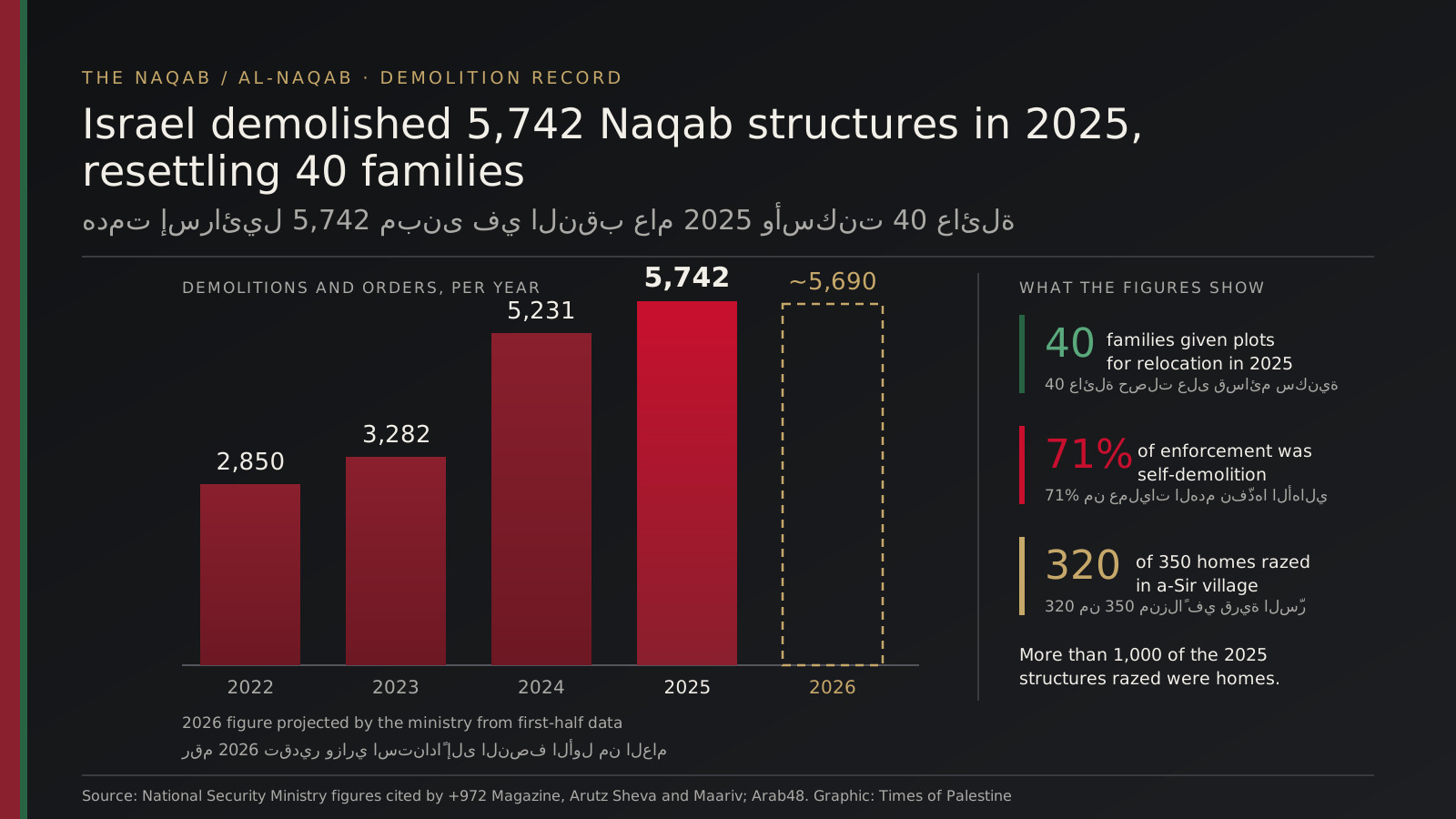
Graphic: Times of Palestine
Original Reporting
The Newsdesk gathers reporting from wire services and primary sources and rewrites every story in-house before publication. How our journalism is made →
Israeli authorities demolished 5,742 structures in the Naqab in 2025, according to National Security Ministry figures cited by the Israeli outlet +972 Magazine in June, up from 2,850 in 2022. More than 1,000 of the structures razed last year were homes. In the same period, +972 reported, 40 families received plots for relocation through Israel's Bedouin Settlement Authority.
The pace has not slowed in 2026.
At a hearing of the Knesset Interior and Environment Committee attended by National Security Minister Itamar Ben Gvir, police, the Israel Land Authority and the Justice Ministry, ministry figures put demolitions and orders at 5,231 in 2024 and 5,742 in 2025, with about 5,690 projected for 2026 on the basis of first-half data, the Israeli news site Arutz Sheva reported.
The same figures showed an 81 percent rise in demolitions over three years compared with the three years before them.
“judicial cover for Israel's policies of segregation and apartheid”
Committee chair Yitzhak Kroizer told the hearing that the Naqab is the most important strategic space in the country and that the state had moved from responsive to preventive enforcement, describing the effort as a struggle over sovereignty and governance, Arutz Sheva reported.
Earlier official data showed 3,282 demolitions in 2023 and 2,007 in the first half of 2024 alone, ynet reported in August 2024, citing enforcement figures.
The Israeli local outlet Walla's southern edition, publishing 2024 data in January 2025, reported that demolitions of inhabited homes rose 42 percent, from 403 in 2023 to 691 in 2024, and that demolitions of warehouses and homes not yet occupied rose 196 percent, from 641 to 1,299.
Most of the destruction is now carried out by residents themselves.
Figures presented to the Knesset and reported by Maariv showed that demolitions following advance enforcement action — where owners pull down their own houses under threat of an order — accounted for 71 percent of enforcement activity, a rise of 47 percent over the previous year.
+972 reported that self-demolition spares the state both the cost of the operation and the public scene of a forced eviction.
The Israel Land Authority, which is responsible for enforcement against unlicensed building, uses an artificial-intelligence system fed by drone, satellite and light-aircraft imagery to identify ground being prepared for construction before building begins, allowing demolition orders to be issued immediately, Israel Hayom reported in December, citing a report by the settlement-monitoring group Regavim.
The same report recorded a 40 percent drop in unlicensed construction in the Naqab, the first decline in a decade, and said the number of structures the group counts as illegal in the region passed 100,000 in 2025.
The legal ceiling on such cases moved in November. On 12 November 2025 the Israeli Supreme Court rejected the final appeal by residents of Ras Jrabah, an unrecognised village east of Dimona, and gave final approval to eviction lawsuits against all of its more than 500 residents, ordering them out within 90 days, according to Adalah, the legal centre that represented them.
Adalah said the ruling grants the state authority to evict people from their land without any legitimate planning purpose or demonstrated necessity, and accused the court of providing "judicial cover for Israel's policies of segregation and apartheid." The organisation noted that the Be'er Sheva District Court had itself found the approval of the plan marred by serious procedural flaws.
The state's case, set out in ten eviction lawsuits filed by the Israel Land Authority in 2019, is that the residents are trespassers on state land needed for the Dimona East Plan.
Adalah says the village covers 340 dunams belonging to the Al-Hawashleh tribe, on whose lands Dimona itself was built, and that residents were offered a single alternative: relocation to the Bedouin town of Qasr al-Sirr. Calcalist reported that the planned Rotem Quarter would hold thousands of housing units.
The 90 days expired in February. Whether the eviction has been carried out is not established in the public record; no judgment, enforcement filing or state announcement setting out what happened to the village has been published since Adalah's statement of 13 November 2025.
In a-Sir, the largest unrecognised village facing demolition orders, the outcome is documented.
Israeli forces demolished 40 homes belonging to the al-Omrani family in September 2025, firing sound and smoke grenades at residents and solidarity activists, Al-Araby al-Jadeed reported at the time; Middle East Eye reported that residents were told they would be billed for the operation, and that they had been moved to the area by the authorities in the 1950s.
By December, the Nazareth-based outlet Arab48 reported that 320 of the village's 350 homes had been destroyed and that families were spending the winter in tents on the rubble.
The Israel Land Authority has published its own account of a 2026 operation. The Israeli site Posta reported in July that inspectors demolished 25 structures belonging to one family, after appeals to the district and Supreme Courts were rejected and enforcement files opened in 2025; the authority said the families had been offered regulated housing in a neighbourhood of Lakiya over the years and declined it.
Bedouin representative bodies dispute that such offers exist at scale. The Regional Council for Unrecognised Villages says the state destroyed about 14,200 Bedouin-owned structures between 2023 and 2025, including 2,155 dwellings, ynet reported from a Beersheba protest in June.
Council spokesman Nati Yefet said residents do not oppose regularisation but want the state to let them live legally where they have lived for decades, and that the state settled them there without ever preparing building plans.
A zoning pilot for Bedouin communities was approved by the Ministerial Committee on Bedouin Sector Affairs in May 2025, under a wider plan adopted in June 2023, according to the Inter-Agency Task Force on Israeli Arab Issues, which reported that Bedouin leaders say it was drawn up without meaningful consultation and that demolitions are proceeding before alternative housing exists.
Roughly 300,000 Bedouin live in the Naqab, the Task Force said, with a quarter to two-fifths of them in 35 unrecognised villages that have no legal status, approved plans or basic infrastructure.
What the pilot has delivered on the ground has not been published. Neither has any state accounting of where the families of a-Sir, now in their second year on the rubble, are meant to go.