West Bank & Jerusalem
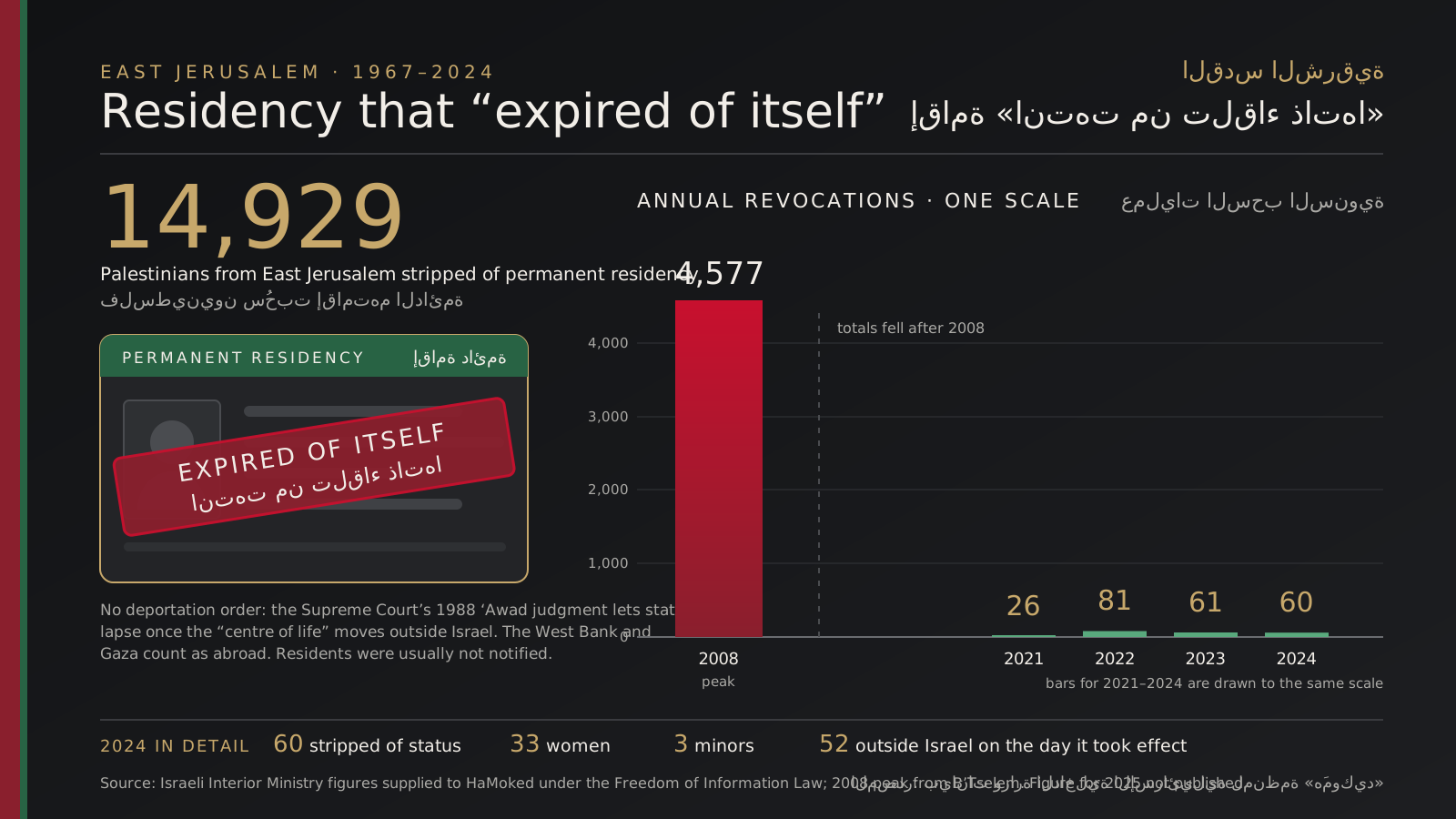
Israel has stripped 14,929 Jerusalemites of residency since 1967
Graphic: Times of Palestine
Original Reporting
Israel revoked the permanent residency of 14,929 Palestinians from East Jerusalem between 1967 and the end of 2024 on the grounds that their status had "expired of itself", according to Interior Ministry figures supplied to the Israeli rights group HaMoked under the Freedom of Information Law.
The figure for 2025 has not been published. HaMoked's annual activity report for 2025 says the ministry answered its January 2025 request only in September of that year, after repeated follow-up, and that response covered 2024: 60 people stripped of status, among them 33 women and three minors, with 52 outside Israel on the day the revocation took effect.
The mechanism is a rule of judicial origin, not a deportation order. HaMoked says the ministry relies on the Supreme Court's 1988 'Awad judgment, under which the Israeli status of East Jerusalem Palestinians may expire "by itself" once they move their centre of life outside Israel or acquire status in another country.
For that purpose, the West Bank and Gaza count as abroad. HaMoked, describing the practice it has challenged since the 1990s, says residents were not normally notified that their status had lapsed and discovered it afterwards, often when applying for a routine service at an Interior Ministry counter.
The courts have repeatedly declined to unsettle the rule.
In its judgment in HCJ 7803/06, published on the Supreme Court's own website, the court found no reason to depart from 'Awad and held that conditioning continued permanent residency on continued residential ties is not discriminatory, because the distinction between a resident and a citizen is a relevant one.
Al-Haq dates that judgment to 13 September 2017. HaMoked says a separate 2011 petition by several organisations against the revocation policy was deleted in 2012 after the justices refused to hear it on the merits.
The annual totals are now far below their peak. A B'Tselem briefing circulated through ReliefWeb in 2013 recorded revocations rising from 2006 and peaking at 4,577 in 2008, before falling. HaMoked's ministry data show 81 revocations in 2022, 61 in 2023 and 60 in 2024, against 26 in 2021.
The Jerusalem figures sit inside a larger register. Amira Hass, writing in Haaretz in December 2020 on the basis of official replies to HaMoked under the Freedom of Information Act, put the number of West Bank Palestinians whose residency Israel cancelled between 1967 and 1994 at 140,000, alongside 108,878 people from Gaza.
A second track runs on political grounds. Al-Haq says Amendment 30 to the Entry into Israel Law, passed on 7 March 2018, empowers the interior minister to revoke the permanent residency of Jerusalem Palestinians for "breach of allegiance" to Israel.
HaMoked, citing ministry data, says six residents had been stripped of status on that ground by the end of 2021, three of them in 2018 and two in 2019; it petitioned in November 2021 against the minister's decision of 17 October 2021 to revoke the residency of Salah Hammouri.
HaMoked posted a further petition against the allegiance amendments on 7 June 2026, under the heading "the right to have rights".
Adalah says a 2023 amendment to the Citizenship and Entry into Israel Law allows revocation of citizenship or permanent residency from people convicted of an offence defined as terrorism who, in the interior minister's assessment, received payments from the Palestinian Authority.
The Times of Israel reported in May 2025 that ministers announced the law would begin to be applied after a two-year delay; Adalah said the same week that four people were in advanced stages of proceedings, with hundreds more targeted.
The Jerusalem Post reported in February 2026 that a first revocation had been carried out, quoting coalition whip Ofir Katz saying he had pressed the system for three years to implement his law.
The Knesset went further in November 2024. The Jewish Chronicle reported the plenum passed by 61 votes to 41 a law allowing the deportation of first-degree relatives of people defined as terror operatives — seven to 15 years for citizens, 10 to 20 years for permanent residents. Adalah called it part of a two-tiered legal system.
In Sheikh Jarrah, Ir Amim said in a report released in late October 2025, "A Stranglehold on Sheikh Jarrah", that two state-backed housing projects presented as urban renewal would settle around 2,000 Israeli families in the neighbourhood. Municipal officials, Arab News reported, say the projects will improve services for Palestinian residents.
Ir Amim counts nearly 80 Palestinian families in the neighbourhood facing eviction suits since 1970. Its researcher Aviv Tatarsky told Arab News that all the projects in the report are state-initiated.
In Silwan, Human Rights Watch reported in June 2026 that more than 2,000 people are at risk of displacement, citing Ir Amim, and that OCHA counts 587 Palestinians displaced by demolitions in East Jerusalem since 7 October 2023, a quarter of them during the March–April 2026 war with Iran.
Ateret Cohanim's executive director Daniel Luria told the Times of Israel that Palestinians in Silwan are "illegal squatters" and that he is correcting a historical injustice.
On family unification, Adalah says the Supreme Court issued an order nisi on 9 July 2024 in nine petitions against the Citizenship and Entry into Israel Law (Temporary Order) of 2022, requiring the state to explain by 2 December 2024 why the ban should not be struck down. No judgment in those petitions has been published in the material available.