Field Reports
Popular committees carry Lebanon's camps as UNRWA cuts hours
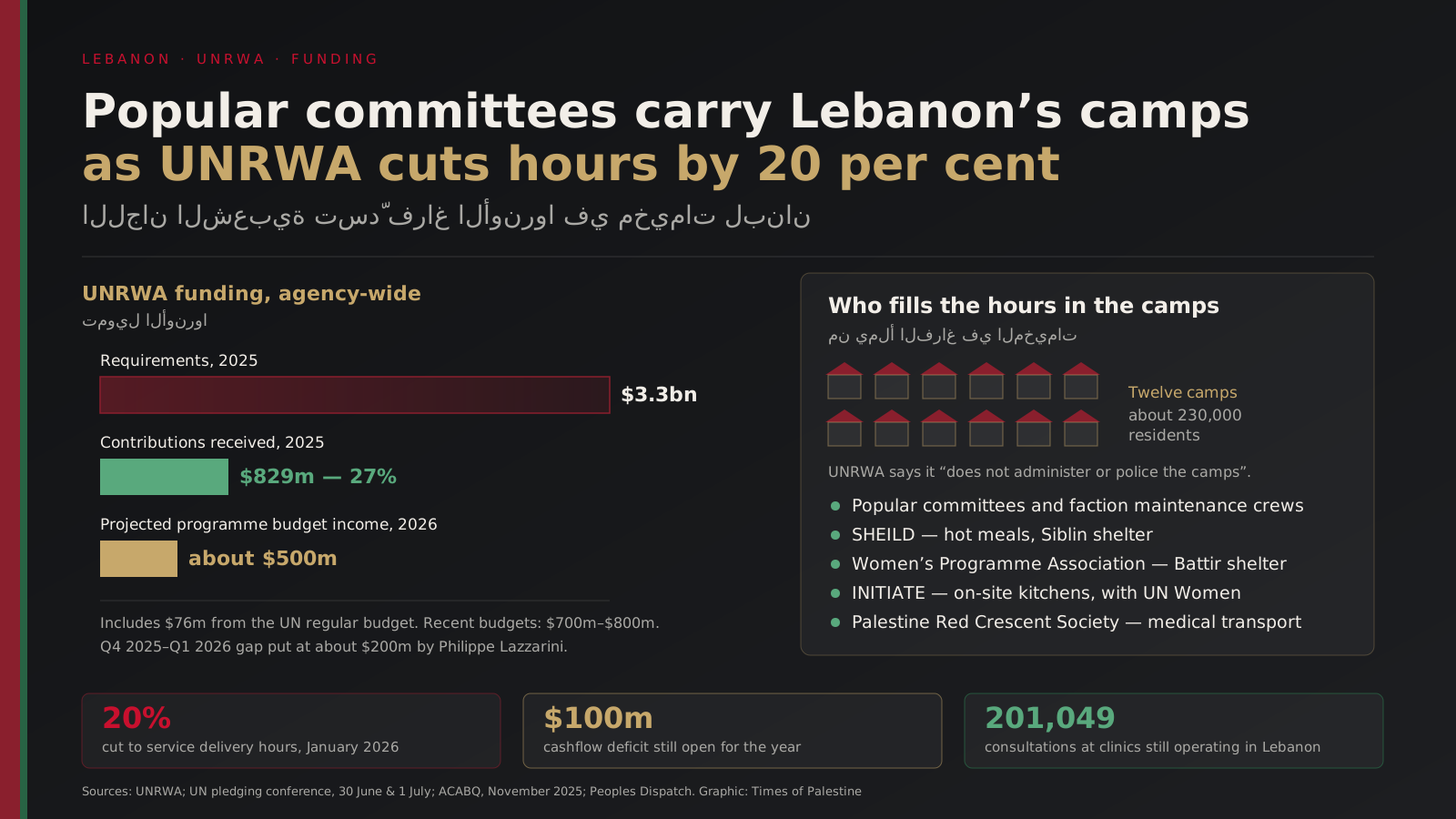
Graphic: Times of Palestine
Original Reporting
The Newsdesk gathers reporting from wire services and primary sources and rewrites every story in-house before publication. How our journalism is made →
UNRWA reduced its service delivery hours by 20 per cent in January 2026, with a matching cut to the salaries of most Palestinian staff, according to the statement Commissioner-General ad interim Christian Saunders delivered to the agency's pledging conference on 1 July. Six months on, the agency says a cashflow deficit of $100 million remains for the year.
The hours that came off the timetable have not gone unfilled in Lebanon's twelve camps. They have been picked up by popular committees, faction-run maintenance crews and a handful of named local associations — bodies whose budgets are not published and whose responsibilities are nowhere set down in law.
The scale of the shortfall is on the public record. A transcript of the 30 June pledging conference published by the United Nations records that UNRWA received $829 million in contributions in 2025, including $76 million from the UN regular budget, against requirements of $3.3 billion — roughly 27 per cent of what the agency said it needed.
The UN Advisory Committee on Administrative and Budgetary Questions, reporting in November 2025, put projected 2026 programme budget income at around $500 million, against recent budgets of between $700 million and $800 million.
Then Commissioner-General Philippe Lazzarini told the General Assembly's Fourth Committee on 13 November 2025 that the gap between the last quarter of 2025 and the first quarter of 2026 came to about $200 million, and that projected income was too low to absorb it.
Secretary-General António Guterres appealed on 1 July for states to cover the remaining $100 million, Al Jazeera reported, citing Reuters and AFP. Middle East Eye reported on 20 July that an UNRWA official repeated the same figure.
In Gaza the measures were sharper. Al Jazeera reported on 30 January, citing a letter from Lazzarini to affected staff, that UNRWA had imposed a 20 per cent salary cut on local staff in Gaza, reduced working hours and terminated the contracts of employees based outside Gaza who had been on exceptional leave, and that the letter attributed the decisions to a 2026 budget shortfall of some $220 million.
Lebanon is where the substitution is most visible, because the agency has never governed the places it serves. UNRWA's own country page states that it provides services in twelve camps and "does not administer or police the camps", which it says is the responsibility of the host authorities.
Its page on Burj Barajneh camp, updated in December 2023, puts it more directly: security and governance there are the responsibility of the popular committees and Palestinian factions.
How many people this affects is itself unsettled. UNRWA records just under 500,000 registered refugees in Lebanon as of February 2025, while noting that registration is voluntary and that deaths and emigration often go unreported. Peoples Dispatch, reporting on protests against service cuts in February 2026, put the number living in the camps at about 230,000.
What has stopped is documented in UNRWA's own emergency reporting.
Its 2026 Lebanon situation reports record that schools across the country and the Siblin Training Centre were closed under an agency decision; that the Ghazieh and Adloun clinics in the Saida area were shut; and that primary care in Beirut ran through the Mar Elias and Burj Hammoud clinics and a temporary emergency clinic in Musaytbeh.
By the thirteenth report in June, UNRWA counted 201,049 consultations at operational clinics since the emergency began, including 18,431 for displaced people. Hospitalisation for conflict injuries, those reports state, is covered not by UNRWA but by Lebanon's Ministry of Public Health and the ICRC.
The same reports name who is cooking. Hot meals at the Siblin shelter are provided by the local partner SHEILD and at the Battir shelter by the Women's Programme Association, under the food security sector led by the World Food Programme.
UNRWA records that on-site kitchens in both agency-run shelters were set up with the community organisation INITIATE, co-funded by UN Women, and with the Women's Programme Association, co-funded by ANERA, and that emergency medical transport is coordinated with the Palestine Red Crescent Society.
The committees' work is older than the crisis. UNRWA's 2014 announcement of a Swiss-funded reverse osmosis water plant in Burj Barajneh described it as built in partnership with the popular committees.
The Palquest encyclopaedia records that in Jalil camp the popular committee installed a water purification station and that its maintenance team repairs the lines when transformers burn out, with most household electricity now bought from private generator subscriptions since Lebanon's economic collapse — subscriptions some families have had to cancel.
Governance inside the camps is not uniform. Palquest states that Burj al-Barajneh has no single popular committee managing daily affairs, with rival structures dating to 1982 and faction offices carrying much of the service work.
Committee officials say the maintenance load has grown as the agency's has shrunk. The outlet Palestine Uncensored quoted the secretary of the Burj al-Barajneh popular committee, Issa Ghadban, saying UNRWA had already halted a number of home restoration programmes and service projects while many houses in the camps remain structurally unsafe.
The Palestinian Refugees Portal reported in March 2026 that residents of the same camp faced cuts to education and health services alongside reduced diesel for the wells that pump their water.
The Palestinian Information Centre reported in November 2025 that Ali Huweidi, director-general of Commission 302 for the Defence of Refugee Rights, said ten teachers had been dismissed from UNRWA schools without prior notice and that five schools in Ein al-Hilweh remained closed after clashes, with no repairs scheduled.
The bodies absorbing the gap are running short themselves.
Raya reported that when Ahmad Abu Houli, the PLO Executive Committee member who heads its refugee affairs department, met heads of West Bank camp service committees on 8 July, the agenda included the committees' own finances and operating costs, and how to keep them delivering basic services. No outcome has been published.
Abu Houli told an Egyptian interviewer in June, in remarks carried by the Palestinian Refugees Portal, that UNRWA's 2026 budget for a minimum level of services had been cut from about $957 million to $750 million.
In Gaza, WAFA reported that heads of popular committees meeting on 27 January warned of mounting anger in the camps over continued cuts and demanded the agency reverse mass dismissal decisions.
Whether the January reductions are reversed depends on money that has not arrived. Saunders told the pledging conference that restoring operations to their past scope will not be possible without it. What no published document establishes is who is answerable, in the meantime, for the water networks, the waste and the unsafe housing inside camps that UNRWA says it does not administer and that Lebanese public services do not enter.