Health & Healing
UN agencies restart Gaza immunisation as coverage falls below 70%
Graphic: Times of Palestine
Original Reporting
The Newsdesk gathers reporting from wire services and primary sources and rewrites every story in-house before publication. How our journalism is made →
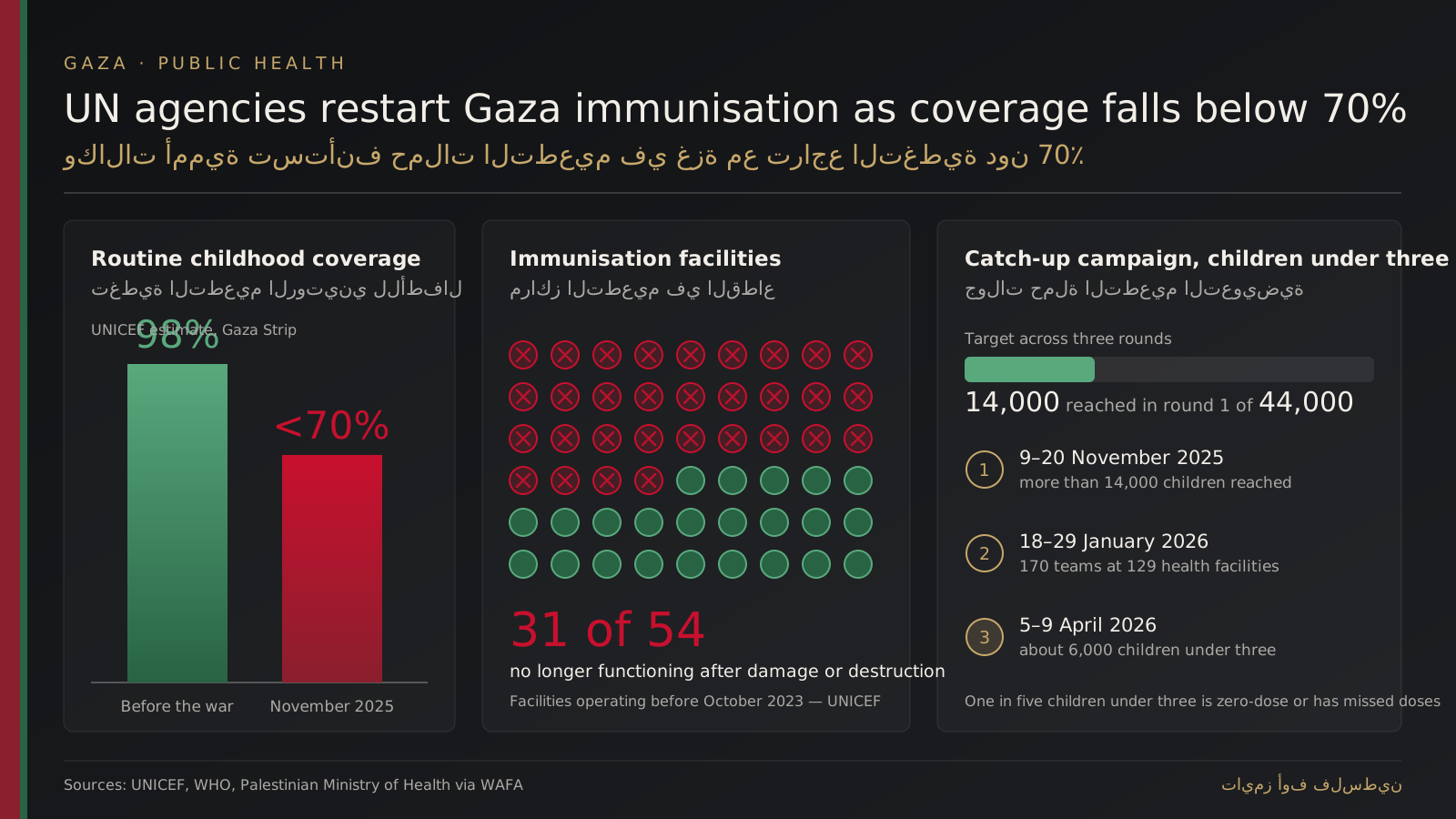
Routine childhood immunisation coverage in the Gaza Strip has fallen below 70 per cent, down from 98 per cent before the war, UNICEF said when it launched a catch-up campaign in November 2025. Of 54 immunisation facilities operating before October 2023, UNICEF said 31 are no longer functioning after being damaged or destroyed.
That is the baseline the vaccination system is now being rebuilt from. The Palestinian health ministry announced the third round of the catch-up campaign on 4 April 2026, according to the official news agency WAFA, which quoted Health Minister Majed Abu Ramadan saying the round would run from 5 to 9 April and target around 6,000 children under the age of three.
The immediate trigger for the collapse was documented in the summer of 2024. The Global Polio Eradication Initiative announced that circulating variant type 2 poliovirus had been isolated from six sewage samples collected on 23 June 2024 from two sites in Khan Younis and Deir al-Balah. WHO said genetic sequencing linked the isolates to a variant poliovirus last detected in Egypt in 2023.
WHO said in August 2024 that routine coverage for the second dose of inactivated polio vaccine had already fallen from 99 per cent in 2022 to below 90 per cent in the first quarter of 2024. A 10-month-old infant was paralysed in August 2024, the first polio case in Gaza in more than two decades, according to reporting by AFP carried by Swissinfo.
The emergency response that followed was large and, by the agencies' own accounts, uneven. UNICEF said it delivered 1,230,000 doses of novel oral polio vaccine type 2 into Gaza along with vaccine carriers, refrigerators and cold-chain equipment, and the first round began on 1 September 2024.
WHO reported that around 560,000 children were vaccinated in that round, conducted in three geographic phases, with the northern phase run from 9 to 11 September targeting some 150,000 children.
The second round closed on 5 November 2024. UNICEF and WHO said 556,774 children under 10 received a second dose and 448,425 children aged two to 10 received vitamin A, about 94 per cent of a target population of 591,714.
Coverage reached 103 per cent in central Gaza and 91 per cent in the south, the agencies said, but in the north, where the campaign was "compromised due to lack of access", it was approximately 88 per cent.
Transmission did not stop. UN News reported in February 2025 that environmental samples collected in Deir al-Balah and Khan Younis in December 2024 and January 2025 confirmed continued circulation, and that the strain was genetically linked to the virus detected earlier in Gaza.
A third mass round ran from 22 to 26 February 2025. WHO and UNICEF said it reached nearly 603,000 children under 10 — about 40,000 more than the two 2024 rounds — after what they described as comprehensive, simultaneous access to all five governorates during the ceasefire then in force.
WHO's regional incident management team put the figure at 602,795. WHO said the round used about 1,660 vaccination teams, 1,242 of them mobile, and deployed 1,242 community mobilisers.
Midway through, WHO's representative in the occupied Palestinian territory, Richard Peeperkorn, told a UN briefing in Geneva that 547,848 of the 591,000 targeted children had been reached, or 92 per cent.
WHO's regional situation report said a fourth polio round was planned "as the situation allows". No announcement that such a round has taken place appears on the record, and neither WHO nor the Global Polio Eradication Initiative has published a finding that transmission in Gaza has been interrupted. Whether environmental sampling has detected the virus since January 2025 is not established in the published record.
The work has since shifted from mass polio rounds to reconstructing the ordinary schedule. UNICEF, UNRWA, WHO and the health ministry set a target of 44,000 children under three across three rounds, delivering three doses of pentavalent, polio, rotavirus and pneumococcal conjugate vaccines and two doses of measles, mumps and rubella vaccine.
UNICEF estimated that one in five children under three in Gaza is either zero-dose or has missed vaccinations because of the war.
The first round reached more than 14,000 children, UNICEF and WHO said in January 2026, adding that nearly a quarter of children who came to vaccination sites had missed scheduled doses or entire vaccine series.
The agencies dated that round 9 to 20 November 2025; UNICEF's launch statement had given 9 to 18 November, and WHO's own footage advisory said 10 to 18 November. The second round ran from 18 to 29 January 2026, delivered by 170 vaccination teams at 129 health facilities with seven mobile teams for hard-to-reach communities.
Cold chain was treated as a precondition rather than an afterthought. UNICEF said it brought all 11 vaccines, syringes and the cold-chain equipment needed for all three rounds into Gaza before the first round began, and trained more than 450 health workers and support staff with WHO, the ministry and partners, with financing from Gavi.
In Gaza City, UNICEF staff and residents carried a solar-powered vaccine refrigerator up a flight of stairs at the Sheikh Radwan clinic on 7 November 2025, replacing units the agency said had been damaged in air strikes.
UNICEF said the campaign's success depends on full respect for the ceasefire, so that families and health workers can reach vaccination sites safely. No Gaza-wide coverage figure more recent than the below-70-per-cent estimate has been published, and it is not yet known whether a fourth round of the catch-up schedule will follow April's.