Health & Healing
UNICEF warns 335,000 Gaza under-fives risk severe developmental delay
Graphic: Times of Palestine
Original Reporting
The Newsdesk gathers reporting from wire services and primary sources and rewrites every story in-house before publication. How our journalism is made →
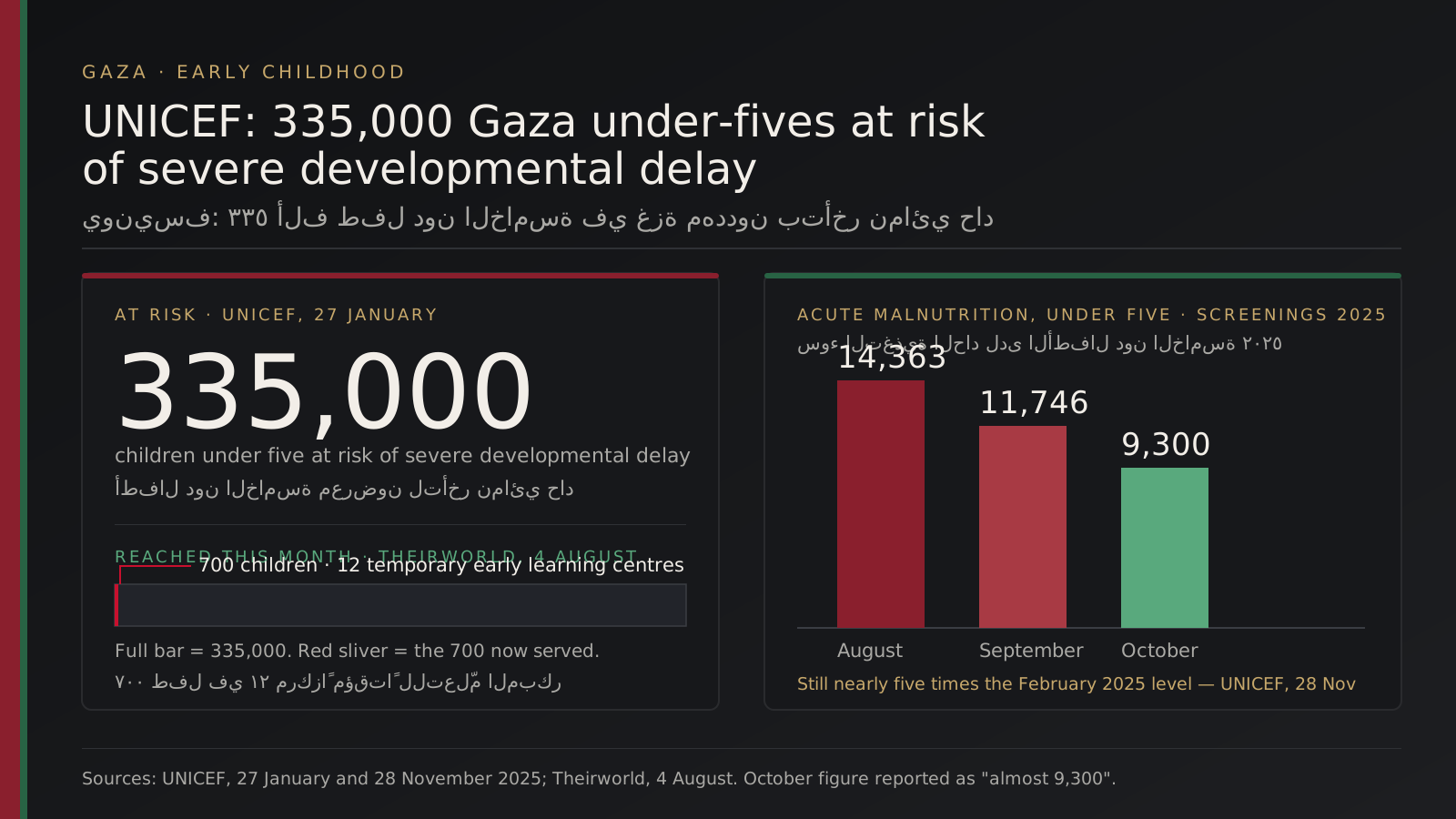
Twelve temporary early learning centres opened in Gaza this month will initially reach about 700 children aged three to five, the British charity Theirworld said on 4 August — a fraction of the more than 335,000 children under five that UNICEF says are at risk of severe developmental delay because early childhood services in the Strip have collapsed.
UNICEF issued that figure from Geneva on 27 January, in the statement announcing the expansion of its Back to Learning programme to 336,000 children.
The same statement said 60 per cent of school-aged children in Gaza then had no access to in-person learning and that more than 90 per cent of schools had been damaged or destroyed. UNICEF spokesperson James Elder, quoted by UNICEF USA, called restoring learning "not a 'nice to have'" but an emergency.
The under-five figure has no published breakdown. UNICEF's January statement does not set out how the 335,000 was calculated, and no Strip-wide developmental screening results for that age group have been released.
Other counts of the same crisis use different boundaries and do not match.
Theirworld's updated report, written by its senior adviser for education in emergencies, Maysa Jalbout, estimates that more than 504,000 pregnant and lactating women and children under six face early childhood development problems — nearly a quarter of Gaza's population — of whom around 175,000 are preschool-aged children growing up without the nutrition, care, safety and early learning they need.
The report's 2025 edition had put the total at more than 570,000.
The nutrition record is the most fully documented part of the picture, and it moves in both directions.
UNICEF said on 28 November 2025 that screenings by the agency and its partners identified almost 9,300 children under five with acute malnutrition in October, down from 11,746 in September and 14,363 in August, but still nearly five times the February 2025 level.
Al Jazeera's Arabic service and the Emirati daily Al-Ittihad carried the same figure, with UNICEF's warning that large quantities of winter supplies remained held at Gaza's crossings.
Save the Children said on 23 July that new data from the Integrated Food Security Phase Classification projects more than 74,000 children under five in Gaza will suffer acute malnutrition in the year to April 2027, including more than 11,000 severe cases.
That is lower than the IPC's December 2025 projection of nearly 101,000 cases with more than 31,000 severe.
The IPC credits the improvement to the aid scale-up after the October 2025 ceasefire, Save the Children said, while noting that aid entry has been falling since February 2026 and that nutritious food parcel distributions and nutrition programmes have been significantly reduced.
The IPC's December analysis left North Gaza out for lack of sufficient data, recording only that nutrition actors there describe the situation as concerning. Gaza governorate was classed at Critical levels, Deir al-Balah and Khan Younis at Serious.
Why the first years carry the risk is not disputed among the specialists cited in the published material. Theirworld's report notes that 90 per cent of brain development takes place in the first five years of life.
Time reported in May, citing the US non-profit Zero to Three, that the first three years are the window in which the brain and central nervous system are still forming, and that prolonged malnutrition in that period can leave reduced IQ, learning disabilities and behavioural problems that persist; stunting, the report said, becomes irreversible after age two.
A review in Frontiers in Public Health notes that severe wasting leaves children up to 11 times more likely to die of common infections.
Before October 2023, early childhood provision in Gaza was thin but functioning, and largely private.
Anera, which helped write the national kindergarten curriculum the Palestinian education ministry launched in 2017 and distributed to more than 2,000 kindergartens in the West Bank and Gaza, records that only about a third of Palestinian four- and five-year-olds were enrolled in preschool.
Gaza's education ministry counted 35,000 children in kindergarten whose schooling was disrupted, the Intercept reported in November 2024. Theirworld puts the number now without access to kindergarten at 70,000.
Palestinian Central Bureau of Statistics data from 2019 and 2020 showed the early childhood development index at 90.9 per cent among four-year-olds and 77.8 per cent among three-year-olds across Palestine, and higher for children who had attended kindergarten — 92.1 per cent against 79.5 per cent for those who had not. The bureau did not publish a separate Gaza index in that release.
Specialist services for developmental disability were already constrained. Gisha reported in 2023 that Gaza's speech therapy field had competent specialists but insufficient resources, and that the equipment needed to programme cochlear implants existed in only three clinics, one of them public.
What is running now is a patchwork. OCHA recorded that partners brought 192 early childhood development kits into Gaza on 21 May, for about 17,000 children. The International Rescue Committee says its early childhood programmes have reached over 22,000 children through structured activities in shelters, mobile kindergartens and community spaces.
UNICEF reported 135,462 children in 111 temporary learning spaces in late January, alongside the first education supplies allowed in after two years of restrictions.
On the nutrition side, the Nutrition Cluster's December bulletin recorded prevention commodities reaching around 60 per cent of children under five and pregnant and breastfeeding women, cash enrolment for 4,000 households of children with severe acute malnutrition and 10,500 with moderate cases, and a WFP "Cash++" approach targeting the first 1,000 days.
UNICEF also trained paediatricians in inpatient management of complicated severe malnutrition, and is redrafting the national nutrition data template — work the bulletin lists as pending.
Theirworld argues that no central body leads the early childhood response, leaving it fragmented across sectors. UNICEF has set a target of in-person learning for all school-age children in Gaza by 2027; no equivalent published target exists for the under-fives.
OCHA reported in June that funding shortfalls were already forcing partners in Gaza to scale down or suspend services, with the Zikim crossing closed for two weeks and convoys rerouted through Kerem Shalom. Whether the kindergartens now opening in tents grow into a system, and how many of Gaza's youngest children are already developmentally delayed rather than at risk of it, remain unmeasured.