Israeli Press
Ynet audit finds unnamed security sources drove 15 threat reports
Graphic: Times of Palestine
Original Reporting
The Newsdesk gathers reporting from wire services and primary sources and rewrites every story in-house before publication. How our journalism is made →
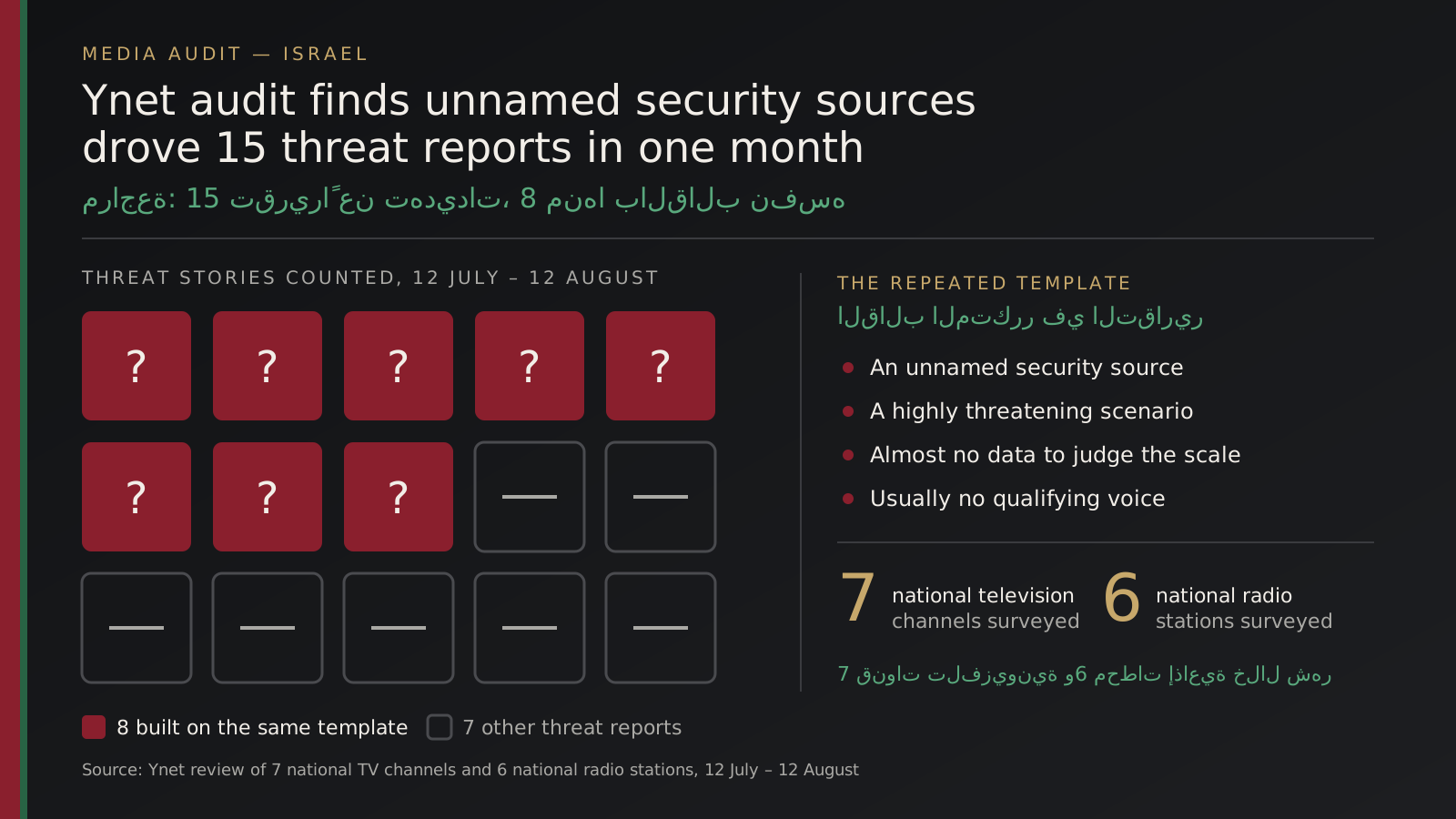
A review published by Ynet in mid-August found 15 distinct threat stories on Israeli national broadcast media over one month, eight of them built on the same template: an unnamed security source, a highly threatening scenario, almost no data that would let a viewer judge the scale of the danger, and usually no qualifying voice anywhere in the original item.
Ynet said the review covered 12 July to 12 August across seven national television channels and six national radio stations.
In its own summary of the findings, Ynet described the material as running from a dramatic Iranian nuclear threat that never existed to reports of a Syrian air force build-up at a time when Syria holds at most two advanced aircraft.
Some of the reports turned out to be fake, Ynet wrote, the credibility of others is in doubt, and many of them travelled onward into Netanyahu's speeches and the remarks of people around him. Ynet added that there is no evidence of an organised intimidation campaign, and noted that an election is approaching.
“being on the ground is essential. It allows journalists to question official accounts on all sides”
The review began with a single item.
Ynet reported that a week before publication, Yedioth Ahronoth and Ynet had themselves carried a story that originated in a dramatic quotation attributed by a controversial far-right blogger in India to Ahmad Vahidi, a senior figure in Iran's Revolutionary Guards, in which Tehran supposedly admitted for the first time that it was developing nuclear weapons.
Netanyahu addressed the purported statement publicly, according to Ynet's account.
Ynet's published summary does not identify the eight patterned items by broadcaster, date or correspondent, so the individual claims cannot be traced from the review itself.
A second illustration of the same sourcing arrived weeks later. Ynet reported in late August that Netanyahu, speaking by telephone with Channel 14 military correspondent Noam Amir, said Iran had tried to assassinate one of his sons and that the information had been barred from publication for months.
Ynet attributed to unnamed sources the assessment of security bodies that the family faces a high-level threat for life, and reported that the Ministerial Committee for Shin Bet Affairs approved lifetime protection on 16 July.
The access side of the file has a recent test case in the occupied West Bank. Yesh Din wrote to the head of Israel's Central Command, Maj. Gen. Avi Bluth, in early August to say that settlers had laid siege to two houses in the village of Qusra, in Area B, Walla reported.
Seven Palestinians, including girls aged 10 and four, had been trapped for three days; the settlers had cut the electricity and the water pipes, and stocks of food and water were running out.
Yesh Din said residents of the Tel Talpiot outpost, set up in Area B in January, had erected a hut beside the two families' homes and imposed the siege that evening.
Walla reported the following day that the army had begun clearing the siege, that dozens of settlers were confronting soldiers, dismantling fences and blocking roads, that the whole area had been declared a closed military zone, and that Bluth came to oversee the operation, spoke with the Palestinian residents and asked the settlers to leave.
The Israel Democracy Institute, writing weeks later, said the IDF Spokesperson had called the acts illegal, disgraceful and improper while the outpost went unevacuated for two days, and concluded that both Israeli publics learned from the episode that the army's words do not predict its actions.
Israel's Press Council said it would approach the IDF Spokesperson to demand an urgent meeting, after what it described as selective enforcement in the coverage of the besieged homes at Qusra. The Council's statement, published during the siege week, does not set out which crews were turned back.
Local Call reported in mid-August that around a hundred activists, most of them Israelis, accompanied by media crews from several countries, reached the vicinity of the house for the first time and left food, bottled water and medicine at the gate after carrying them roughly a kilometre on foot, while soldiers and Border Police blocked access to the house itself and threatened to disperse the group by force.
One of the besieged residents, Abu Ridi, told Local Call by phone from inside that nothing had changed and the family was still under siege — days after the army was reported to have begun lifting it.
Local Call also noted what was absent at Qusra: no army claim of gunmen to be disproved, no assertion of mutual friction of the kind the IDF Spokesperson routinely supplies.
Gaza remains closed to independent foreign reporting.
The Foreign Press Association petitioned Israel's Supreme Court in September 2024 for access, according to Al Jazeera; the Committee to Protect Journalists filed its own challenge in the same court in October 2025, saying its review found Israel's blanket prohibition on independent media access unlike the arrangements in other recent wars.
In April 2026, Al Jazeera reported, executives of more than two dozen international media companies wrote jointly to Israel, arguing that "being on the ground is essential. It allows journalists to question official accounts on all sides."
Whether the Press Council obtained its meeting with the army spokesman, and whether any broadcaster has corrected one of the eight items Ynet flagged, is not on the public record.
The Council's own history with wartime coverage complaints is mixed: The Seventh Eye reported in November 2024 that its ethics tribunal shelved a complaint brought by MK Ofer Cassif against Channel 12 and presenter Danny Kushmaro over a broadcast in which Kushmaro filmed himself taking part in the demolition of a building in southern Lebanon.