Field Reports
Gaza's social development ministry registers orphans, not their guardians
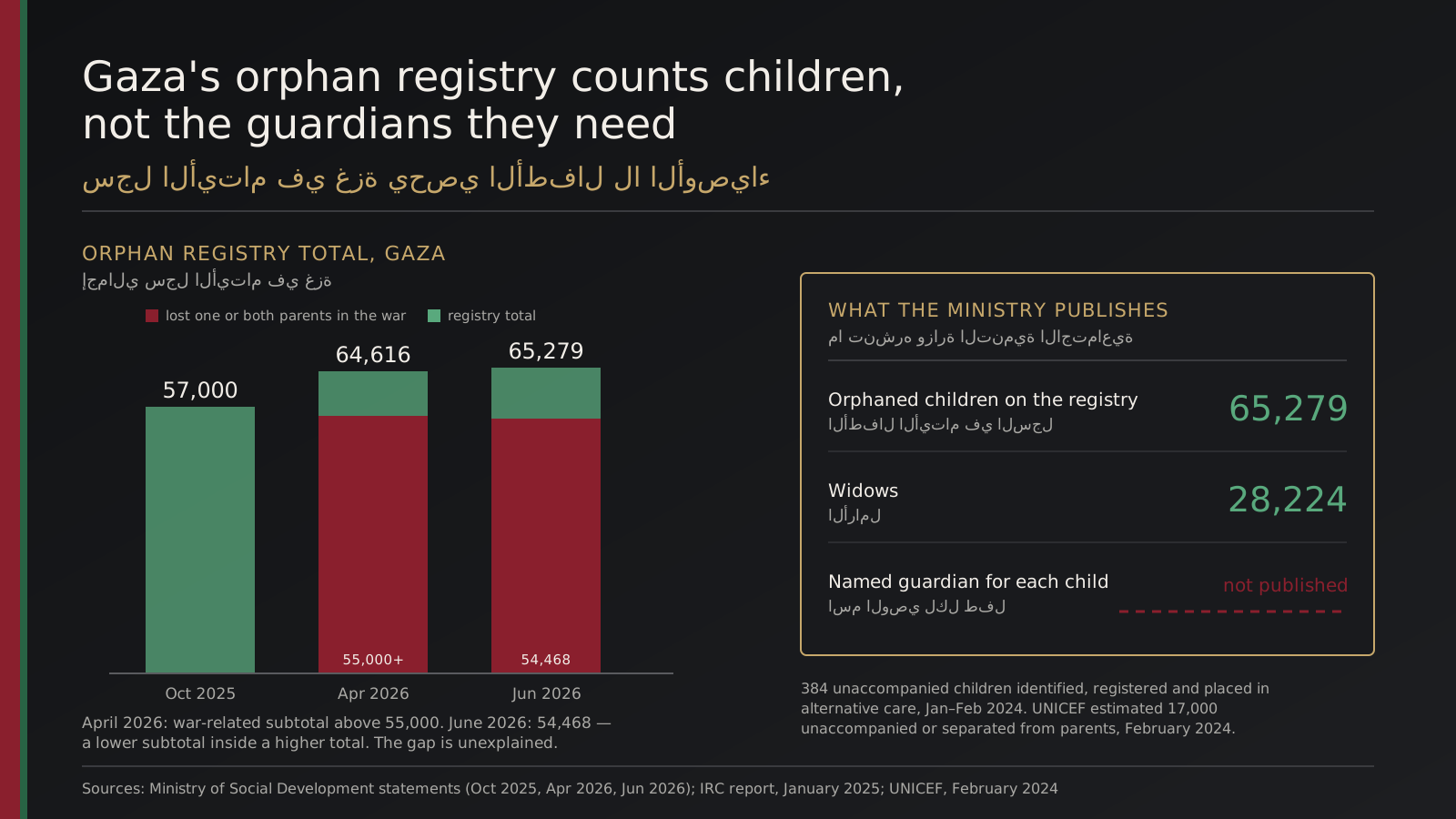
Graphic: Times of Palestine
Original Reporting
The Newsdesk gathers reporting from wire services and primary sources and rewrites every story in-house before publication. How our journalism is made →
The Palestinian Ministry of Social Development had 65,279 orphaned children on its Gaza registry at the end of June 2026, according to a ministry press statement carried by Palestinian outlets including the Freedom and Justice portal and Aajeg. Of those, the ministry said 54,468 lost one or both parents during the war, and 2,039 children were added to the orphan rolls between the start of the ceasefire and July 2026.
The same statement put the number of widows at 28,224, of whom 742 were widowed between 10 October 2025 and July 2026.
What the ministry publishes is a count of children. It is not a count of guardians. Its statements set out totals for orphans and widows without saying how many children live in a documented care arrangement, who was assessed as a carer, or what a household receives for taking a child in.
The registry has grown steadily since the ceasefire. In October 2025 the ministry said the number of orphans in Gaza had reached 57,000, as reported by the Shehab news agency and Al Jazeera.
In its statement for Arab Orphan Day on 3 April 2026, issued from Ramallah and published on its own website, the ministry put the figure at 64,616, of whom more than 55,000 had lost one or both parents during the preceding period.
The two ministry statements do not reconcile. The April figure for war-related orphanhood was above 55,000; the June figure was 54,468, a lower subtotal within a higher overall registry. Neither statement explains the difference.
The category itself is broader than the word suggests. The ministry counts children who lost one or both parents, so the registry total is not a count of children left without any surviving parent — a distinction that matters for guardianship, because a child with a surviving mother is not a child in need of placement.
The separate caseload — unaccompanied and separated children, the ones who actually require someone to be appointed — has never been counted with any confidence. UNICEF estimated in February 2024 that at least 17,000 children in Gaza were unaccompanied or separated from their parents.
The International Rescue Committee, in its report on unaccompanied and separated children published in January 2025, described that estimate as conservative, noting it represented about one percent of a displaced population of 1.7 million, while separation rates in emergencies are typically put at three to five percent.
The registration gap is starker. The IRC report cited the Child Protection Area of Responsibility as reporting that 384 unaccompanied and separated children were identified, registered and given support in shelters or other alternative care arrangements between January and February 2024.
The IRC said a comprehensive figure was difficult to obtain because the data sat with different actors and a structured system to identify and register these children had only been operational since the beginning of 2024.
Responsibility for alternative care rests with the Ministry of Social Development, the IRC report said. It described a referral pathway under which an identified unaccompanied child is notified to SOS Children's Villages International, UNICEF and the ministry, reviewed by a committee drawn from those bodies and others, and, if approved, placed with SOS Children's Villages International until reunification closes the case.
Most children were never in that pathway. A UN survey in April 2024, cited in the IRC's August 2024 statement on the report, found 41 percent of families in Gaza were caring for children who were not their own — more than eight times the rate expected in an emergency. That informal kinship care, largely undocumented, is what has absorbed the caseload.
The IRC also recorded that the Child Protection Area of Responsibility and UNICEF were seeking partners to support families already caring for such children, and that telecommunications outages and access restrictions were obstructing family tracing. Medical staff described so many children arriving for treatment with no surviving relatives that a term was coined for them: wounded child with no surviving family.
Rebuilding the paperwork has fallen partly to families. In August 2025 the ministry opened an online channel for registering and updating orphan data in Gaza, allowing households to review and correct their children's records so that relief bodies could rely on the information, the Sanad news agency reported.
Whether adolescents are placed at all is not answered in the published record. Neither the ministry's statements nor the IRC's review gives an age breakdown of children in alternative care, and neither sets out an allowance figure for a host household.
Conditions keep moving the children. In the same statement, the ministry said 638 families had lost their shelter entirely and more than 800 families had been displaced again by incursions and the widening of the line known as the yellow line, with some leaving their tents to sleep in the open.
The ministry has not said whether the reconstituted registry will record a named guardian for each child, or when a placement figure will be published. Until it does, the number that exists counts loss, not care.