Culture & Arts
Palestine marks eighteen years since Mahmoud Darwish's passing
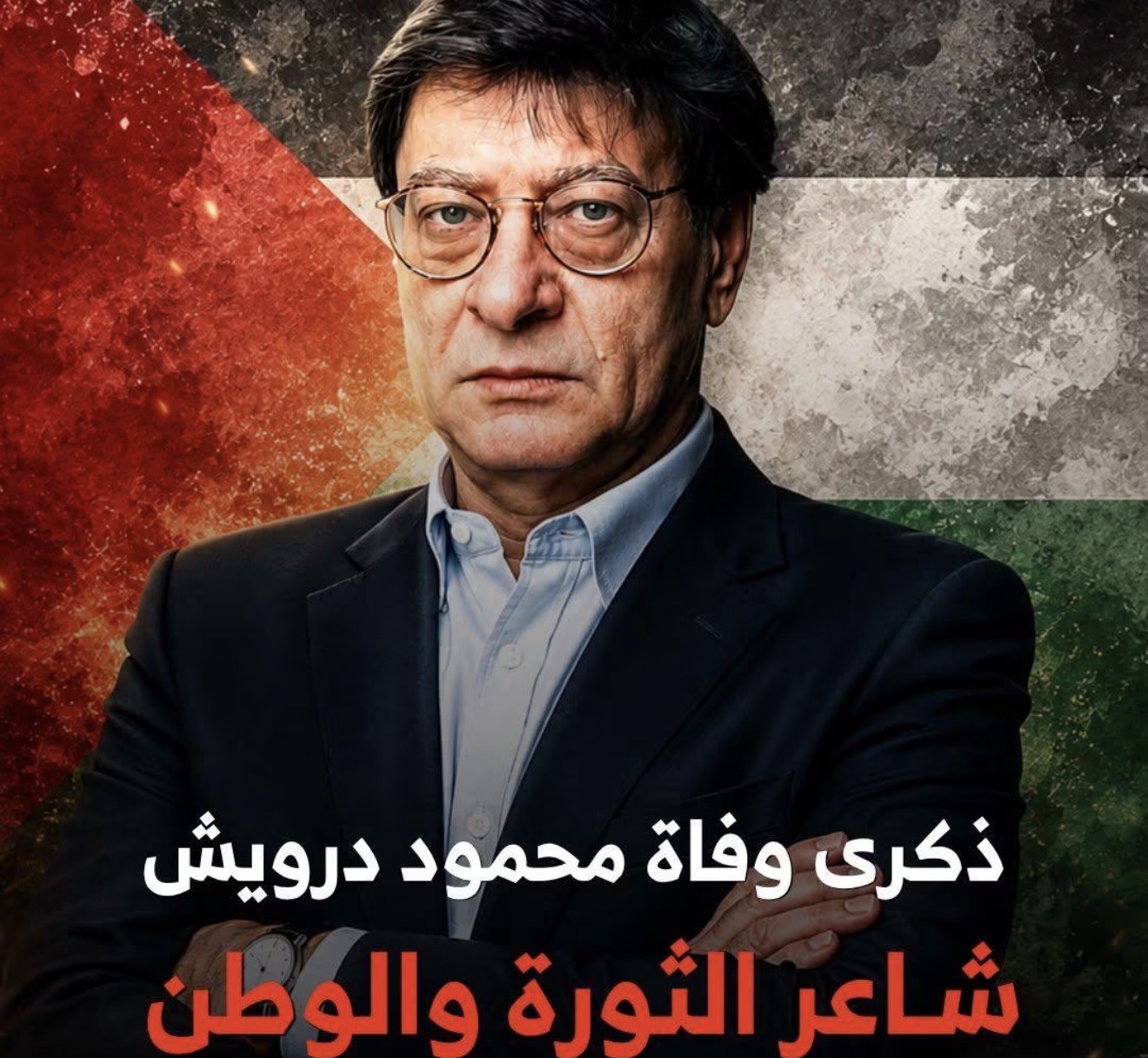
Image credit: Artwork: supplied by the publisher, Times of Palestine
Original Reporting
The Newsdesk gathers reporting from wire services and primary sources and rewrites every story in-house before publication. How our journalism is made →
Eighteen years have passed since 9 August 2008, when Mahmoud Darwish died in a Houston hospital after open-heart surgery and Palestine discovered what it means to bury a national poet. Ramallah gave him a funeral the city had granted only to Yasser Arafat before him, and laid him on a hilltop beside the Palace of Culture that now carries his museum.
Eighteen years on, the anniversary finds his verse doing what it has always done — standing in for a country that is still not allowed to exist on its own land, and consoling the people who carry it.
On this earth is what deserves life.
Mahmoud Darwish
The boy from al-Birwa#
Darwish was born on 13 March 1941 in al-Birwa, a Galilee village of olives and wheat east of Acre. He was seven when the Nakba erased it: the family fled to Lebanon in 1948 and slipped back across the border a year later to find the village gone, its people scattered, and their own names entered in the new state's registries as "present-absentees."
The wound became the work early. At twenty-two, in the 1964 collection "Olive Leaves," he wrote "Identity Card" — write it down: I am an Arab — and an entire people recognized its voice. The poem cost him: Israeli authorities jailed him repeatedly through the 1960s and held him under house arrest in Haifa before he left in 1970, for what became twenty-six years of exile.
Exile as a map#
The exile itinerary reads like the century's Palestinian atlas: Cairo, then Beirut — where he edited the literary journal al-Karmel and lived the 1982 siege — then Tunis and Paris. He wrote the Palestinian Declaration of Independence that Arafat proclaimed in Algiers in 1988, and resigned from the PLO Executive Committee in 1993 in disagreement with the Oslo Accords.
In 1996 he came back, dividing his last years between Ramallah and Amman. The late books — "Mural," written after the 1998 heart surgery he survived; "State of Siege," written in Ramallah under the 2002 siege — turned his own mortality and his city's encirclement into some of modern Arabic's most read poetry.
The poems that became a homeland#
By his death, Darwish had published more than two dozen collections, been translated into over twenty languages, and collected the honors of several continents — the Lannan Cultural Freedom Prize in 2001, the Netherlands' Prince Claus Award in 2004, France's Order of Arts and Letters.
Marcel Khalife's settings of "Rita and the Rifle" and "I Long for My Mother's Bread" carried the poems to listeners who had never opened a book of verse.
The deeper honor is harder to measure: three generations of Palestinians have learned the shape of their own story in his lines, and mourners from Gaza to the diaspora still reach for them first when the news becomes unbearable.
Eighteen years on#
This year's anniversary arrives in wartime, and its commemorations are shaped by it. Al-Araby al-Jadeed reported that planned events were postponed, leaving one defiant exception on a Haifa stage.
That exception is "The Lover," a musical theatre work at the Sard theatre that walks his life through its stations — al-Birwa, Haifa of the early sixties and the Rita poems, Beirut, Paris, and finally Ramallah, closing with "The Dice Player" and "Think of Others."
His museum keeps the flame on the Ramallah hilltop where he is buried, and his village keeps returning to the culture pages — this week in the story of Mona Miari, the singer and daughter of al-Birwa now carrying its memory onto the world's stages.
Eighteen years after his heart stopped in Texas, the poet of revolution and homeland remains what his people called him at the graveside: the voice in which Palestine speaks to itself.

%20(cropped).jpg?width=640)