Culture & Arts
Sama' Abdulhadi carries Ramallah's techno scene to global festivals
Graphic: Times of Palestine
Original Reporting
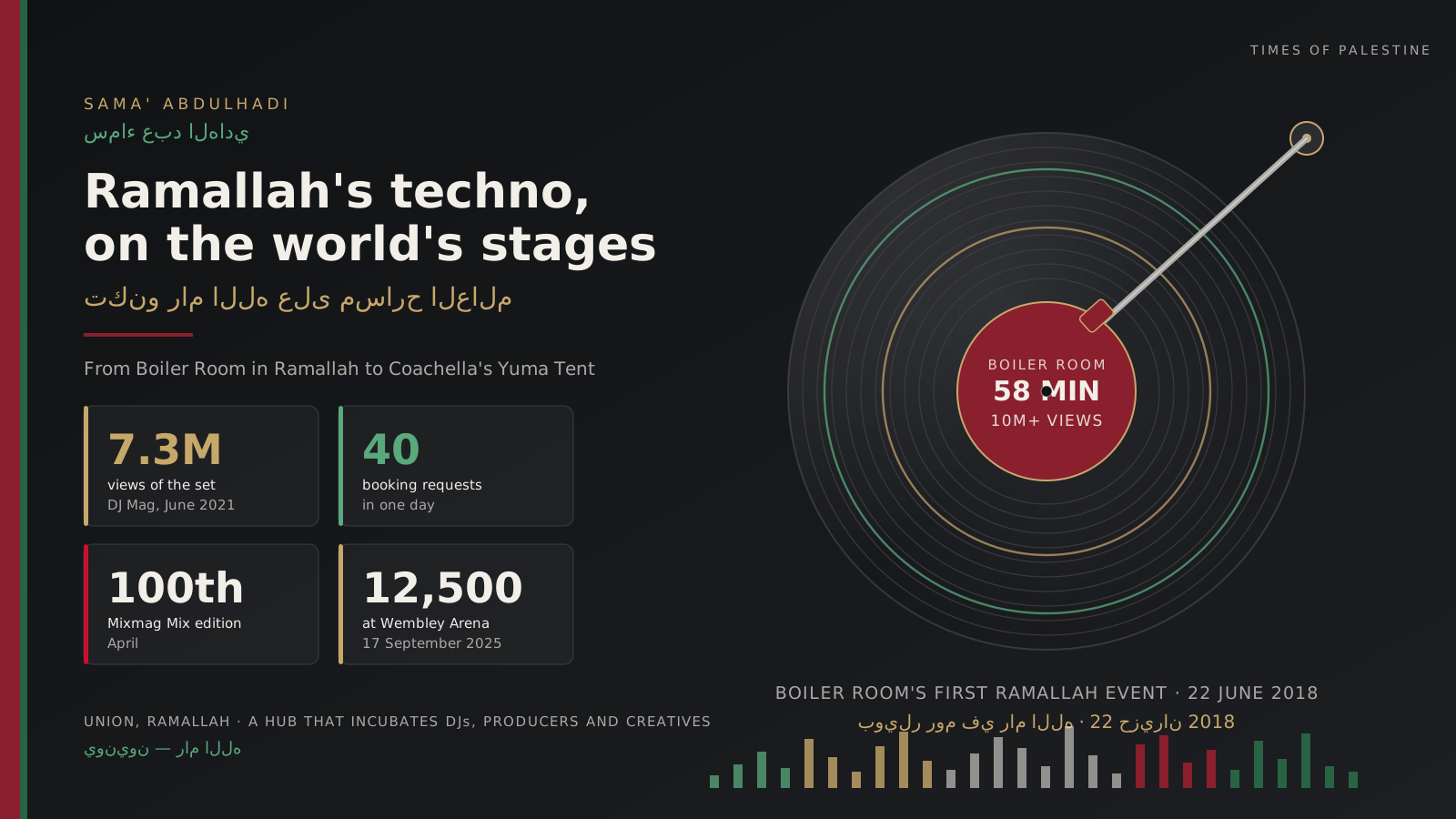
Sama' Abdulhadi was handed the 100th edition of Mixmag's Mix series in April, an anniversary slot the magazine gives to a single DJ, and she took it while unable to get home.
Mixmag described her as "the best known, most visible Palestinian in dance music" and reported that, when they spoke, she could not travel to her hometown of Ramallah because of travel restrictions caused by the violence in the region.
The distance is new. The scene she is carrying is not.
Boiler Room staged its first event in Ramallah on 22 June 2018, billing it as a showcase of the Palestinian underground, with Abdulhadi alongside Jazar Crew, Julmud, Dakn and Makimakkuk.
DJ Mag reported in June 2021 that her set from that night had passed 7.3 million views, one of the platform's most-watched, and described her beaming through a pounding techno set to a crowd of mostly family and friends. Her agency biography now puts the 58-minute set above ten million views.
The bookings changed overnight. "The weekend of the Boiler Room," she told DJ Mag, "I got 40 booking requests in one day. Before, I would get 20 requests a month, if I was lucky."
The Onassis Foundation, which has programmed her, says she is the first Palestinian DJ to gain international recognition and that her career began in Beirut's techno scene, where she refined what she calls "Berlin techno, but I perceive it in a Lebanese way." Her agency biography traces the path from there: audio engineering at SAE Institute London, two albums under her former alias Skywalker, sound design work in Cairo including on the Egyptian films "The Builders" and "Thread and Wall", training with the Oscar-winning sound designer Nicolas Becker, and the launch of her own publishing agency, Awyav, with the Arabic music incubator Eka3.
The French magazine Numéro reported that she dropped the Skywalker name in 2017 and had begun putting on electronic parties in Palestine in 2010.
DJ Mag reported that when Abdulhadi was 13, during the Second Intifada, Israeli forces took over her apartment block in Ramallah and locked her and her family on the roof.
Back in Ramallah she built infrastructure rather than a solo career.
She told Red Bull she wanted "a safe space, a home and a hub", and contacted DJ friends across Palestine to form a collective open to anyone — stage designers, graffiti artists, people who build light systems — where everyone works every job at a party: two hours on the decks, an hour on the door, an hour in the bathrooms, and whatever money comes in gets split.
The Palais de Tokyo, which has hosted her, describes the hub, Union, as a Ramallah venue that incubates DJs, producers and creatives.
Late in 2020, that work collided with the Palestinian Authority.
Beatport, which had commissioned a four-part residency, said the third instalment was a five-hour solo set filmed in the courtyard of a hostel on the Nabi Musa site, approved in writing by the General Director of the Palestinian Ministry of Tourism, with 30 friends and crew present; the recording ended when a group entered and ordered guests out, citing religious protections for the site.
Arab48 reported that the public prosecution brought two charges, desecrating a religious site and breaching emergency measures against the spread of Covid-19, and ynet reported that Palestinian sources said she was held on suspicion of desecrating Islam.
Her family said publicly that the event had been agreed in advance with the Ministry of Tourism, that Nabi Musa was treated as an archaeological and tourist site, and that the set took place in the bazaar courtyard, on the opposite side of the complex from the mosque, which was never approached.
Her father told CNN he rejected the claim that she had desecrated a holy place, saying the event was held in another part of the compound.
She was released after eight days in a Jericho jail, on a court order setting a 500 Jordanian dinar cash bond, with a travel ban and no indictment, awaiting the attorney general's decision on whether the charges would be pursued.
Ammar Dweik, director of the Independent Commission for Human Rights, had asked the PA to release her, saying she had permission and that "if electronic music was not appropriate for it, the ministry should not have given its authorisation." A petition for her release drew more than 100,000 signatures, and she said afterwards she was "overwhelmed by the support from my fellow musicians, artists, activists and the entire music community." No public announcement of the attorney general's decision has followed.
Speaking to Billboard from Ramallah months later, she said she had stayed home and worked on production at first, then decided to face it and finish the residency.
The career since has run through the largest stages in dance music. Her agency lists Glastonbury, Fusion, Circoloco, Primavera, Belfast's AVA, Brazil's Warung and Exit's Dance Arena in Serbia, a sold-out four-Friday residency at London's Phonox in January 2023, and a BBC Radio 1 Essential Mix.
The National reported that she played Coachella's Yuma Tent across both weekends in 2025, and that a Guardian critic named her one of the festival's highlights.
During the war she has used the visibility directly. CNN reported that she performed at Together for Palestine at Wembley Arena on 17 September 2025, on a bill with Bastille, James Blake, Jamie xx, PinkPantheress, Saint Levant and Elyanna; the fundraiser, organised by Brian Eno, drew 12,500 people, with proceeds going to Palestinian-led organisations.
In June 2025 she pulled out of Sónar, saying she "cannot and will not be associated with festivals or institutions backed by KKR", one of several withdrawals over the festival's investor. Resident Advisor, opening its new season with her in September, called it the most outspoken she had ever been.
Her verdict on her own industry, in a clip from that interview: after 7 October, techno shattered.
Her own account of her role, given to This Week in Palestine, is narrower than the title she is given: everyone has a part to play, and what she does best is press these buttons and play techno music.
DJ Mag noted in 2021 that Palestinians in the occupied West Bank do not have freedom of movement, and that she faced a choice between Ramallah and a residency card in Paris. The closure has since settled that question for her. When she will play Ramallah again is not something any published record answers.