Opinion & Analysis
Arab state broadcasters should copy the leaner Alhurra Washington built
Graphic: Times of Palestine
Original Reporting
The Newsdesk gathers reporting from wire services and primary sources and rewrites every story in-house before publication. How our journalism is made →
For twenty-one years Alhurra was the easiest joke in Arab media: a satellite channel Washington paid for and nobody watched. This year the joke has an uncomfortable second act. The United States tore the channel down, kept the newsroom, and rebuilt it as something smaller, cheaper and, on its own figures, more read than the television ever was.
Palestinian readers have every reason to distrust an outlet Congress funds to tell America's story. They have no reason to ignore how it was fixed, because every Arab capital is paying for the same dish and none has dared to turn it off.
What Washington was paying for#
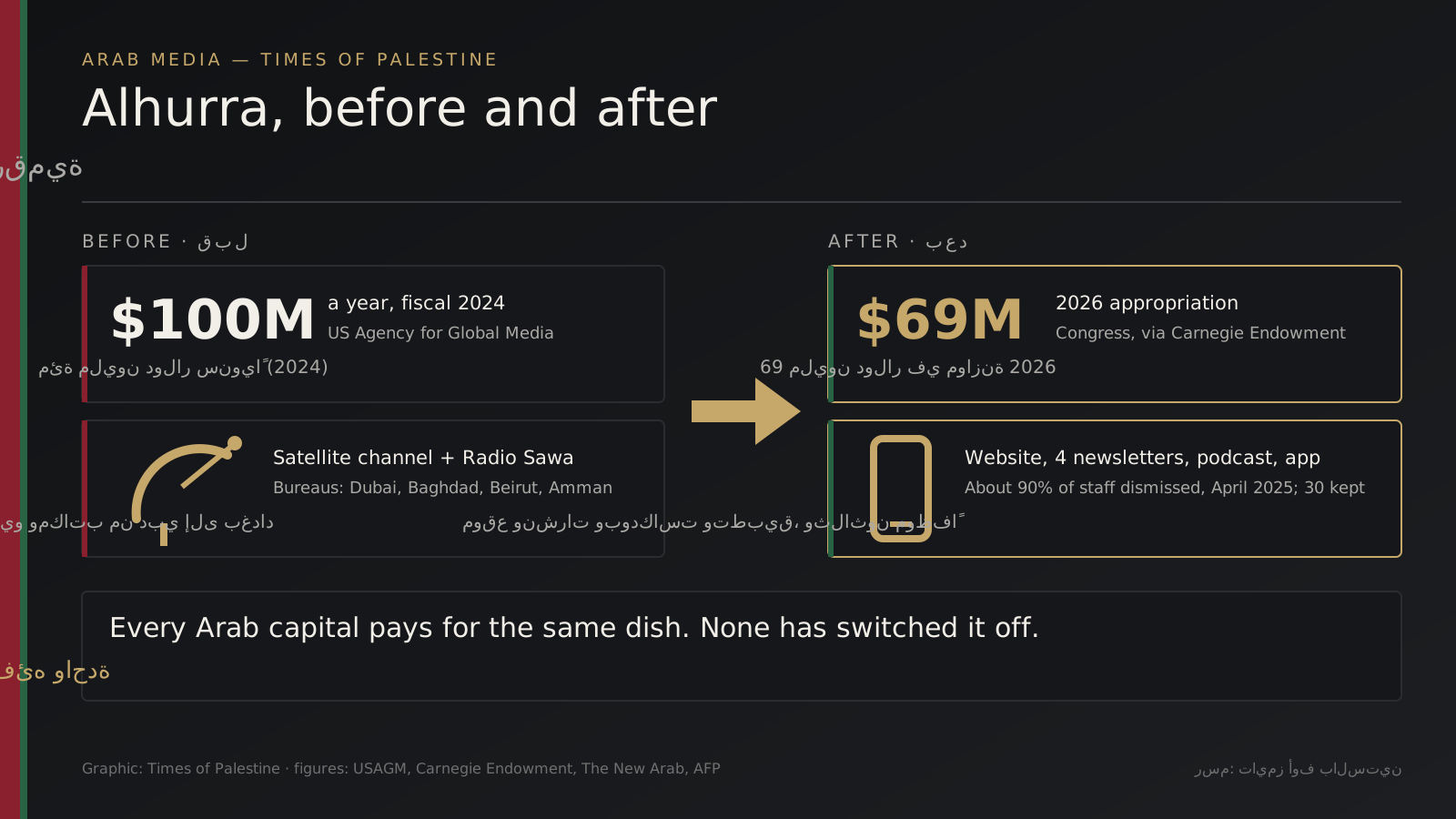
The channel went on air in February 2004, eleven months after the invasion of Iraq, with a first-year budget of about $67 million. By the 2024 fiscal year its parent, the Middle East Broadcasting Networks, was spending roughly $100 million a year, according to the US Agency for Global Media, which funds it.
The audience never followed the money. A 2008 investigation by ProPublica and CBS's 60 Minutes found the channel drawing about two percent of viewers in the markets it surveyed, and a Senate report the same year questioned both its effectiveness and its expense.
Weekly reach, which the network put at 35 million in 2005, settled at 25 to 27 million for the decade to 2022, under nine percent of Arab adults, by the count of the University of Southern California's Center on Public Diplomacy. The network's own claim last year was 34 million a week; nobody outside it has ever verified that number.
The demolition#
The cut came in two blows, and neither was a plan. In September 2024 Congress ordered about $20 million off the budget.
MBN dismissed 160 people, a fifth of its staff, and folded Alhurra Iraq into the main channel, its then-acting chief Jeffrey Gedmin promising a network "leaner, more efficient, more agile, and ultimately more effective", the agency's announcement said. Radio Sawa, the pop-and-headlines station launched in 2002, went silent that November.
Then on 15 March 2025, one day after Congress had appropriated the year's money, the Trump administration's Department of Government Efficiency and Kari Lake, the president's adviser at the agency, terminated MBN's grant.
On 11 and 12 April the network dismissed about ninety percent of its workforce, kept 30 people, and took Alhurra off the air. All 99 staff in Dubai learned of their dismissal from an email headed "Thank you for your service", AFP reported.
"I'm left to conclude that she is deliberately starving us of the money we need to pay you, our dedicated and hard-working staff."
Jeffrey Gedmin, on Kari Lake, in severance letters to staff, April 2025
The human cost was real and the newsroom did not handle it well. About 60 of the dismissed journalists were in the United States on work visas and at least 25 faced deportation, The New Arab reported. Dubai staff told the same outlet that MBN paid no compensation and booked no flights home.
A federal judge, Royce Lamberth, ruled on 25 April that the withholding was likely unlawful and ordered the funds restored. In December the agency terminated the grant a second time, saying it "no longer effectuates agency priorities", and MBN sued again. How much of its money has actually reached the network since is not public.
What survived, and what it costs now#
Here is the part worth envying. The thirty people who stayed kept the website alive, and during the June 2025 Israel-Iran war Radio Free Europe reported audiences across the region surging to Alhurra's site and social feeds.
Congress, which the administration had asked for $153 million to wind the whole agency down, instead wrote $653 million for it into the 2026 appropriation, $69 million of it for MBN, the Carnegie Endowment noted in April.
What that money bought is not a television channel. In notes he publishes on the network's site, Gedmin describes a "digital-first, AI-powered newsroom": a new Arabic-English site launched on 10 June, four weekly newsletters, a podcast, a magazine of features and commentary, an app, and an "Emerging Threats" team.
He also claims the restructuring "has saved the American taxpayer millions of dollars" and another million a year in rent. The network now calls itself the "Arabic-first source of news and commentary connecting the Middle East and the United States", not a channel at all.
Strip the branding and the arithmetic is this: a $100 million satellite operation with a stalled audience became a $69 million digital outlet whose two best-read products, by its own account, are an Iran briefing and a Washington briefing in Arabic. The dish, the studios, the Dubai headquarters and the radio transmitters are gone, and the readership the network reports went up, not down.
The dish nobody turns off#
Now look at the region. Egypt's National Media Authority, heir to the Maspero building and the old Radio and Television Union, signed a framework on 26 August in front of Prime Minister Mostafa Madbouly to settle 88.3 billion Egyptian pounds of historic debt by handing state land to the National Investment Bank, Advanced Television reported.
That is about 1.4 billion euros owed by a broadcaster whose payroll Al-Monitor counted at 37,000 a decade ago, for channels its young audience has already left. Sixty-one percent of Arab youth now get their news from social media and 45 percent from television, the ASDA'A BCW Arab Youth Survey found.
Al Jazeera publishes no accounts. When oil fell in 2016, Doha cut about 500 of the network's roughly 5,200 jobs, Gulf News reported, and the size of the subsidy that pays the rest is a state secret.
Saudi Arabia's Public Investment Fund paid 7.46 billion riyals, about $2 billion, last year for 54 percent of MBC, the group that owns Al Arabiya, Arab News reported. Sky handed full control of Sky News Arabia to Abu Dhabi's International Media Investments in June. The Iraqi Media Network publishes no audited statements, the State Media Monitor records.
Closest to home, the Palestinian Broadcasting Corporation is funded entirely by the Palestinian Authority, publishes no accounts and answers to a general supervisor of official media appointed by the president, the State Media Monitor's 2026 profile says. The one figure in circulation, from PA budget tables shared by public-sector salary trackers, is about 141 million shekels a year, 63 million of it salaries.
That is a television channel paying full wages inside an authority that could pay most of its civil servants only half of their March salary, as PBC's own news site reported at the time.
Learn it before someone does it to you#
The lesson is not that Washington was wise. It was not: a court found the cut unlawful, the dismissals were cruel, and the digital newsroom that emerged was a survival reflex, not a design. Nor is the lesson that Alhurra's output deserves Palestinian trust.
Its mandate, in the agency's words, is a "distinctly American voice" and a "counterweight" to Iran, China and Russia, and readers here will judge that copy sentence by sentence as they always have.
The lesson is about the machine. A state-funded Arabic newsroom can shed its satellite channel, its studios and most of its payroll and end up with more readers, provided the people who stay are journalists and the products they make, newsletters, podcasts and a site that loads, are the ones the audience actually opens.
Every Arab capital knows this and none has done it, because a television channel is a monument and a newsletter is not.
Gedmin's own defence of his network was that "media in the Middle East thrive on a diet of anti-Americanism", and that killing Alhurra would "open the field to American adversaries and Islamic extremists".
Arab readers can set the politics of that sentence aside and still hear the warning in it for their own broadcasters: the money is finite, the audience has already moved, and the choice is between switching off the dish yourself or waiting for someone else to do it by email.