Opinion & Analysis
Board of Peace charter gives Trump veto over Gaza reconstruction
Graphic: Times of Palestine
Original Reporting
The Newsdesk gathers reporting from wire services and primary sources and rewrites every story in-house before publication. How our journalism is made →
The roadmap that now governs the Gaza ceasefire does not say where Israeli forces must stop. That omission, and the chain of authority the surrounding documents build above it, is what a reading of the current texts produces.
The document is dated 30 July 2026. Al Jazeera reported the following day that mediators from Egypt, Qatar, Türkiye and the United States had finalised it, that Trump announced it late on the Thursday, that Hamas said it had agreed to surrender weapons in stages, and that Israel had not publicly accepted the proposal. Hamas said it would implement nothing unless Israeli forces withdrew as required.
On the withdrawal line itself, The Times of Israel reported this month that the Board of Peace avoided specifying whether Israel must pull back to the original ceasefire line, choosing ambiguity in order to keep both sides at the table.
Al Jazeera reported in July that Israel had extended the so-called Yellow Line further into the Strip, which it said experts consider a possible violation of the arrangement the roadmap is meant to carry forward.
The roadmap's own language, in the version published by the Center for Israel Education, is precise about reconstruction and vague about sovereignty.
Rebuilding proceeds under "a plan and timetable prepared and supervised by BoP and NCAG" — the Board of Peace and the National Committee for the Administration of Gaza — under the slogan "One Authority, One Weapon, One Law." The first of the fifteen points, on that text, is full acceptance of the international framework.
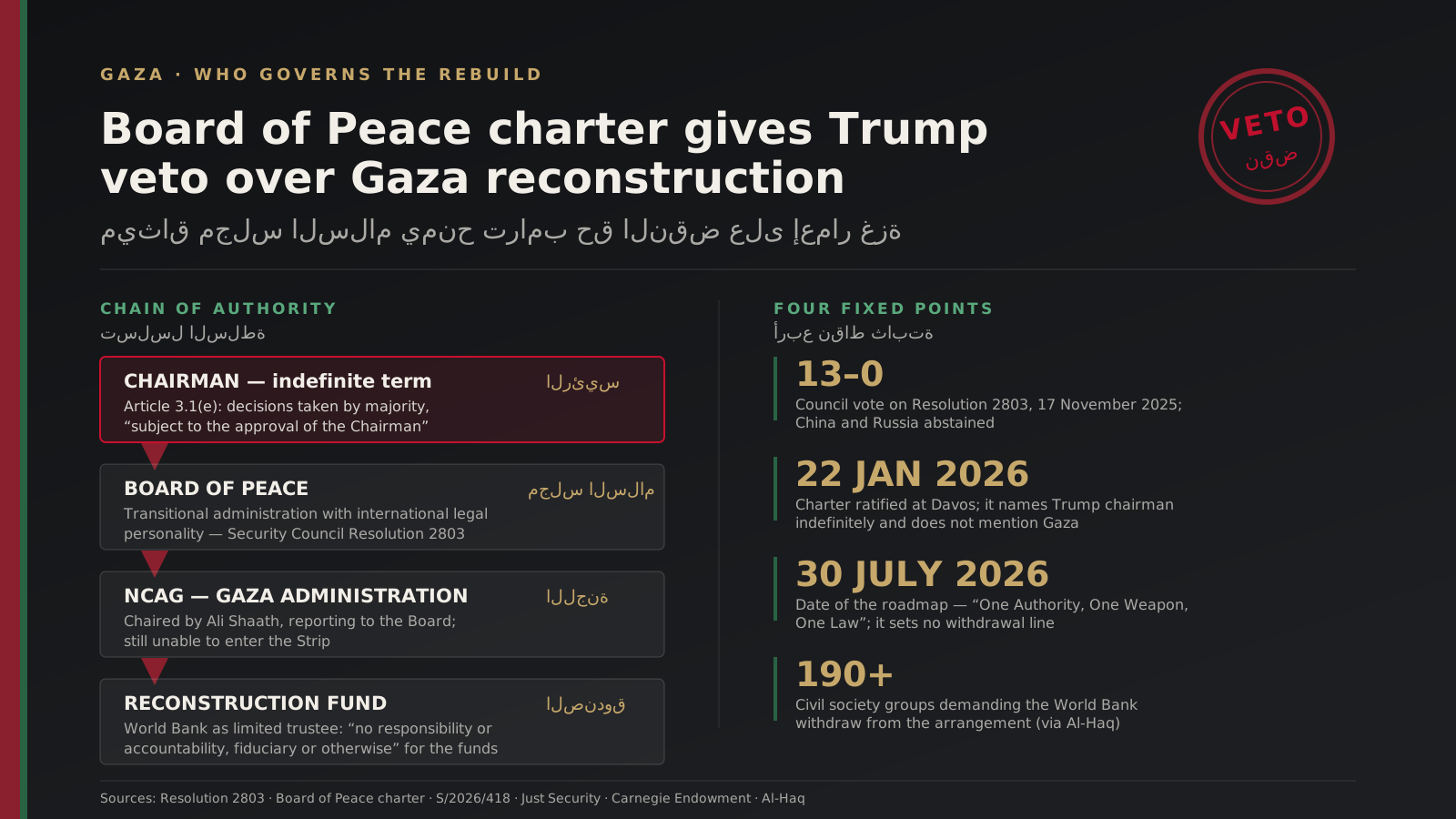
That framework is Security Council Resolution 2803, adopted on 17 November 2025 by 13 votes to none with China and Russia abstaining.
Its second paragraph welcomes the Board as a transitional administration with international legal personality, coordinating funding for Gaza's redevelopment "until such time as the Palestinian Authority (PA) has satisfactorily completed its reform program" and can take back control of Gaza.
Statehood appears once, conditionally: once reform is carried out and redevelopment advances, "the conditions may finally be in place for a credible pathway to Palestinian self-determination and statehood."
Who decides whether those conditions are met is not assigned to any Palestinian institution. JNS, writing in March in support of the resolution's design, put the point without complaint: the preconditions are all subject to Board of Peace assessment, and the decision is discretionary.
The Quincy Institute reached the same reading from the opposite direction in December, noting that the pathway carries no timetable and no firm guarantee, and that Israeli withdrawal is tied to benchmarks negotiated among the stabilisation force, Israel, the United States and the ceasefire guarantors.
On the force, Just Security's February analysis quoted paragraph 7: the International Stabilization Force is to be created "in close consultation and cooperation with the Arab Republic of Egypt and the State of Israel," and "shall work with Israel and Egypt." It is empowered to use all necessary measures.
Chatham House wrote in November that this phrase is the Council's standard authorisation of force, and that while the Board and the force are to support humanitarian deliveries, the resolution places no obligation on Israel specifically to stop obstructing aid.
Troop generation has followed the same asymmetry. The Board's own account of its 19 February meeting in Washington records that Indonesia, Morocco, Kazakhstan, Kosovo and Albania committed troops, that Egypt and Jordan would train a new Gaza police force, and that Major General Jasper Jeffers commands. JNS reported in April, citing Israel Hayom, that Israel blocked Turkish participation in military operations and that Washington accepted the Israeli position.
The money runs through a vehicle whose trustee has disclaimed responsibility for it. The World Bank's Board of Executive Directors approved the Gaza Reconstruction and Development Fund in November 2025 as a financial intermediary fund.
The Carnegie Endowment, quoting the Bank's own documentation in March, noted that the Bank acts as a limited trustee with "no responsibility or accountability, fiduciary or otherwise, for the use of the funds" once transferred.
Carnegie added that of the Bank's thirty-two such funds, the two used for reconstruction of a territory — Ukraine and Haiti — both had the Bank inside the governing group rather than outside it.
The Board's first report to the Security Council, dated 15 May 2026 and circulated as S/2026/418, describes the fund as operating under the strategic direction of the Board and the NCAG, with oversight by the High Representative for Gaza.
Modern Diplomacy reported last week that World Bank President Ajay Banga has said a financial controller was seconded to the Board to build oversight standards. More than 190 civil society groups, in a statement published by Al-Haq, have demanded the Bank withdraw from the arrangement altogether.
Above all of it sits the charter ratified at Davos on 22 January 2026. CNN, which obtained the draft, reported it describes the Board as an international organisation working in "areas affected or threatened by conflict" — with no mention of Gaza — and makes Trump chairman indefinitely.
Just Security's reading of Article 3.1(e) is that Board decisions are taken by majority "subject to the approval of the Chairman," which amounts to a chairman's veto, and that the chairman selects which states are invited; the invitation extended to Canada was revoked after the Canadian prime minister's Davos speech.
The Palestinian body inside this structure has not reached Gaza. The Arab Center in Washington reported in July that the NCAG, chaired by Ali Shaath and reporting to the Board, remained unable to enter the Strip because of Israeli objections, six months after Hamas's administrative committee agreed to hand over.
The committee's size is recorded differently: The Times of Israel described twelve members in January, the Arab Center fifteen in July.
The Palestinian Authority's claim, as carried by WAFA, is that Gaza is an integral part of the State of Palestine and that it is ready to assume full responsibility within the unity of land, people and institutions.
Al-Haq's position, filed to the Human Rights Council in its 61st session, is that the plan endorsed by 2803 breaches the UN Charter and peremptory norms, and that third states should refuse to implement it.
The counter-case is not weak. Chatham House observed that without the resolution the plan could not have been implemented at all. Forty states attended the February meeting and pledged roughly $17 billion, according to the Long War Journal.
Deaths have continued through it. OCHA recorded 856 Palestinians killed since the October 2025 ceasefire in its 15 May update, citing local health authorities; Al Jazeera put the figure at at least 1,100 by the end of July. The Board's mandate expires on 31 December 2027. Its charter sets no end date.