Palestinians in Israel
Israeli police solve 12 percent of Arab community killings
Graphic: Times of Palestine
Original Reporting
The Newsdesk gathers reporting from wire services and primary sources and rewrites every story in-house before publication. How our journalism is made →
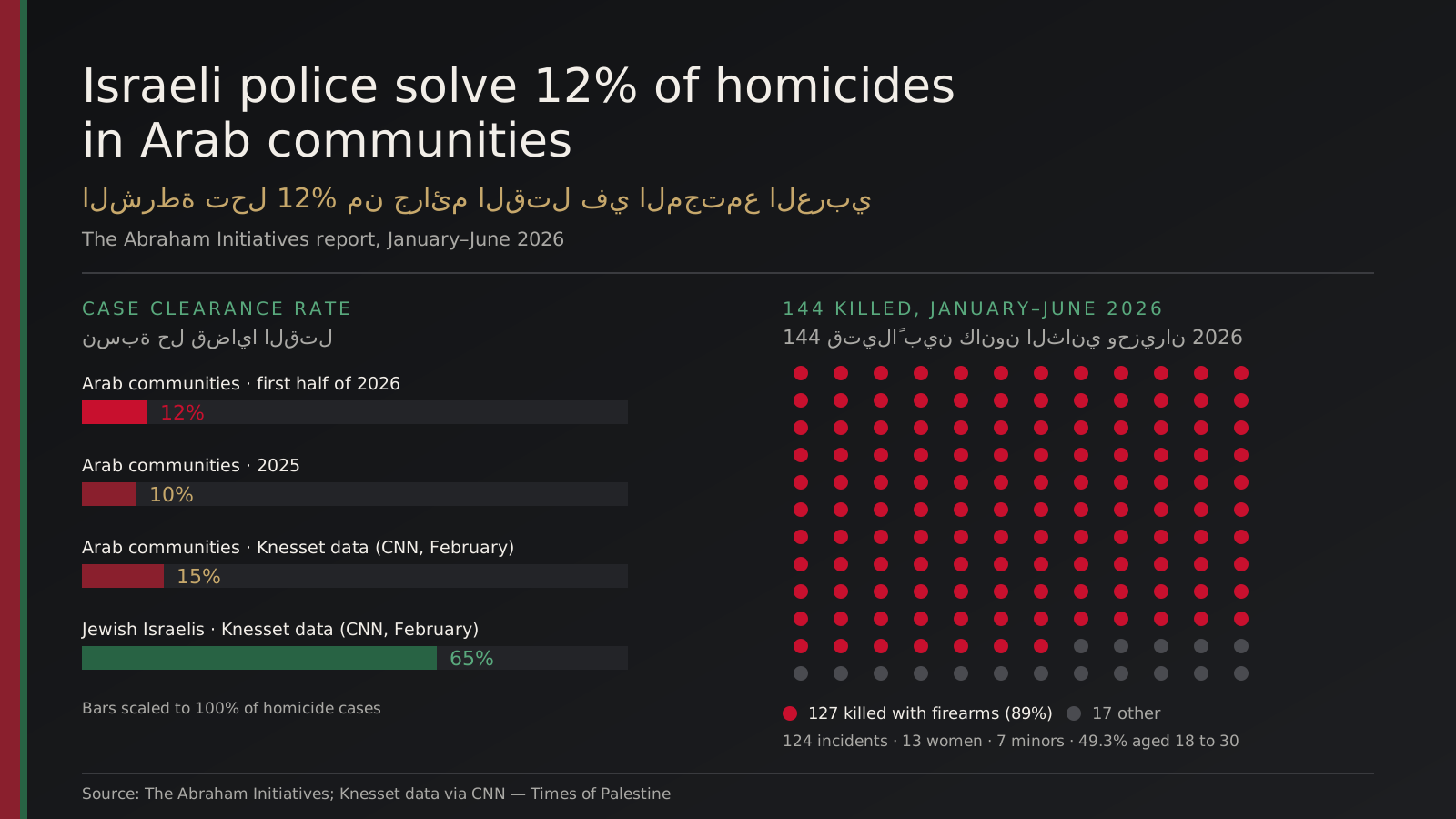
Israeli police solved 12 percent of homicides in Arab communities in the first half of 2026, the Abraham Initiatives said in a report released at the end of June, as the toll reached the highest half-year figure the organisation has recorded.
The watchdog, which tracks violent crime in Arab society from open sources, counted 144 homicide deaths between January and the end of June. Its report said 140 of the dead were Arab citizens of Israel and four were Palestinian residents of East Jerusalem, who fall under the authority of the Israel Police despite not holding citizenship.
The clearance figure for 2025 was worse. The same organisation put it at 10 percent.
Its breakdown, reported by the Hebrew-language outlet Davar, recorded 144 people killed in 124 separate incidents, against 128 in the same period of 2025. February was the deadliest month with 33 killed. Just under half the dead, 49.3 percent, were aged 18 to 30. Seven were minors, 13 were women, and 127 — 89 percent — were killed with firearms.
The killings cluster. Nearly 40 percent occurred in northern Israel, the Abraham Initiatives said. Lod had the highest toll of any locality with nine dead, followed by Nazareth, Umm al-Fahm, Ramle and Rahat with eight each.
The pace of 2026 outstripped every recent year. The organisation noted that the hundredth victim of the year was recorded on day 121, whereas 2025 reached that threshold on 30 May, 2024 on 23 June, 2023 on 9 June, 2022 on 24 November and 2021 on 18 October.
By early July the group counted at least 150 dead, a 17 percent rise on the same point in 2025, The Times of Israel reported.
In a later update carried by the Arabic-language site Bokra, the tally stood at 157 — 153 citizens and four residents, of whom 137 were shot, seven stabbed and six killed in fires. Twelve were women and girls. Five were killed by police gunfire. The comparable figure a year earlier was 139.
What the clearance percentage means in case files was set out in the organisation's analysis of 2025, published in January and reported by the outlet JDN. Of 252 deaths in criminal circumstances that year, it found 32 indictments had been filed. Twelve of those concerned people killed by police fire.
That left, on the organisation's count, 20 solved files out of 240 criminal homicides. In many cases suspects were arrested and then released for want of evidence, it said.
The Israel Police rejected the analysis. Its response, quoted by JDN, said the figures were incorrect and that the organisation should join the national effort. The police have not published their own case-clearance data for 2026.
The disparity between communities is drawn from state material. CNN reported in February that police solved 15 percent of homicides in Arab communities against 65 percent among Jewish Israelis, citing Knesset data and Eilaf, the Center for Advancing Security in Arab Society.
The Abraham Initiatives put the 2025 toll at 252, the deadliest year on record, with Arab citizens accounting for over 80 percent of violent killings while making up around a quarter of the population.
Money allocated to the problem has not been spent. Haaretz reported in December, citing official ministry data, that the National Security Ministry under Itamar Ben Gvir used only half the funds earmarked for fighting crime and violence in Arab society under the 2022–2026 five-year budget.
That same month, ministers approved moving NIS 220 million intended for Arab communities to the police. A joint statement from Prime Minister Benjamin Netanyahu, Social Equality Minister Yair Golan and Ben Gvir called the cabinet decision a critical step in a national plan against crime and illegal weapons in the Arab sector, The Times of Israel reported.
A Knesset committee session convened earlier in December on the diversion of Arab economic development funds went ahead without either ministry. The committee chair confirmed to The Times of Israel that both offices refused to attend. Golan declined to comment. The public affairs director of the Abraham Initiatives, Yanal Jabarin, told the committee the cuts would directly harm education, personal security and health in Arab communities.
Police Commissioner Danny Levy said in late January that law enforcement had seen a continuous decrease in crime statistics. The Abraham Initiatives tally published days later contradicted that. In May, Maariv reported that Levy had ordered all training cancelled and resources redirected to the feuds driving the killings, with central district units and elite Lahav 433 formations reassigned.
Arab political bodies have escalated. The Higher Follow-Up Committee, chaired by Jamal Zahalka, began preparing a three-day general strike in February, according to Arab48, and Anadolu reported shops, schools and institutions closing during a strike day, with a mass demonstration called in Sakhnin. Tens of thousands protested nationwide, the Christian Science Monitor reported in February.
Local officials have themselves been shot at. The National Committee of Heads of Arab Local Authorities condemned a shooting in May that wounded the head of the Jadeidi-Makr local council and his deputy, calling it an unprecedented escalation.
No updated clearance figure has been published since the half-year report, and no independent audit of how the diverted NIS 220 million was spent is on the public record.
.jpg?width=640)


%20(cropped).jpg?width=640)