Field Reports
Tomorrow's Youth Organization extends its Nablus lifeline to Gaza's families
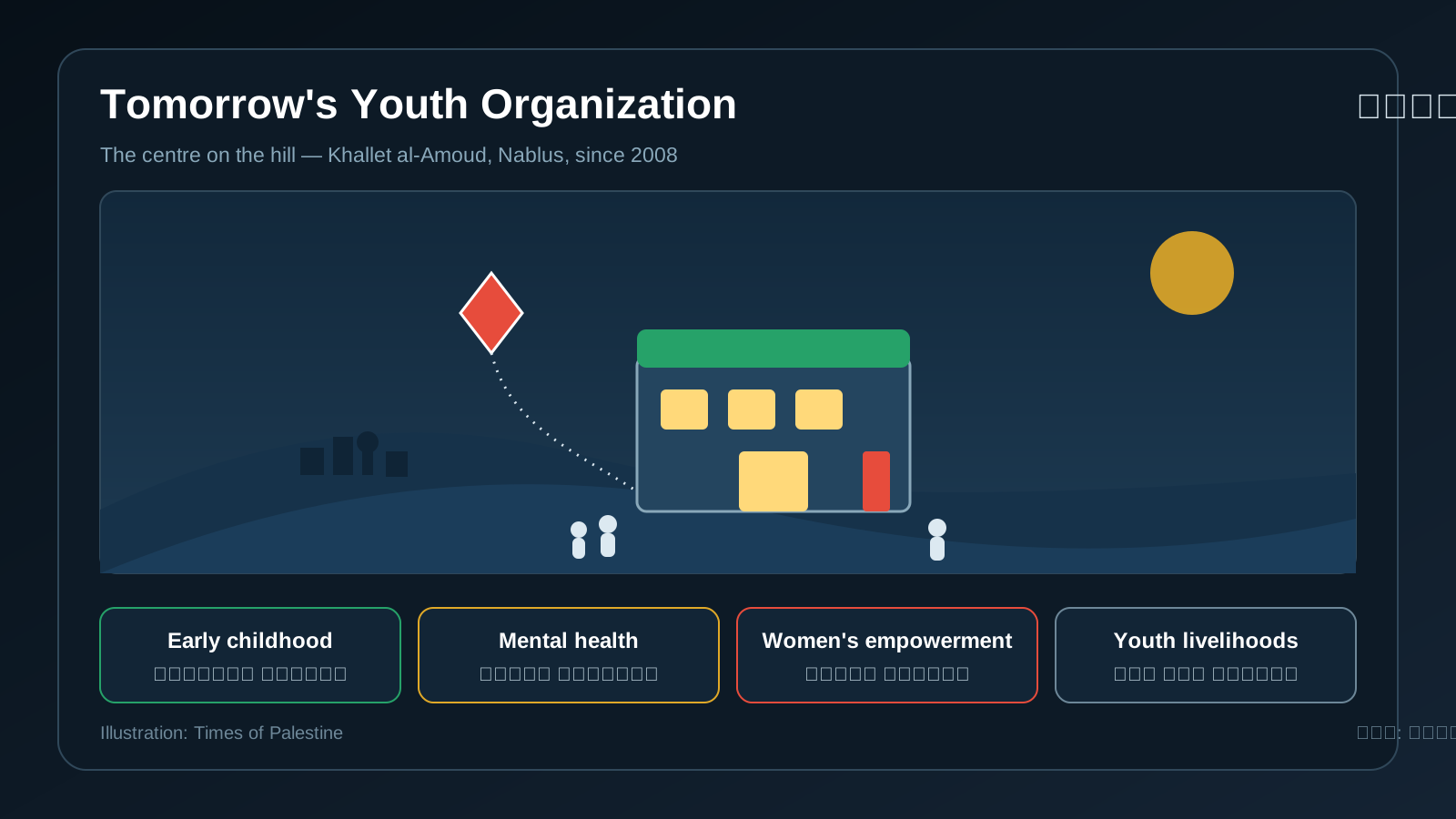
Graphic: Times of Palestine
Original Reporting
The Newsdesk gathers reporting from wire services and primary sources and rewrites every story in-house before publication. How our journalism is made →
On a hillside in Khallet al-Amoud, above Nablus's old city, an American nonprofit has spent eighteen years proving a simple idea: that children from the camps deserve the same start as children anywhere. Tomorrow's Youth Organization — TYO to the families who climb the hill to reach it — has grown from one centre into a lifeline that now stretches to Gaza.
The organization was founded in 2007 by Hani Hikmat Masri, a Nablus-born Palestinian-American businessman who built his career in Washington and never let go of the city he came from. The next year he opened the Nablus centre, which the organization describes as the first American nonprofit based in the city — not a visiting project, but a neighbour with a long-term address.
Masri took his undergraduate degree at the University of Florida and a graduate degree at the University of Colorado, served in Jordan's diplomatic corps as director of the foreign ministry's United Nations department and then as consul at the Jordanian embassy in Washington, and became an American citizen in 1987. He chairs an investment management firm in McLean, Virginia, and is TYO's president as well as its founder.
The address matters. TYO's centre serves the children and mothers of Balata, Askar and El-Ain — the refugee camps that ring Nablus and carry some of the West Bank's densest poverty — alongside the old city's poorest quarters. The families it serves have lived through two decades of raids, closures and loss.
What the centre teaches#
The programs run in four strands: early-childhood education, mental health, women's empowerment and youth livelihoods. Four-year-olds get classrooms with art, music and play — the kind of start their parents rarely had. University students train as volunteers and translators, and young graduates learn the skills that make a first job possible.
The mental-health program, sponsored by the Qatar Fund for Development, sends social workers into the centre's classrooms and into families' homes — psychosocial support delivered where children actually live, in a city where fear arrives with every incursion.
The women's empowerment strand treats mothers as the community's engine, not its afterthought: literacy, fitness, entrepreneurship and business training that has helped women from the camps open and grow enterprises of their own. Cherie Blair, Quincy Jones and Bill Clinton have all lent the organization their support over the years.
What the money bought#
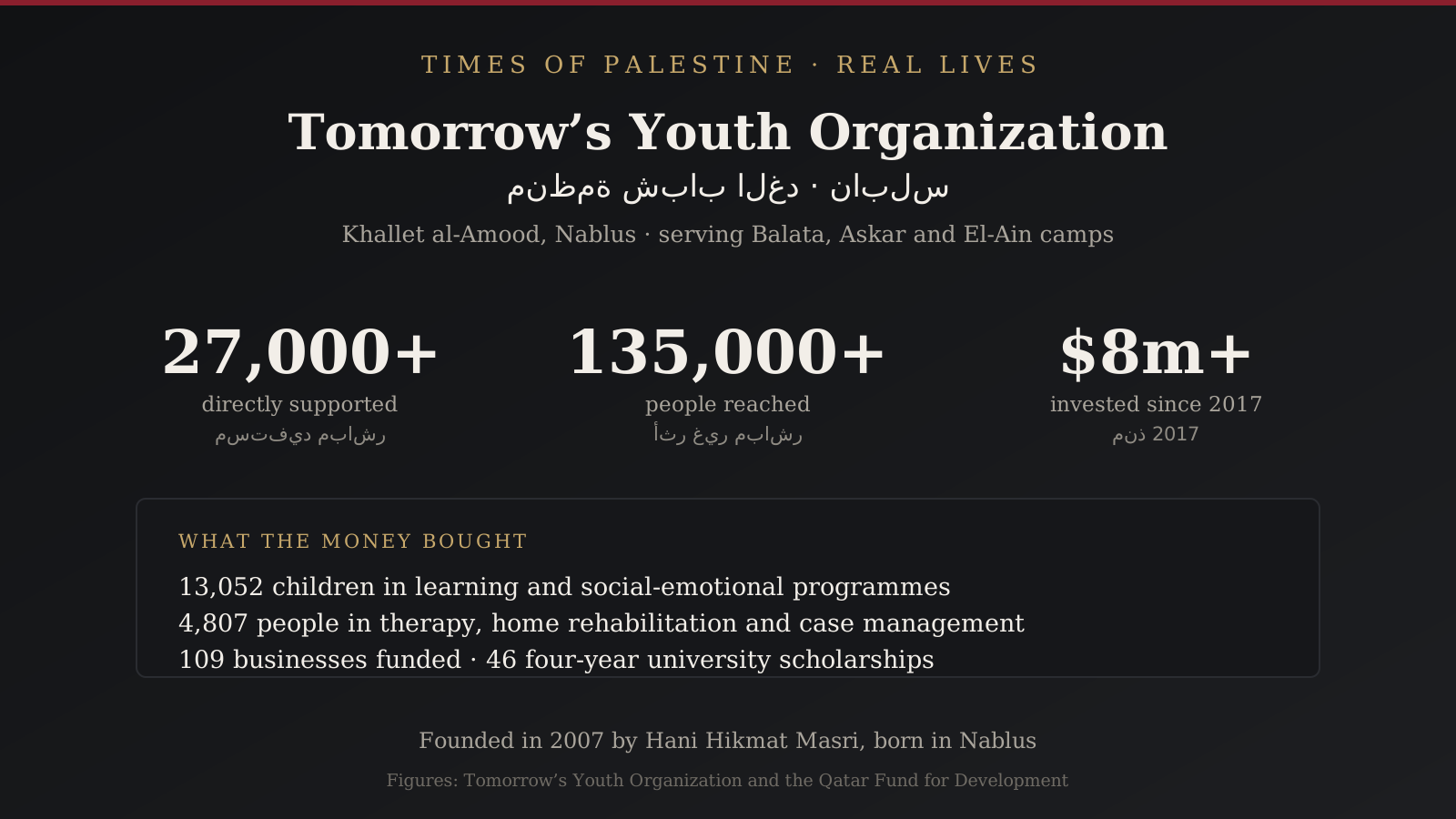
The organization's longest partnership is with the Qatar Fund for Development, which began in 2017. Over the eight years since, according to figures TYO publishes, the fund has invested more than $8 million in the Nablus centre — and the organization sets out what that produced rather than leaving it as a total.
- 13,052 children and adolescents in academic development and social-emotional learning
- 4,807 people who received home-based rehabilitation, psychotherapy, social work and case management
- 2,000 women through empowerment programmes
- 1,785 caregivers and educators trained in mental health and psychosocial support
- 1,776 young people who strengthened job readiness and found sustainable employment
- 1,553 young people trained in employability and entrepreneurship
- 109 youth- and women-led businesses funded with grants of up to $15,000 each
- 46 four-year university scholarships
TYO counts more than 27,000 children, youth and women directly supported, and more than 135,000 people affected. Publishing that breakdown is itself uncommon among organizations working in Palestine, and it is what makes an account like this one possible to write.
What the filings show#
Because TYO is a US 501(c)(3), its accounts are public. Fifteen years of Form 990 filings are on record under EIN 26-1409007, and they show an organization that has spent $13.3 million since 2010 against $15.4 million raised.
The pattern in those filings is the clearest evidence of what the war changed. TYO's income arrives in irregular blocks — $3.67 million in 2017, the year the Qatar partnership began, and $3.91 million in 2022 — while spending stayed near $600,000 to $900,000 a year for most of the decade.
Then it roughly doubled. The organization spent $1.85 million in 2023 and $2.03 million in 2024, against $2.6 million raised across those two years. It ran deficits deliberately, drawing reserves down from $3.78 million at the end of 2022 to $2.7 million at the end of 2024 — spending more than $1 million of its own balance sheet into the emergency.
That is what reserves are for, and choosing to spend them during the worst two years in the West Bank's recent history is a decision worth crediting rather than glossing. It is also not indefinitely repeatable: at the 2024 rate, the money runs out unless income rises to meet it.
The 2024 return also settles the question donors ask first. Part IX splits the $2,026,997 three ways: $1,874,309 to programme services, $134,218 to management and general, $18,470 to fundraising. That is 92.5 percent on programmes against 6.6 percent on administration and under 1 percent on fundraising — comfortably above the 75 percent that charity assessors generally treat as the mark of a well-run organization.
Schedule F answers the sharper question of where the money physically went. TYO reports one office and 40 employees, agents and contractors in the region, and $1,560,646 spent there on early childhood education, youth development and advancing women in Palestine. That is 77 percent of everything the organization spent that year, and 83 percent of its programme budget, landing in Palestine rather than in Virginia.
The line items read like the work: $227,363 on professional training, $118,885 on transport to bring children to classes, $40,978 on food and clothing.
Executive director Raffoul Saadeh was paid $140,000. Masri, listed on the return as president and executive director, was paid nothing — his compensation is recorded as $0, as is the treasurer's. Charity Navigator rates the organization 91 percent, four stars, and records that its financial statements are reviewed by an independent accountant.
The war years#
Since October 2023, the organization has turned its neighbourhood model toward emergency relief. Its "Lifeline to Palestine" campaign delivers food security, mental-health support and home rehabilitation — and extends beyond Nablus to families in Gaza, with the organization pledging that every donated dollar goes directly to those in need.
Since last October, TYO has increased its efforts to mitigate the hardships and provide immediate relief to families in need and in critical conditions.
Tomorrow's Youth Organization, Lifeline to Palestine campaign
That expansion tells the story of the moment: an institution built patiently for one city's children, now carrying weight far beyond it. The centre on the hill still opens its doors each morning in Khallet al-Amoud — and its founder's wager, that investing in a Palestinian child's earliest years is the surest development work there is, has never looked sounder.
Masri, who grew up beside the camps his centre now serves, framed the mission from the start as generational: build the healthy society first, and tomorrow's youth will build the rest. Eighteen years on, the children of that first classroom are the university volunteers teaching the next ones.