Politics & Diplomacy
Washington recruits African armies to fill Gaza's stabilization force
.jpg?width=640)
Image credit: Ugandan AMISOM contingent guard of honour, Mogadishu, 10 October 2011 — Wikimedia Commons / AMISOM Public Information (AU-UN IST, John Rose), CC0 1.0 · License
Original Reporting
The Newsdesk gathers reporting from wire services and primary sources and rewrites every story in-house before publication. How our journalism is made →
Three senior Burundian officers spent part of last week in Israel. So did a delegation of Ugandan officials. Both came to talk about sending their soldiers to Gaza.
The Associated Press reported the visits at the weekend, citing an official of President Donald Trump's Board of Peace. "We shared significant knowledge with one another," the official said of the Burundians, "and the Burundi representatives expressed interest in our mission."
Ten months after the Security Council authorised an International Stabilization Force for Gaza, the search for soldiers to fill it has reached Kampala and Gitega.
For a Palestinian in Rafah, this is not a distant procurement question. It decides who will be standing at the checkpoints of the first zone the force enters, whose orders they take, and where a family goes to complain when something is done to them.
Kampala got the call in July#
Uganda's defence minister, Kiryowa Kiwanuka, told parliament that President Yoweri Museveni had received a request from the United States in July, delivered through emissaries of Trump.
Parliament approved the deployment on Thursday 6 August, citing Section 38 of the Uganda People's Defence Forces Act, Article 210 of the constitution and Security Council Resolution 2803. Kiwanuka defended the motion by pointing to Uganda's record in Somalia, South Sudan and the Central African Republic.
The motion passed without committee review, over objections that Ugandan legislators put on the record.
"We are committing Ugandan soldiers to an active war zone," the opposition chief whip, Paul Mwiru, told the chamber. "Parliament deserves adequate time to consult technical officers."
Another member, Enos Asiimwe, asked the question that has followed this force since February. "We also need to know the funding of this force," he said. "Who is going to fund our stay in Gaza?"
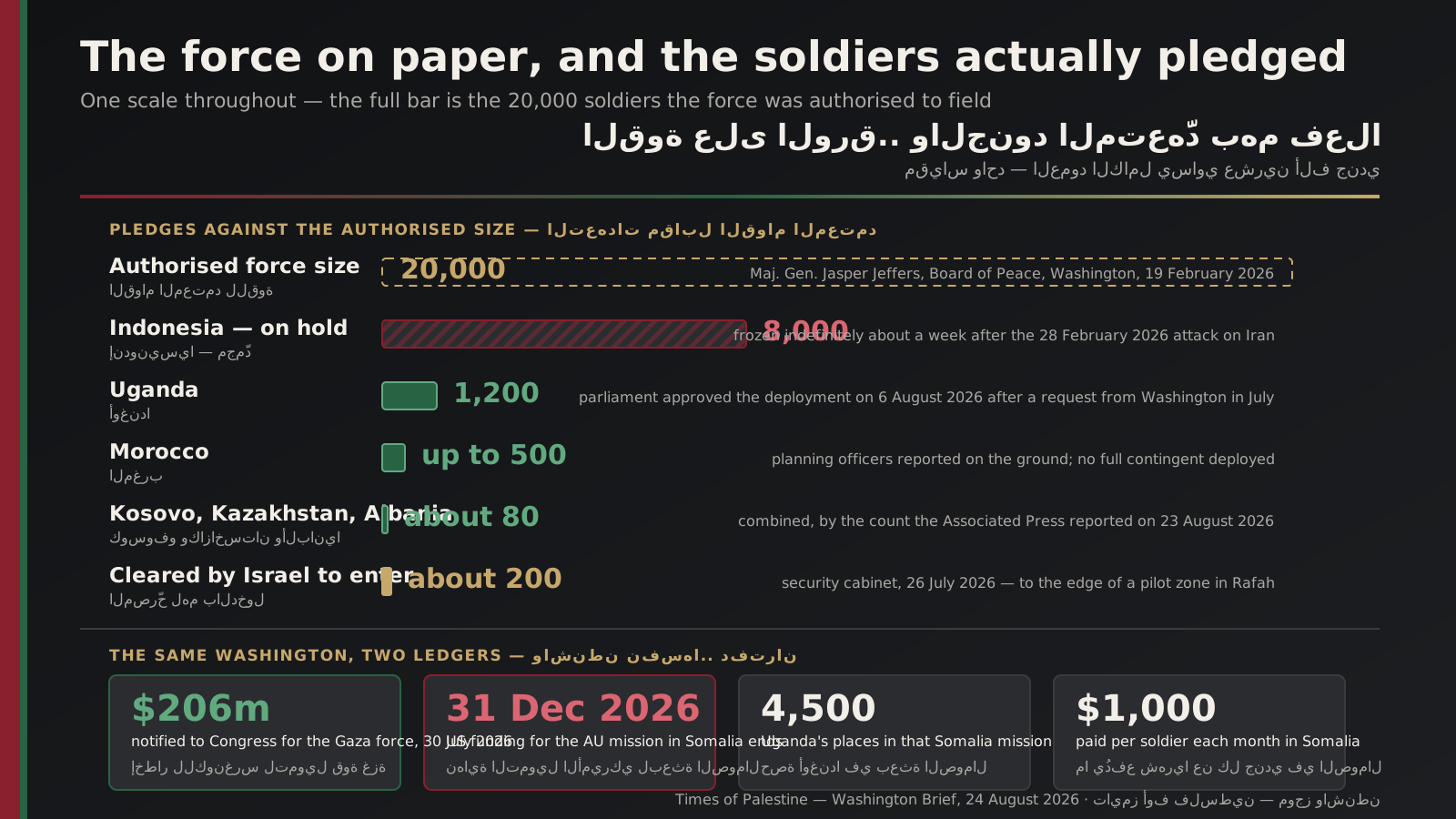
Uganda would be the first sub-Saharan African state in the force, with about 1,200 personnel by the count the Associated Press reported.
The arithmetic of a force that is mostly paper#
Resolution 2803, adopted on 17 November 2025, authorised the force for two years. At the Board of Peace's inaugural meeting in Washington on 19 February, its commander, the American Major General Jasper Jeffers, set the size at 20,000 soldiers.
Against that number, the pledges now stand at roughly 1,200 from Uganda, up to 500 from Morocco, and about 80 between Kosovo, Kazakhstan and Albania.
Indonesia's 8,000 — by far the largest commitment, and the one that would have given the force a Muslim majority and a deputy commander from Jakarta — has been on indefinite hold since roughly a week after the United States and Israel attacked Iran on 28 February this year.
That single decision is the reason Ugandan and Burundian officers were in Israel last week. The Iran war made open cooperation with Washington and Israel costly for Arab and Muslim governments, and the force lost the contributors that would have made it legible to the people it is meant to police.
The recruitment drive itself is not new. The Wall Street Journal reported in December 2025 that the State Department had approached more than 70 countries for troops or funding, and that 19 had indicated some willingness to help. Eight months later, the deployable total is under 2,000.
Israel's security cabinet voted on 26 July to admit about 200 of them, to the edges of a planned humanitarian pilot zone in the flattened city of Rafah, with every further contingent requiring the personal approval of Prime Minister Benjamin Netanyahu, Defence Minister Israel Katz and Foreign Minister Gideon Sa'ar.
Why the shortlist looks the way it does#
Israeli officials briefing news organisations on the July cabinet decision described a filter: contributing states must have peace agreements with Israel and must not be "acting against Israel or its officials in international forums".
That clause quietly disqualifies much of the Muslim world, whose governments have backed the South Africa case at the International Court of Justice or the arrest warrants at the International Criminal Court. It does not disqualify Burundi, which on 27 October 2017 became the first state to withdraw from the Rome Statute altogether.
Palestinian readers should be clear about what that does and does not mean in Gaza. Because Palestine is a party to the Rome Statute, the court's jurisdiction runs over crimes committed on Palestinian territory whoever commits them, and a contributing state's own exit from the treaty does not travel with its soldiers.
Somalia's ledger, read from Washington#
The two governments now being courted are the two that have carried African peacekeeping for two decades, and Washington's treatment of that work runs the other way.
On 1 July the United States notified the African Union that it would not fund the AU Support and Stabilization Mission in Somalia beyond 31 December, the Institute for Security Studies reported.
Washington said it would not veto the renewal of the mandate but would block UN logistical and operational support. It had already withheld its share of the UN support office budget — about a quarter of it — from August 2025.
Successive American administrations have refused to apply Resolution 2719, the 2023 mechanism that would let African Union operations draw up to three-quarters of their funding from UN assessed contributions. In December 2024 the United States held that "the conditions have not been met for an immediate transition".
The money in question is not large. The African Union estimated the Somalia mission needed $196 million for 2025, most of it the $1,000 a month paid to each soldier's government, and the troop allocation agreed that February gave Uganda 4,500 of the places.
Burundi, a contributor since 2007, offered 3,000 soldiers, was told Mogadishu would accept 1,000, and announced its exit; Egypt took its place with 1,091. The Institute for Security Studies researcher Bram Verelst wrote in January 2025 that Burundi's defence budget had been largely financed through its peacekeeping deployment.
Set beside that, the State Department's notification to Congress on 30 July of $206 million for the Gaza force reads as a statement of priorities rather than a sum. The same Washington that is closing the account for African soldiers in Mogadishu has opened one for African soldiers in Rafah.
The record, and the paperwork that is missing#
Both armies arrive with a documented history that Palestinians are entitled to know.
In September 2014 Human Rights Watch published findings on two AU bases in Mogadishu, based on interviews with 21 Somali women and girls, describing ten rapes or sexual assaults and fourteen cases of sexual exploitation by Ugandan or Burundian personnel since 2013, the youngest of them a girl of twelve.
The African Union rejected the report's conclusions and ran its own investigation, which found two of the twenty-one allegations proven. Uganda had sent a court martial to Mogadishu for a year in 2013; Human Rights Watch counted one case reaching a national military court in the years that followed.
What is absent in Gaza is the paperwork that would make any of this answerable. The Israeli cabinet granted the force immunity under Israel's Immunities of International Organizations Law, but no comprehensive status agreement has been published setting out criminal jurisdiction, detention authority, civil liability or a claims procedure.
The legal analyst Edmarverson A. Santos, reviewing the decision in late July, described the absence of a disclosed claims mechanism as a transparency and accountability gap, and noted that no remedy can be guaranteed before the governing agreements are published.
Carol Daniel-Kasbari of the Quincy Institute, which argues for American military restraint, called the design "Oslo with helmets" in December and urged that any extension of the mandate require "clear evidence of Palestinian consent, through elections or another representative mechanism".
Nobody in Kampala, Gitega, Jerusalem or Washington has yet described the mechanism by which a family in Rafah could object to the soldiers arriving at their street, or where that objection would be heard.

%20(cropped).jpg?width=640)


%20(cropped).jpg?width=640)