Politics & Diplomacy
Washington told Gulf allies it may strike Iran November 4

Image credit: Al Udeid Air Base, Qatar, 2004 — TSGT Scott Reed, US Air Force, via Wikimedia Commons (public domain) · License
Original Reporting
The Newsdesk gathers reporting from wire services and primary sources and rewrites every story in-house before publication. How our journalism is made →
Washington is running its Middle East on an American calendar this week, and everything on it turns on Tuesday.
The United States has not struck Iran since 1 September. President Donald Trump has said he would hold off until the midterm elections — the congressional vote held halfway through a presidential term — are finished. American officials have now told the Gulf states what they expect to follow.
The warning that reached the Gulf capitals#
MSNOW reported on Saturday, citing three senior Gulf Arab officials briefed on the planning, that the administration has told Gulf governments to prepare for a short, intense round of strikes on Iran as soon as 4 November, the day after the vote. The Wall Street Journal reported that Gulf states had received similar briefings about a high-intensity operation after the elections.
A White House official would not confirm it. "We do not comment on sensitive military plans that may or may not exist," the official told MSNOW.
The capitals that would host such a campaign are not enthusiastic. Gulf officials told both outlets they are pressing Washington to de-escalate, anxious about Iran's answer, and that some governments might refuse to let strikes launch from their territory.
Anwar Gargash, diplomatic adviser to the president of the United Arab Emirates, said on Sunday that "we're hoping that there is a diplomatic breakthrough". Egypt's foreign minister, Badr Abdelatty, said on Saturday he was "extremely worried" about escalation.
For Palestinians this is not a distant file. Households, bakeries, hospitals and generator-run clinics buy their diesel through the Israeli market, so a Gulf escalation reaches a West Bank fuel pump long before it reaches a negotiating table.
A letter and a phone call in the same week#
The military track is not the only one running. Agence France-Presse reported on Saturday that Vice-President JD Vance had sent a letter to Iran's security chief, Mohsen Rezaei. A senior Iranian official said the American "tone has completely changed", and Foreign Minister Abbas Araghchi said the letter had been discussed at a senior level in Tehran.
Iranian negotiators were in Doha on Sunday for a third day of indirect talks with Qatari mediators. A Qatari official said the Qatari team "has remained in frequent contact with US negotiators throughout the talks", though an American official told The Times of Israel there was no breakthrough and no plan for US mediators to join the room.
Trump spoke to Prime Minister Benjamin Netanyahu by telephone on Saturday as the administration weighed renewed action, the Wall Street Journal reported. Speaking to reporters in Palm Beach, Trump said talks were "going fine" while calling Iran "not very reliable", and said the United States was ready to deal with "one or two" remaining sites.
Secretary of State Marco Rubio said diplomatic engagement was continuing and that the president had made no final decision.
Tehran has set its own conditions. A senior Iranian official said on Saturday there would be no nuclear talks and no reopening of the Strait of Hormuz until the United States accepts Iran's demands. Supreme Leader Mojtaba Khamenei ordered the armed forces to answer any new attack with no "geographic limits".
"We do not comment on sensitive military plans that may or may not exist."
A White House official, asked about reported briefings to Gulf states on strikes from 4 November
Israel has no government to decide with#
The second date on Washington's calendar was 27 October, and it produced a parliament nobody can command. Israel's final count gave Netanyahu's bloc 53 seats and Gadi Eisenkot's bloc 48, with 61 needed for a majority. The Arab parties took a combined 19 seats, their strongest showing, and both Jewish-led blocs have ruled out seating them.
Ahmad Tibi of the Joint List said his list is ready to support a government against Netanyahu from outside the coalition. President Isaac Herzog told party leaders on Sunday to "stop climbing up trees and face the reality" of the result, and said his consultations on who should try to form a government begin on Wednesday.
Washington has not said what it wants out loud. A US official told The Times of Israel on 29 October that the administration had taken no decision to intervene in coalition talks and that reports naming a preferred coalition were "false and premature". Asked by Axios whether he would back a Netanyahu-led unity government, Trump said he had not thought about it and would "take a look".
Israeli broadcasters report a sharper preference. Channel 13 said Washington does not want Bezalel Smotrich or Itamar Ben Gvir in the next government, and Kan reported the administration particularly wants Ben Gvir out, seeing him as an obstacle to American plans for Gaza. Both men support an Israeli takeover of Gaza and the removal of its population, which is not what the ceasefire plan Washington brokered says.
Politico reported on 30 October that the mood in the American capital has turned. "There is Netanyahu fatigue here," a former Trump administration official told the outlet, adding that a less provocative Israeli government would be "an opportunity to stop the bleeding".
A second former official told Politico the White House would prefer a government "more compliant" than Netanyahu's, and that Smotrich and Ben Gvir in office "would undermine almost every one of Trump's visions".
Senator Chris Murphy, the Connecticut Democrat, argued that Netanyahu had obstructed American efforts to get out of the Iran war and "will continue to be a very influential voice in Trump's ear".
What waits in Gaza while the votes are counted#
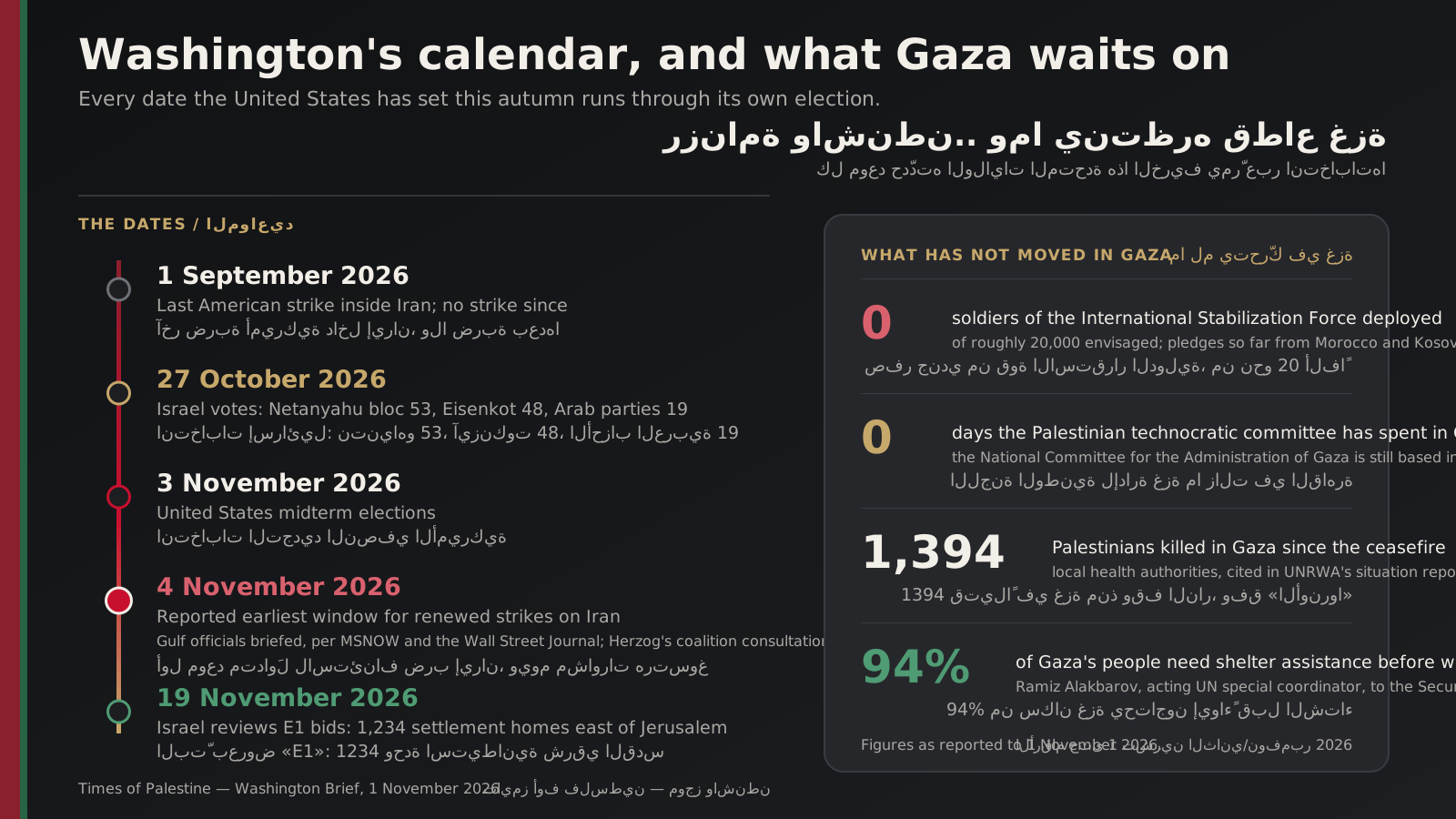
The cost of this waiting is measured in Gaza, where nothing on the American plan has arrived. The International Stabilization Force authorised by Security Council Resolution 2803 a year ago has not deployed a single soldier, according to the independent monitoring group Security Council Report.
The same monitor notes the force may ultimately field a fraction of the roughly 20,000 personnel first envisaged. Its commander, US Major General Jasper Jeffers, holds pledges formalised by Morocco in July and Kosovo in September.
The National Committee for the Administration of Gaza — the Palestinian technocratic body meant to run civil affairs — has written a six-month recovery programme and is still sitting in Cairo.
Nickolay Mladenov, the Board of Peace's high representative for Gaza, wrote to the head of Israel's COGAT, the military body that controls movement and goods, demanding Israel immediately admit both the committee and the force, Haaretz reported in mid-October.
Bloomberg reported on Saturday that the Board has asked Italy for police, fire service and carabinieri advisers to help build a Gaza security force, and that Rome has not decided.
Sources close to the Board told The Telegraph last month that little would move before the elections — "maybe nothing that can be seen from the outside as 'major movement'".
Palestinians have been counting the interval. Local health authorities cited in UNRWA's 24 September situation report recorded 1,394 people killed in Gaza since the ceasefire took effect in October 2025.
On Sunday, Hamas-affiliated media reported eight more killed in two strikes, one near Khan Younis and one in Gaza City that killed a child; the Israeli military had not commented.
Ramiz Alakbarov, the acting UN special coordinator, told the Security Council that 94 percent of Gaza's people need shelter assistance before winter, and that "no one should have to risk their life simply to find a safe place to shelter".
The West Bank has its own date. Israel opened bidding on 18 August for 1,234 homes in E1, the corridor east of Jerusalem whose construction would cut the northern West Bank from the south.
Bids closed on 19 October, and Attorney General Gali Baharav-Miara ordered the evaluation postponed so the tender could not serve as campaign material. The Israel Land Authority says its committee will not review the bids before 19 November. Alakbarov called E1 "an existential threat to the two-State solution".
In London on Saturday, the Metropolitan Police said 325 people were arrested outside the American embassy at a protest over the proscription of Palestine Action, the group Washington designated a terrorist organisation in August. Britain's Supreme Court hears the appeal against the British ban on 4 November — the same day the Gulf has been told to watch.