Culture & Arts
Hannah Lillith Assadi wins America's top fiction prize with her father's exile
Graphic: Times of Palestine
Original Reporting
The Newsdesk gathers reporting from wire services and primary sources and rewrites every story in-house before publication. How our journalism is made →
A boy leaves Safad in 1948 and never stops travelling. Seventy years later, his daughter has carried him onto the biggest stage American literature has.
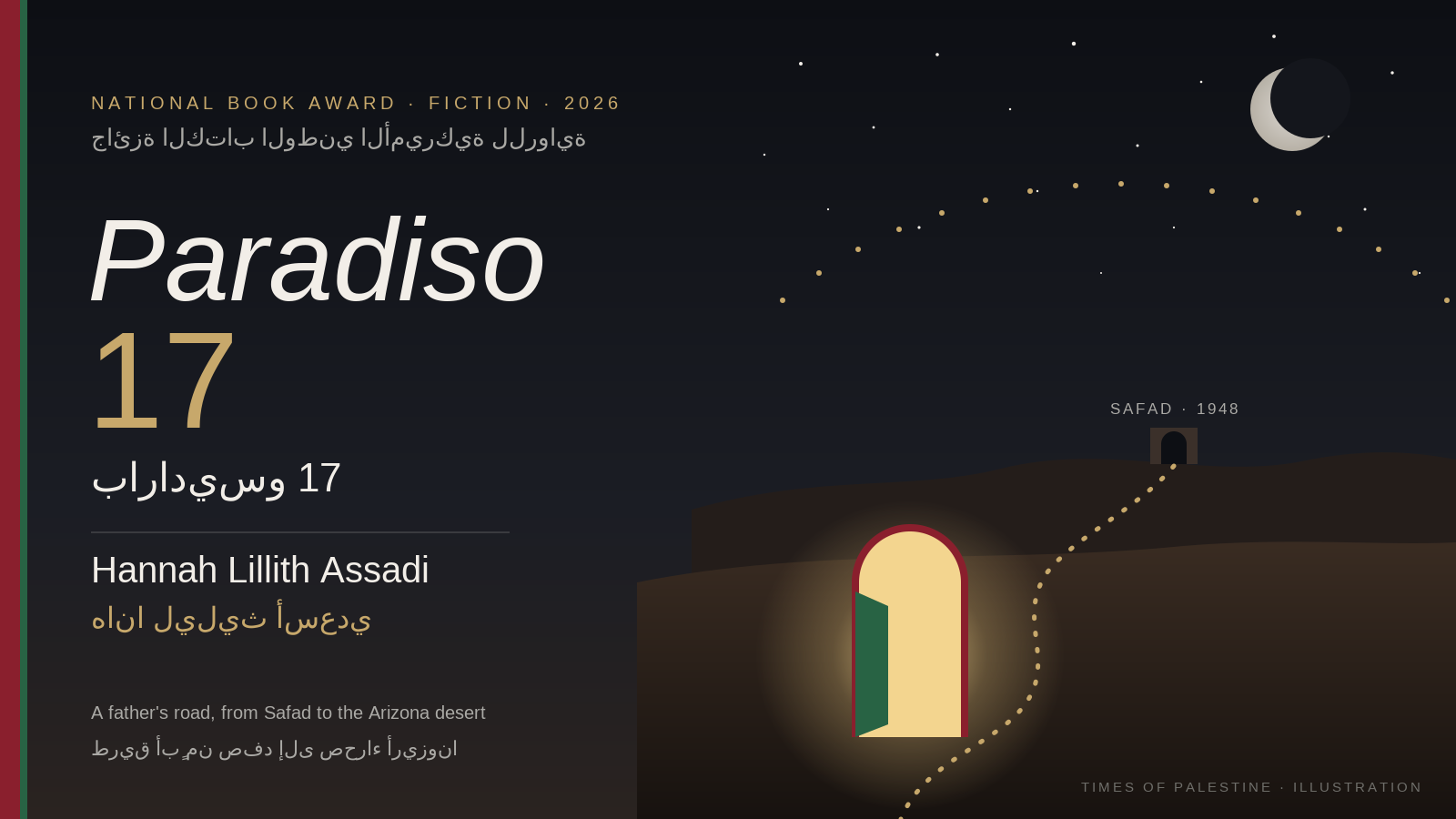
Hannah Lillith Assadi's Paradiso 17, a novel built from the life of her Palestinian father, won the 2026 National Book Award for Fiction in New York on 18 November. The prize was the last one announced at the 77th National Book Awards ceremony at Cipriani Wall Street, Publishers Weekly reported.
The judges called the book a "visionary, finely wrought portrait of rupture and endurance," Haaretz reported. In a season crowded with novels, they chose the story of one Palestinian refugee who spends his whole life looking for the door back home.
A speech that began at a deathbed#
Assadi told the audience that the novel began at her father's bedside, in the last stretch of his illness. "I watched cancer ravage my father's body, and genocide ravage his people and their children," she said, in a line NPR carried from the speech.
Lit Hub's account of the evening described an emotional address in which she summoned her late father and turned the room toward the story of Palestine. For a few minutes, the biggest night in American publishing listened to a Palestinian family.
Her father was Sami Abdul Fattah Assadi, who lived from 1943 to 2022. "For my father, the Nakba was his most formative memory and his first memory of the world," she has said in interviews about the book.
Sufien, who became Frank Leone#
The novel's hero is Sufien, a character Assadi has described as inspired by her late father. The book opens as he is dying, then lets his memory run backwards through seven decades of displacement.
The road is long. It runs from Safad, emptied in the Nakba, through Syria and the Kuwaiti desert, which he leaves at seventeen; to an Italian university town, where he takes the name Frank Leone; to New York; and finally to the wild country of Arizona, where his daughter grows up.
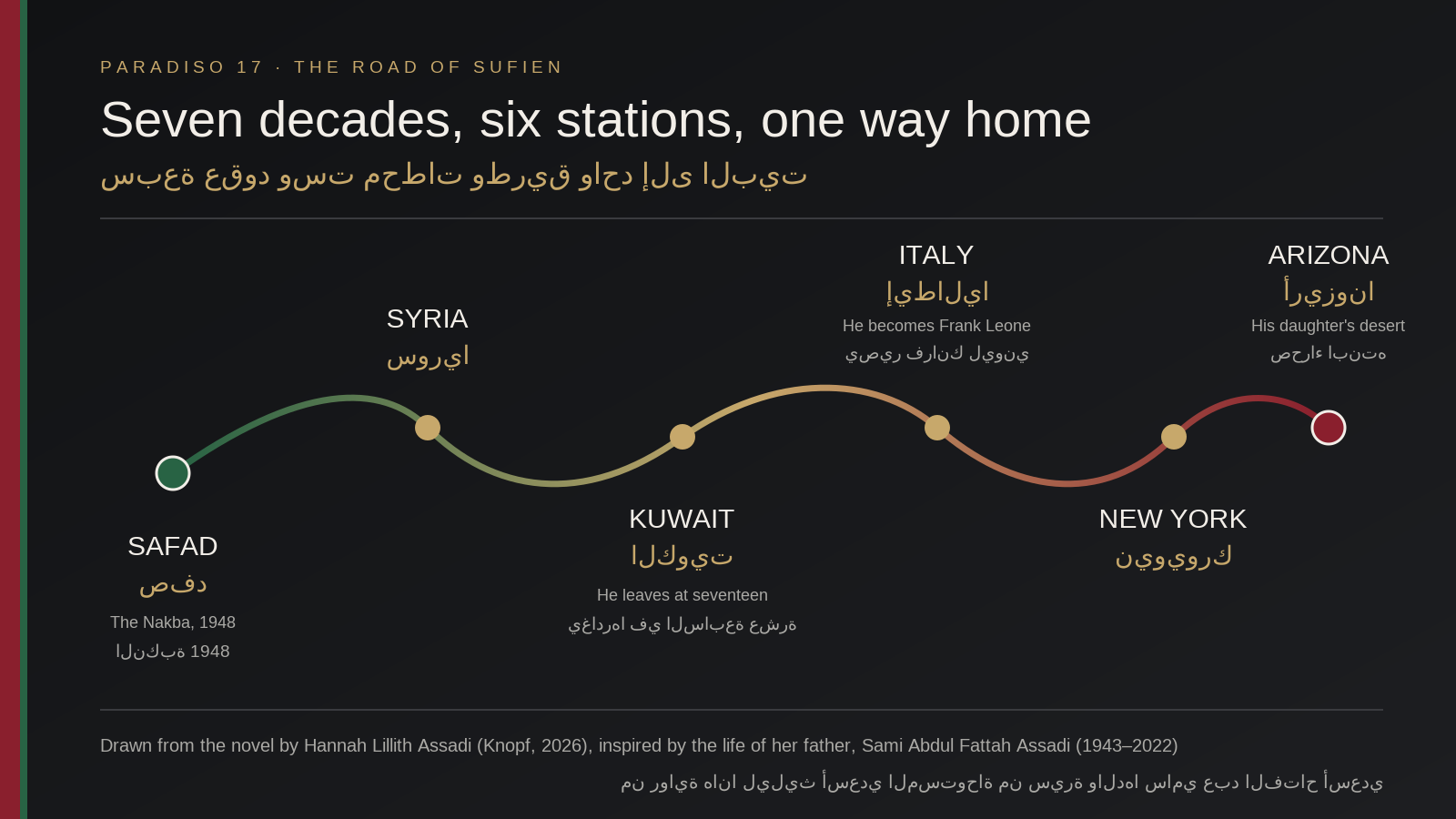
Much of that geography, Assadi has said, comes from what she remembers of her father's "outlandish (likely semi-fabricated) stories." The novel honours the stories as he told them. A man who lost his country kept the right to tell his life his own way.
Frank Leone was the nickname and pen name her father used in his years abroad, and it was almost the book's title. She has said in interviews that her editor felt it made the novel sound a little like a mafia story — so she reached for Dante instead.
Dante's seventeenth canto and the salt of exile#
In the seventeenth canto of Dante's Paradiso, the poet's ancestor foretells his banishment from Florence and tells him what exile will taste like. In Longfellow's translation:
Thou shalt have proof how savoureth of salt the bread of others, and how hard a road the going down and up another's stairs.
Dante, Paradiso, Canto XVII
Seven hundred years later, the line fits a Palestinian refugee as if it had been written for him. Assadi's title makes Sufien's exile part of the oldest conversation in European literature — and lets the number seventeen echo through his life, from the age at which he leaves his family's home in Kuwait onward.
The reviews met the book at that height. Publishers Weekly called it "beautiful and heartbreaking." Kirkus gave it a starred review and called Sufien unforgettable. In Britain, the novel made the longlist for the 2026 Women's Prize for Fiction, and in the New Statesman the critic Raphael Cormack read it through the displacement of the author's own father.
A writer of the desert and the city#
Assadi was born in New York City in 1986 to a Palestinian father and a Jewish mother, and she grew up in Arizona, in the desert that runs through all three of her novels. She studied at Columbia University, earning both her bachelor's degree and her MFA there, and now teaches fiction at Columbia's School of the Arts and at the Pratt Institute. She lives in Brooklyn.
Her debut, Sonora (2017), won the Rosenthal Family Foundation Award from the American Academy of Arts and Letters and was a finalist for the PEN/Robert W. Bingham Prize for Debut Fiction. Her second novel, The Stars Are Not Yet Bells (2022), was named a best book of the year by The New Yorker and NPR.
The National Book Foundation itself spotted her early: in 2018 it named her one of its "5 Under 35" honourees. Eight years later, the same foundation has handed her its highest prize for fiction.
Paradiso 17, her third novel, was published by Knopf in March 2026.
A night of Arab writers#
Assadi was not the only Arab writer honoured that evening. The Egyptian author Abdelrahman ElGendy won the nonfiction award for Huna, his memoir of revolution and prison, but could not collect it in person: the United States had refused him a visitor visa, NPR reported, and a stand-in accepted the award in his place.
The award comes a year after the Lebanese-American novelist Rabih Alameddine won the same fiction prize, and as Palestinian stories reach readers far beyond the region's literature shelves. Haaretz framed this year's result as a prize that puts Palestinian exile in the spotlight.
For Palestinian readers, the book is something simpler and closer. It is the story so many families carry — the house left in 1948, the cities that never quite became home, the children raised far away on stories that may be a little embroidered and are entirely true in the way that matters.
In Paradiso 17, a daughter has written her father's road down, and the world has stopped to read it.